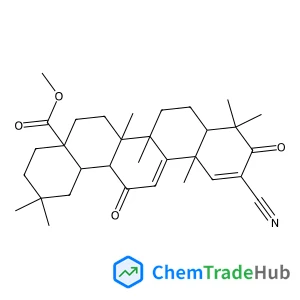
Methyl 2-cyano-3,12-dioxooleana-1,9(11)-dien-28-oate
CAS Number:
218600-53-4
Molecular Formula:
C32H43NO4
Bernadetta Gajewska, Samuel Raccio, Kyle J. Rodriguez
Copper trisodium chlorophyllin is obtained from natural chlorophyll, and is widely used as a major green food colorant in cosmetics and in medical devices. Copper chlorophyllin also proves to be an efficient catalyst and comonomer for atom transfer radical polymerizations (ATRP). Aqueous ATRP of poly(ethylene glycol) acrylate (PEGA) results in PEGA-chlorophyllin copolymers with narrow molecular weight distributions and a controlled content of chlorophyllin. The reactions proceed with first order kinetics, and the polymer's molecular weight increases with conversion. The resulting copolymers could find application in drug delivery and in biomedical materials, or as solar energy harvesting materials. In order to suppress the incorporation of the catalyst into the growing polymer chains, the vinyl bond of chlorin e6, one of the major porphyrin components of chlorophyllin, is deactivated by hydrobromination and hydration. Complexation of copper by the porphyrin leads to a bio-derived catalyst which mediates the polymerization of PEGA, yielding homopolymers with molecular weights ranging from 4000–5000 g mol−1 and dispersities ≤ 1.11. UV-Vis spectroscopy indicates that chlorophyllin is stable during the polymerization. Copper chlorophyllin is a plant-derived compound from a renewable feedstock that can be used for a more environmentally friendly route to ATRP.
Yeru Liu, James Robert Jennings, Xingzhu Wang, Qing Wang
DOI: 10.1039/C3CP50998B
Xuefeng Lu, Hongjie Wang, Meng Chen, Lei Fan, Chao Wang, Shuhai Jia
DOI: 10.1039/C3CP50372K
Chuan Shi, Christopher P. O'Grady, Andrew A. Peterson, Heine A. Hansen
DOI: 10.1039/C3CP50645B
Magali Duvail, Jean-François Dufrêche, Lise Arleth, Thomas Zemb
DOI: 10.1039/C3CP43981J
Venkata Bharat Ram Boppana, Feng Jiao, Dave Newby, Jr., Jude Laverock, Kevin E. Smith, Jean Claude Jumas, Greg Hutchings, Raul F. Lobo
DOI: 10.1039/C3CP44635B
Arnošt Mládek, Miroslav Krepl, Michal Otyepka, Pavel Banáš, Marie Zgarbová, Petr Jurečka
DOI: 10.1039/C3CP44383C
Pierre Terech, Minhao Yan, Manuel Maréchal, Guy Royal, Jose Galvez, Sabareesh K. P. Velu
DOI: 10.1039/C3CP50671A
Panteleimon G. Takis, Konstantinos D. Papavasileiou, Loukas D. Peristeras, Vasilios S. Melissas, Anastassios N. Troganis
DOI: 10.1039/C3CP44606A
Peter Sebald, Rainer Oswald, Peter Botschwina, Kentarou Kawaguchi
DOI: 10.1039/C3CP44236E
When handling 4-(2-Furylmethyl)thiomorpholine 1,1-dioxide (CAS: 79206-94-3), it ...
When handling 4-Chloro-N-[2-(4-morpholinyl)ethyl]benzamide (CAS: 71320-77-9), it...
Waste containing this compound (CAS: 62921-74-8) should be handled according to ...
Waste containing (S)-Methyl 2-amino-3-cyclohexylpropanoate should be collected i...
This compound can be synthesized using a multi-step process involving the conjug...
There are several alternatives to (2E)-3-(3,4-Dichlorophenyl)acrylic acid in syn...
Ethyl 6-(2-nitrophenyl)imidazo[2,1-b][1,3]thiazole-3-carboxylate (CAS: 925437-84...
Waste containing 2-(1,3-Thiazol-2-yl)ethanamine (CAS: 18453-07-1) should be coll...
Methyl 5-iodo-2-methylbenzoate can be synthesized through the iodination of meth...
5-Chloro[1,2,4]triazolo[1,5-a]pyridine is commonly synthesized via the condensat...

Polymer Chemistry welcomes submissions in all areas of polymer science that have a strong focus on macromolecular chemistry. Manuscripts may cover a broad range of fields, yet no direct application focus is required.