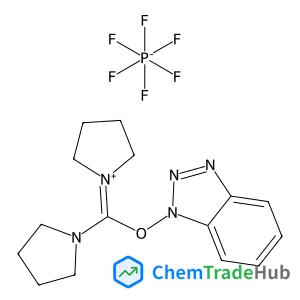
(1H-Benzotriazol-1-yloxy)(di-1-pyrrolidinyl)methylium hexafluorophosphate
CAS Number:
105379-24-6
Molecular Formula:
C15H21F6N5OP
Houbo Zhou, Christopher M. Plummer, Huaan Li, Huahua Huang, Pengfei Ma, Le Li, Lixin Liu, Yongming Chen
Previously, we developed amination modification of polyethylene by metal-free organocatalytic reaction. Here, we applied this chemistry to modify isotactic polypropylene (PP) to investigate the regioselectivity to different carbons. Specifically, this reaction was conducted in tetrachloroethane at 100 °C under a nitrogen protection where C–N bonds were selectively generated from the tertiary C–H bonds of the PP backbone in the presence of N-hydroxyphthalimide (NHPI) and bis(2,2,2-trichloroethyl) azodicarboxylate (BTCEAD). The grafting content of BTCEAD was as high as 4.7 units per 100 propylene units. Thus, a methodology for the regioselective post-functionalization of PP without metal catalysts has been developed. The obtained PP-g-BTCEAD was sequentially used as an atom transfer radical polymerization (ATRP) macro-initiator to graft polymers, such as polystyrene (PS) and poly(methyl) methacrylate (PMMA). The grafting polymerization was unequivocally proved by multiple characterization methods. The graft copolymers were applied as phase compatibilizers to improve blending of PP with PS and PMMA.
Guillaume Bareigts, Christophe Labbez
DOI: 10.1039/C6CP08056A
Sergio Giuffrida, Lorenzo Cordone
DOI: 10.1039/C6CP06848K
Zhanli Cao, Zhendong Li, Fan Wang, Wenjian Liu
DOI: 10.1039/C6CP07588F
Rocío Domínguez, Núria F. Montcada, Pilar de la Cruz, Fernando Langa
DOI: 10.1039/C6CP08166E
Lingyun Zhu, Hua Geng, Yuanping Yi, Zhixiang Wei
DOI: 10.1039/C6CP07417K
Ke Zhang, Rashid Khan, Hongyan Guo, Irfan Ali, Xiuling Li, Yunxiang Lin, Haiping Chen, Wensheng Yan, Xiaojun Wu, Li Song
DOI: 10.1039/C6CP07270D
Xiaoli Sun
DOI: 10.1039/C6CP07690D
Sarawoot Impeng, Siwarut Siwaipram, Sareeya Bureekaew, Michael Probst
DOI: 10.1039/C6CP07771D
When handling 4-(2-Furylmethyl)thiomorpholine 1,1-dioxide (CAS: 79206-94-3), it ...
When handling 4-Chloro-N-[2-(4-morpholinyl)ethyl]benzamide (CAS: 71320-77-9), it...
Waste containing this compound (CAS: 62921-74-8) should be handled according to ...
Waste containing (S)-Methyl 2-amino-3-cyclohexylpropanoate should be collected i...
This compound can be synthesized using a multi-step process involving the conjug...
There are several alternatives to (2E)-3-(3,4-Dichlorophenyl)acrylic acid in syn...
Ethyl 6-(2-nitrophenyl)imidazo[2,1-b][1,3]thiazole-3-carboxylate (CAS: 925437-84...
Waste containing 2-(1,3-Thiazol-2-yl)ethanamine (CAS: 18453-07-1) should be coll...
Methyl 5-iodo-2-methylbenzoate can be synthesized through the iodination of meth...
5-Chloro[1,2,4]triazolo[1,5-a]pyridine is commonly synthesized via the condensat...

Polymer Chemistry welcomes submissions in all areas of polymer science that have a strong focus on macromolecular chemistry. Manuscripts may cover a broad range of fields, yet no direct application focus is required.
![[4-Amino-2-(methylsulfanyl)-5-pyrimidinyl]methanol structure](https://static.chemtradehub.com/structs/588/588-36-3-fc73.webp "[4-Amino-2-(methylsulfanyl)-5-pyrimidinyl]methanol structure")