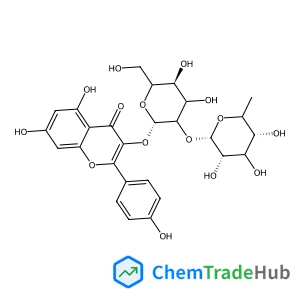
5,7-Dihydroxy-2-(4-hydroxyphenyl)-4-oxo-4H-chromen-3-yl 2-O-(6-deoxy-alpha-L-mannopyranosyl)-beta-D-glucopyranoside
CAS Number:
32602-81-6
Molecular Formula:
C27H30O15
Alyssa Gilbert, Ronald S. Haines, Jason B. Harper
A unimolecular substitution process was studied in five different ionic liquids, with systematic variation of either the cation or anion, in order to determine the factors leading to the increase in the rate constant for the process relative to acetonitrile. It was found that both components of the ionic liquid, and the proportion of the salt in the reaction mixture, affect the rate constant. Activation parameters determined for the process suggest that there is a balance between interactions of the components of the ionic liquid with both starting material and transition state. A correlation was found between the rate constant and a combination of Kamlet–Taft solvent parameters; with the polarisability of the solvent being the most significant factor. As this reaction proceeds through both unimolecular and bimolecular pathways, competition experiments determined that the unimolecular pathway for the reaction can be favoured using small amounts of ionic liquid in the reaction mixture, demonstrating the potential to control reaction mechanisms using ionic liquids.
Kai Qiu, Mingxia Yan, Shouwang Zhao, Hongwei Fan, Shengli An, Xinping Qiu, Guixiao Jia
DOI: 10.1039/D1CP04047B
DOI: 10.1039/D1CP03631A
Alexander E. Khudozhitkov, Sergei S. Arzumanov, Alexander V. Toktarev, Svetlana V. Cherepanova, Anton A. Gabrienko, Daniil I. Kolokolov, Alexander G. Stepanov
DOI: 10.1039/D1CP03060D
Jianbo Gao
DOI: 10.1039/D1CP02508B
Johann Pototschnig, Zahra Jamshidi, Lucas Visscher
DOI: 10.1039/D1CP03220H
Jiaquan Huang, Xinyi Zhao, Xunkun Huang, WanZhen Liang
DOI: 10.1039/D1CP03509F
Yunxia He, Jing Li, Lin Tao, Shuai Nie, Timing Fang, Xitao Yin, Qi Wang
DOI: 10.1039/D1CP04539C
Yang Cong, Yu Zhai, Jitai Yang, Adam Grofe, Hui Li
DOI: 10.1039/D1CP04490G
Jun-Wei Liao, Robert Sung, Kuangsen Sung
DOI: 10.1039/D1CP03581A
Guoliang Li, Ying Yao, Shengyao Lü, Yaoming Xie, Gary E. Douberly, Henry F. Schaefer, III
DOI: 10.1039/D1CP04309A
When handling 2-Chloro-1,2-bis(4-methylphenyl)ethanone (CAS: 71193-32-3), it is ...
4-Ethoxy-3-(5-methyl-4-oxo-7-propyl-1,4-dihydroimidazo[5,1-f][1,2,4]triazin-2-yl...
Methyl 3-Oxo-4-Androsten-17-Carboxylate (CAS: 2681-55-2) should be stored in a c...
(R)-3-Amino-4-(3-hexylphenylamino)-4-oxobutylphosphonic acid is primarily used i...
2-Methyl-2-propanyl 3-amino-3-carbamoyl-1-azetidinecarboxylate (CAS: 1254120-14-...
There are alternative reagents that can be used in synthesis instead of (E)-4-(t...
[2-(3-Chlorophenyl)-1,3-thiazol-4-yl]methanol (CAS: 121202-20-8) is a crystallin...
The market and research trends for Methyl (2S)-[(4S)-2,2-dimethyl-1,3-dioxolan-4...
The market for 1-Bromo-2-isocyanatoethane (CAS: 42865-19-0) is driven by its use...
4-Nitro-D-phenylalanine hydrochloride (CAS: 147065-06-3) is primarily used in re...

Organic & Biomolecular Chemistry (OBC) publishes original and high impact research and reviews in organic chemistry. We welcome research that shows new or significantly improved protocols or methodologies in total synthesis, synthetic methodology or physical and theoretical organic chemistry as well as research that shows a significant advance in the organic chemistry or molecular design aspects of chemical biology, catalysis, supramolecular and macromolecular chemistry, theoretical chemistry, mechanism-oriented physical organic chemistry, medicinal chemistry or natural products. Articles published in the journal should report new work which makes a highly-significant impact in the field. Routine and incremental work is generally not suitable for publication in the journal. More details about key areas of our scope are below. In all cases authors should include in their article clear rationale for why their research has been carried out.