











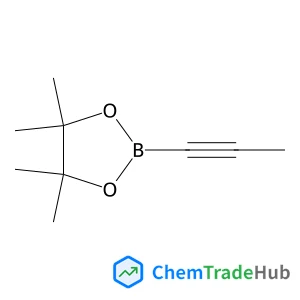
4,4,5,5-Tetramethyl-2-(1-propyn-1-YL)-1,3,2-dioxaborolane
CAS Number:
347389-75-7
Molecular Formula:
C9H15BO2
Xiaoyan Lv, Xing Zheng, Zhigang Yang, Zhong-Xing Jiang
Dual-functionalization of monodisperse oligoethylene glycols, especially hetero-functionalization, provides a series of highly valuable intermediates for life and materials sciences. However, the existing methods for the preparation of these compounds suffer excessive protecting and activating group manipulation as well as tedious purification. Here, a one-pot dual-substitution strategy with macrocyclic sulfates of polyethylene glycols as the key intermediates was developed for the convenient and scalable preparation of a series of homo-functionalized and hetero-functionalized oligoethylene glycols in just 1 step. A high synthetic efficacy was achieved by avoiding the protecting and activating group manipulation and the intermediate purification.
Lin Wang, Zhi-Gang Ma, Xiao-Jing Wei, Qing-Yuan Meng, Deng-Tao Yang, Shao-Fu Du, Zi-Fei Chen, Li-Zhu Wu, Qiang Liu
DOI: 10.1039/C4GC00337C
Do Joong Kim, Kyung Hwan Oh, Jin Kyoon Park
DOI: 10.1039/C4GC00684D
Xincheng Wang, Yanlei Song, Chongpin Huang, Fengbing Liang, Biaohua Chen
DOI: 10.1039/C4GC00811A
Ling-Hong Gong, Yi-Yu Cai, Xin-Hao Li, Ya-Nan Zhang, Juan Su, Jie-Sheng Chen
DOI: 10.1039/C4GC00981A
B. S. Rajput, S. R. Gaikwad, S. K. Menon, S. H. Chikkali
DOI: 10.1039/C4GC00543K
Daqian Ding, Jianjian Wang, Jinxu Xi, Xiaohui Liu, Guanzhong Lu, Yanqin Wang
DOI: 10.1039/C4GC00737A
Emily A. Peterson, Barry Dillon, Izzat Raheem, Paul Richardson, Daniel Richter, Rachel Schmidt, Helen F. Sneddon
DOI: 10.1039/C4GC00615A
Liyuan Zhang, Yangyang Wang, Wanting Yu, Baiwan Deng, Kai Zhang, Jiexi Wang
DOI: 10.1039/C4GC00761A
Fang Zhang, Xiaotao Wu, Chao Liang, Xiaoyan Li, Zhen Wang, Hexing Li
DOI: 10.1039/C4GC00178H
2-Methylbenzene-1,4-diamine dihydrochloride (CAS: 615-45-2) should be stored in ...
(1S,4S)-2,5-Diazabicyclo[2.2.1]heptane dihydrobromide is generally considered sa...
(6-Chloropyridazin-3-YL)methanamine finds applications in the pharmaceutical ind...
2-Fluoro-3-methylphenol is primarily used in the synthesis of pharmaceuticals, p...
When handling 3-Methoxy-4-nitrobenzonitrile, it is important to wear appropriate...
When handling 1,3-Oxazolo[4,5-b]pyridine-2(3H)-thione (CAS: 211949-57-4), it is ...
4-Ethynylbenzamide (CAS: 90347-86-7) falls under various regulatory guidelines i...
3-(2-Ethylphenyl)-2-thioxo-4-imidazolidinone is primarily used as an intermediat...
(2-Fluoro-6-methoxyphenyl)acetic acid, also known as 4-fluoro-3-methoxybenzoic a...
Market trends for 2-[4-(Hydroxymethyl)phenoxy]ethanol (CAS: 102196-18-9) indicat...

Organic & Biomolecular Chemistry (OBC) publishes original and high impact research and reviews in organic chemistry. We welcome research that shows new or significantly improved protocols or methodologies in total synthesis, synthetic methodology or physical and theoretical organic chemistry as well as research that shows a significant advance in the organic chemistry or molecular design aspects of chemical biology, catalysis, supramolecular and macromolecular chemistry, theoretical chemistry, mechanism-oriented physical organic chemistry, medicinal chemistry or natural products. Articles published in the journal should report new work which makes a highly-significant impact in the field. Routine and incremental work is generally not suitable for publication in the journal. More details about key areas of our scope are below. In all cases authors should include in their article clear rationale for why their research has been carried out.

![3-[(3R,4R)-3-[(6-aminopyrimidin-4-yl)-methyl-amino]-4-methyl-1-piperidyl]-3-oxo-propanenitrile structure](https://static.chemtradehub.com/structs/164/1640971-60-3-83a4.webp "3-[(3R,4R)-3-[(6-aminopyrimidin-4-yl)-methyl-amino]-4-methyl-1-piperidyl]-3-oxo-propanenitrile structure")





