












Synthesis of 2-substituted 3-chlorobenzofurans via TMSCl-mediated nucleophilic annulation of isatin-derived propargylic alcohols
Literature Information
Publication Date
2018-08-08
DOI
10.1039/C8OB01731J
Impact Factor
3.876
Authors
Zhou Sun, Kuirong Xiang, Hua Tao, Liqun Guo, Ying Li
View Original
Abstract
A TMSCl-mediated cascade annulation of isatin-derived propargylic alcohols for the synthesis of 2-substituted 3-chlorobenzofurans is now reported. Mechanistic investigations showed that this proceeded through a sequential Meyer–Schuster rearrangement/nucleophilic addition/intramolecular annulation. TMSCl not only acts as a promoter, but also acts as a chlorine source in this protocol.
Recommended Journals
Related Literature
Highly-excited state properties of cumulenone chlorides in the vacuum-ultraviolet
Quynh L. D. Nguyen, William K. Peters, Ryan C. Fortenberry
2020-05-09
Paper
DOI: 10.1039/D0CP01835J
Premelting of ice adsorbed on a rock surface
V. Esteso, L. G. MacDowell, D. F. Parsons, F. Spallek, H. Míguez, C. Persson, Stefan Yoshi Buhmann, I. Brevik
2020-04-24
Paper
DOI: 10.1039/C9CP06836H
Theoretical free energy profile and benchmarking of functionals for amino-thiourea organocatalyzed nitro-Michael addition reaction
2020-05-05
Paper
DOI: 10.1039/D0CP00481B
DFT insights into electrocatalytic CO2 reduction to methanol on α-Fe2O3(0001) surfaces
Nandha Kumar, Nicola Seriani, Ralph Gebauer
2020-04-20
Paper
DOI: 10.1039/C9CP06453B
Anisotropic hydrogen bond structures and orientation dependence of shock sensitivity in crystalline 1,3,5-tri-amino-2,4,6-tri-nitrobenzene (TATB)
Feng Guo, Kuiguang Yao, Zhipeng Lu, Yu Ma, Yushi Wen, Xiaogan Dai, Ming Li, Xinping Long
2020-04-07
Paper
DOI: 10.1039/C9CP06208D
Effect of strain and defects on the thermal conductance of the graphene/hexagonal boron nitride interface
Jieren Song, Chaocan Cai, Yujiao Bai, Linlin Miao, Rongguo Wang
2020-05-12
Paper
DOI: 10.1039/D0CP01727B
Revisiting the Volmer–Heyrovský mechanism of hydrogen evolution on a nitrogen doped carbon nanotube: constrained molecular dynamics versus the nudged elastic band method
Rasmus Kronberg, Heikki Lappalainen, Kari Laasonen
2020-01-24
Paper
DOI: 10.1039/C9CP06474E
Chemical potentials of electric double layers at metal–electrolyte interfaces: dependence on electrolyte concentration and electrode materials, and application to field-effect transistors
Chihiro Nanjo, Daisuke Yokogawa, Michio M. Matsushita, Kunio Awaga
2020-04-14
Paper
DOI: 10.1039/D0CP00423E
You might also like
Compound Q&A
What are the main uses of 4-Nitrophenyl phosphate disodium salt hexahydrate (CAS: 333338-18-4)?
4-Nitrophenyl phosphate disodium salt hexahydrate is primarily used as a substra...
333338-18-44-Nitrophenyl phosph...
Compound Q&A
What are the main uses of 2-(Trifluoromethyl)-1,3-oxazole-4-carboxylic Acid (CAS: 1060816-01-4)?
2-(Trifluoromethyl)-1,3-oxazole-4-carboxylic Acid (CAS: 1060816-01-4) is widely ...
1060816-01-42-(Trifluoromethyl)-...
Compound Q&A
How should 2-Fluoro-4-biphenylcarboxylic acid (CAS: 137045-30-8) be stored?
2-Fluoro-4-biphenylcarboxylic acid should be stored in a cool, dry place at room...
137045-30-82-Fluoro-4-biphenylc...
Compound Q&A
What industries use Prednisolone-21-Carboxylic Acid (CAS: 61549-70-0)?
Prednisolone-21-Carboxylic Acid is primarily used in the pharmaceutical industry...
61549-70-0Prednisolone-21-Carb...
Compound Q&A
How should 4-(Hydrazinomethyl)-1,2,3-benzenetriol (CAS: 3614-72-0) be stored?
4-(Hydrazinomethyl)-1,2,3-benzenetriol (CAS: 3614-72-0) should be stored in a co...
3614-72-04-(Hydrazinomethyl)-...
Compound Q&A
What industries use 4-Amino-1-methyl-1H-pyrazole-5-carboxylic acid hydrochloride (CAS: 92534-70-8)?
4-Amino-1-methyl-1H-pyrazole-5-carboxylic acid hydrochloride (CAS: 92534-70-8) i...
92534-70-84-Amino-1-methyl-1H-...
Compound Q&A
What regulatory guidelines apply to dehydropachymic acid (CAS: 77012-31-8)?
Dehydropachymic acid (CAS: 77012-31-8) is regulated by various agencies. It fall...
77012-31-8Dehydropachymic acid
Compound Q&A
What is the market or research trend for 6-[(2,2-Dimethylpropanoyl)amino]nicotinic acid (CAS: 898561-66-5)?
The market and research trends for 6-[(2,2-Dimethylpropanoyl)amino]nicotinic aci...
898561-66-56-[(2,2-Dimethylprop...
Compound Q&A
How should 1,10-Phenanthroline-2,9-dicarbaldehyde (CAS: 57709-62-3) be stored?
1,10-Phenanthroline-2,9-dicarbaldehyde should be stored in a cool, dry place awa...
57709-62-31,10-Phenanthroline-...
Compound Q&A
How is 5-Carbamoyl-11-oxo-10,11-dihydro-5H-dibenzo[b,f]azepin-10-yl acetate (CAS: 113952-21-9) typically synthesized?
5-Carbamoyl-11-oxo-10,11-dihydro-5H-dibenzo[b,f]azepin-10-yl acetate can be synt...
113952-21-95-Carbamoyl-11-oxo-1...
Source Journal
Organic & Biomolecular Chemistry

CiteScore:
3.4
Self-citation Rate:
10.3%
Articles per Year:
1041
Organic & Biomolecular Chemistry (OBC) publishes original and high impact research and reviews in organic chemistry. We welcome research that shows new or significantly improved protocols or methodologies in total synthesis, synthetic methodology or physical and theoretical organic chemistry as well as research that shows a significant advance in the organic chemistry or molecular design aspects of chemical biology, catalysis, supramolecular and macromolecular chemistry, theoretical chemistry, mechanism-oriented physical organic chemistry, medicinal chemistry or natural products. Articles published in the journal should report new work which makes a highly-significant impact in the field. Routine and incremental work is generally not suitable for publication in the journal. More details about key areas of our scope are below. In all cases authors should include in their article clear rationale for why their research has been carried out.
Recommended Compounds
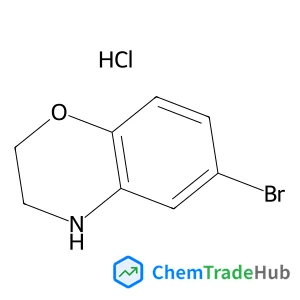
6-Bromo-3,4-dihydro-2H-1,4-benzoxazine hydrochloride (1:1)
CAS Number:
1260803-10-8
Molecular Formula:
C8H9BrClNO
Recommended Suppliers





Disclaimer
This page provides academic journal information for reference and research purposes only. We are not affiliated with any journal publishers and do not handle publication submissions. For publication-related inquiries, please contact the respective journal publishers directly.
If you notice any inaccuracies in the information displayed, please contact us at support@chemtradehub.com. We will promptly review and address your concerns.