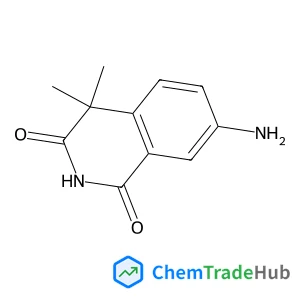
1,3(2H,4H)-Isoquinolinedione, 7-amino-4,4-dimethyl-
CAS Number:
14576-22-8
Molecular Formula:
C11H12N2O2
Ryu Sakamoto, Naomichi Hirama
This article describes a variety of 3,3-disubstituted 2-oxindoles that bear carbonyl groups, which are efficiently obtained from a radical reaction between N-arylacrylamides and aliphatic aldehydes. The reaction is initiated by the photolysis of hypervalent iodine(III) reagents and proceeds smoothly under mild, metal-free conditions.
Christian Schwermann, Nikos L. Doltsinis
DOI: 10.1039/C9CP06419B
Meng Yan, Tao Li, Peiru Zheng, Rubin Wei, Yanyan Jiang, Hui Li
DOI: 10.1039/D0CP00985G
Ruodi Cheng, Jonathan Martens, Travis D. Fridgen
DOI: 10.1039/D0CP00069H
Lucie Duplouy, Alain Moissette, Matthieu Hureau, Vincent De Waele, Isabelle Batonneau-Gener
DOI: 10.1039/D0CP01701A
Peter Licence, Chi-Linh Do-Thanh, Huimin Luo, Sheng Dai
DOI: 10.1039/D0CP01454K
Mark D. Driver, Christopher A. Hunter
DOI: 10.1039/D0CP01570A
Junling Ma, Minjun Yang, Christopher Batchelor-McAuley, Richard G. Compton
DOI: 10.1039/D0CP01904F
Naciye Esma Tirtom, Yang Hsu, Hung-Wen Li
DOI: 10.1039/D0CP01061H
4-Nitrophenyl phosphate disodium salt hexahydrate is primarily used as a substra...
2-(Trifluoromethyl)-1,3-oxazole-4-carboxylic Acid (CAS: 1060816-01-4) is widely ...
2-Fluoro-4-biphenylcarboxylic acid should be stored in a cool, dry place at room...
Prednisolone-21-Carboxylic Acid is primarily used in the pharmaceutical industry...
4-(Hydrazinomethyl)-1,2,3-benzenetriol (CAS: 3614-72-0) should be stored in a co...
4-Amino-1-methyl-1H-pyrazole-5-carboxylic acid hydrochloride (CAS: 92534-70-8) i...
Dehydropachymic acid (CAS: 77012-31-8) is regulated by various agencies. It fall...
The market and research trends for 6-[(2,2-Dimethylpropanoyl)amino]nicotinic aci...
1,10-Phenanthroline-2,9-dicarbaldehyde should be stored in a cool, dry place awa...
5-Carbamoyl-11-oxo-10,11-dihydro-5H-dibenzo[b,f]azepin-10-yl acetate can be synt...

Organic & Biomolecular Chemistry (OBC) publishes original and high impact research and reviews in organic chemistry. We welcome research that shows new or significantly improved protocols or methodologies in total synthesis, synthetic methodology or physical and theoretical organic chemistry as well as research that shows a significant advance in the organic chemistry or molecular design aspects of chemical biology, catalysis, supramolecular and macromolecular chemistry, theoretical chemistry, mechanism-oriented physical organic chemistry, medicinal chemistry or natural products. Articles published in the journal should report new work which makes a highly-significant impact in the field. Routine and incremental work is generally not suitable for publication in the journal. More details about key areas of our scope are below. In all cases authors should include in their article clear rationale for why their research has been carried out.
![N-[2-(4-Hydroxyphenoxy)-4-nitrophenyl]methanesulfonamide structure](https://static.chemtradehub.com/structs/109/109032-22-6-7c88.webp "N-[2-(4-Hydroxyphenoxy)-4-nitrophenyl]methanesulfonamide structure")
![[(1S,2S,3R,4S,7R,9S,10S,12R,15S)-4,12-Diacetyloxy-15-[(2R,3S)-3-benzamido-3-phenyl-2-(2,2,2-trichloroethoxycarbonyloxy)propanoyl]oxy-1,9-dihydroxy-10,14,17,17-tetramethyl-11-oxo-6-oxatetracyclo[11.3.1.03,10.04,7]heptadec-13-en-2-yl] benzoate structure](https://static.chemtradehub.com/structs/100/100431-55-8-7104.webp "[(1S,2S,3R,4S,7R,9S,10S,12R,15S)-4,12-Diacetyloxy-15-[(2R,3S)-3-benzamido-3-phenyl-2-(2,2,2-trichloroethoxycarbonyloxy)propanoyl]oxy-1,9-dihydroxy-10,14,17,17-tetramethyl-11-oxo-6-oxatetracyclo[11.3.1.03,10.04,7]heptadec-13-en-2-yl] benzoate structure")