













Enantioselective total synthesis and biological evaluation of (−)-solanacol
Literature Information
Publication Date
2018-07-12
DOI
10.1039/C8OB01287C
Impact Factor
3.876
Authors
L. J. Bromhead, A. R. Norman, K. C. Snowden, B. J. Janssen, C. S. P. McErlean
View Original
Abstract
An enantioselective synthesis of the phenyl ring-containing strioglactone, (−)-solanocol, is described. Application of a Dynamic Kinetic Resolution (DKR) in the stereo-defining step enabled a step-economical synthesis to be achieved, and allowed access to natural and non-natural enantiomers with equal facility. Results of seed germination assays and Differential Scanning Fluorimetry (DSF) measurements with the known strigolactone receptor protein, Decreased Apical Dominance 2 (DAD2), are reported.
Related Literature
Polysilane-supported Pd and Pt nanoparticles as efficient catalysts for organic synthesis
Hidekazu Oyamada, Ryo Akiyama, Hiroyuki Hagio, Takeshi Naito, Shū Kobayashi
2006-09-05
Communication
DOI: 10.1039/B610241G
Three-dimensionally ordered macroporous carbons having walls composed of hollow mesosized spheres
Sang-Wook Woo, Keiji Sasajima, Takashi Takei
2006-09-18
Communication
DOI: 10.1039/B607196A
Nature of biological water: a femtosecond study
Kankan Bhattacharyya
2008-04-18
Feature Article
DOI: 10.1039/B800278A
Porous 3-D honeycomb architecture by self-assembly of helical H-bonded molecular tapes
Arnaud-Pierre Schaffner, Gersande Lena, Solveig Roussel, André Aubry, Jean-Paul Briand, Claude Didierjean, Gilles Guichard
2006-09-11
Communication
DOI: 10.1039/B604747E
Structurally-defined potassium-mediated regioselective zincation of amino- and alkoxy-substituted pyridines
Ben Conway, David V. Graham, Eva Hevia, Alan R. Kennedy, Jan Klett, Robert E. Mulvey
2008-05-16
Communication
DOI: 10.1039/B805606D
Thermoreversible sol–gel transition of an aqueous solution of polyrotaxane composed of highly methylated α-cyclodextrin and polyethylene glycol
Masatoshi Kidowaki, Toshiyuki Kataoka
2006-08-21
Communication
DOI: 10.1039/B607373E
A mechanistic rationalization of unusual kinetic behavior in proline-mediated C–O and C–N bond-forming reactions
Suju P. Mathew, Martin Klussmann, Hiroshi Iwamura, David H. Wells, Jr., Alan Armstrong
2006-08-31
Communication
DOI: 10.1039/B609926B
Detection of zinc ions under aqueous conditions using chirality assisted solid-state fluorescence of a bipyridyl based fluorophore
Sivaramapanicker Sreejith, Kizhumuri P. Divya, Ayyappanpillai Ajayaghosh
2008-04-23
Communication
DOI: 10.1039/B802958J
You might also like
Compound Q&A
What are the main uses of 4-Nitrophenyl phosphate disodium salt hexahydrate (CAS: 333338-18-4)?
4-Nitrophenyl phosphate disodium salt hexahydrate is primarily used as a substra...
333338-18-44-Nitrophenyl phosph...
Compound Q&A
What are the main uses of 2-(Trifluoromethyl)-1,3-oxazole-4-carboxylic Acid (CAS: 1060816-01-4)?
2-(Trifluoromethyl)-1,3-oxazole-4-carboxylic Acid (CAS: 1060816-01-4) is widely ...
1060816-01-42-(Trifluoromethyl)-...
Compound Q&A
How should 2-Fluoro-4-biphenylcarboxylic acid (CAS: 137045-30-8) be stored?
2-Fluoro-4-biphenylcarboxylic acid should be stored in a cool, dry place at room...
137045-30-82-Fluoro-4-biphenylc...
Compound Q&A
What industries use Prednisolone-21-Carboxylic Acid (CAS: 61549-70-0)?
Prednisolone-21-Carboxylic Acid is primarily used in the pharmaceutical industry...
61549-70-0Prednisolone-21-Carb...
Compound Q&A
How should 4-(Hydrazinomethyl)-1,2,3-benzenetriol (CAS: 3614-72-0) be stored?
4-(Hydrazinomethyl)-1,2,3-benzenetriol (CAS: 3614-72-0) should be stored in a co...
3614-72-04-(Hydrazinomethyl)-...
Compound Q&A
What industries use 4-Amino-1-methyl-1H-pyrazole-5-carboxylic acid hydrochloride (CAS: 92534-70-8)?
4-Amino-1-methyl-1H-pyrazole-5-carboxylic acid hydrochloride (CAS: 92534-70-8) i...
92534-70-84-Amino-1-methyl-1H-...
Compound Q&A
What regulatory guidelines apply to dehydropachymic acid (CAS: 77012-31-8)?
Dehydropachymic acid (CAS: 77012-31-8) is regulated by various agencies. It fall...
77012-31-8Dehydropachymic acid
Compound Q&A
What is the market or research trend for 6-[(2,2-Dimethylpropanoyl)amino]nicotinic acid (CAS: 898561-66-5)?
The market and research trends for 6-[(2,2-Dimethylpropanoyl)amino]nicotinic aci...
898561-66-56-[(2,2-Dimethylprop...
Compound Q&A
How should 1,10-Phenanthroline-2,9-dicarbaldehyde (CAS: 57709-62-3) be stored?
1,10-Phenanthroline-2,9-dicarbaldehyde should be stored in a cool, dry place awa...
57709-62-31,10-Phenanthroline-...
Compound Q&A
How is 5-Carbamoyl-11-oxo-10,11-dihydro-5H-dibenzo[b,f]azepin-10-yl acetate (CAS: 113952-21-9) typically synthesized?
5-Carbamoyl-11-oxo-10,11-dihydro-5H-dibenzo[b,f]azepin-10-yl acetate can be synt...
113952-21-95-Carbamoyl-11-oxo-1...
Source Journal
Organic & Biomolecular Chemistry

CiteScore:
3.4
Self-citation Rate:
10.3%
Articles per Year:
1041
Organic & Biomolecular Chemistry (OBC) publishes original and high impact research and reviews in organic chemistry. We welcome research that shows new or significantly improved protocols or methodologies in total synthesis, synthetic methodology or physical and theoretical organic chemistry as well as research that shows a significant advance in the organic chemistry or molecular design aspects of chemical biology, catalysis, supramolecular and macromolecular chemistry, theoretical chemistry, mechanism-oriented physical organic chemistry, medicinal chemistry or natural products. Articles published in the journal should report new work which makes a highly-significant impact in the field. Routine and incremental work is generally not suitable for publication in the journal. More details about key areas of our scope are below. In all cases authors should include in their article clear rationale for why their research has been carried out.
Recommended Compounds
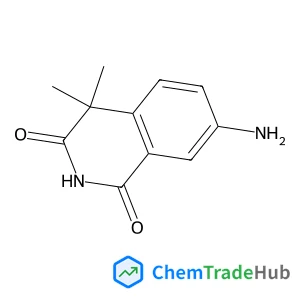
1,3(2H,4H)-Isoquinolinedione, 7-amino-4,4-dimethyl-
CAS Number:
14576-22-8
Molecular Formula:
C11H12N2O2
Recommended Suppliers







Disclaimer
This page provides academic journal information for reference and research purposes only. We are not affiliated with any journal publishers and do not handle publication submissions. For publication-related inquiries, please contact the respective journal publishers directly.
If you notice any inaccuracies in the information displayed, please contact us at support@chemtradehub.com. We will promptly review and address your concerns.