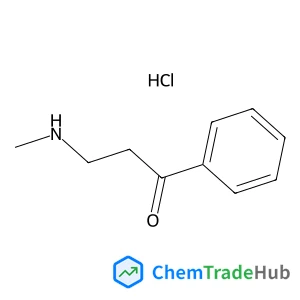
3-(Methylamino)-1-phenyl-1-propanone hydrochloride (1:1)
CAS Number:
2538-50-3
Molecular Formula:
C10H14ClNO
Mengyuan Xia, Yuehu Wang, Shuzhen Mu
A biomimetic synthetic strategy and combinatorial chemistry were used to synthesize 34 novel monoterpenoid indole alkaloid (MIA) analogues, and their cytotoxic activities against five cancer cell lines (SW-480, A-549, HL-60, SMMC-7721, and MCF-7) were determined using the 3-(4,5-dimethylthiazol-2-yl)-5-(3-carboxymethoxyphenyl)-2-(4-sulfophenyl)-2H-tetrazolium (MTS) assay. Fourteen of these analogues (7, 16–18, and 23–32) showed significantly greater inhibition of tumour cell proliferation than cisplatin. Compounds 17 and 18 showed the highest cytotoxic activity against the HL-60 cell line with IC50 values of 0.90 μM and 0.43 μM, respectively. Compound 18 slightly induced apoptosis and arrested the cell cycle in SW-480, A-549, HL-60, SMMC-7721, and MCF-7 cells. Analysis of the primary structure–activity relationships reveals that the introduction of different substituent groups at the C-3, C-5, and C-6 positions of the indole moiety and the C-10 position of the genipin moiety might have an effect on the antitumour activity of the resulting compounds.
Yang-Xin Yu
DOI: 10.1039/B911901A
Xiang Wang, Mohammad R. Islam, Emily J. Danoff, Douglas S. English
DOI: 10.1039/B908523H
Hongming Yin, Keli Han
DOI: 10.1039/C002270E
Mitsuhiko Miyazaki, Jiro Saikawa, Hideki Ishizuki, Takunori Taira, Masaaki Fujii
DOI: 10.1039/B822310F
Dahbia Talbi, Ian W. M. Smith
DOI: 10.1039/B908416A
Luca Grisanti, Cristina Sissa, Francesca Terenziani, Anna Painelli, Dominique Roberto, Francesca Tessore, Renato Ugo, Silvio Quici, Ilaria Fortunati, Eleonora Garbin, Camilla Ferrante, Renato Bozio
DOI: 10.1039/B911268E
Juan J. Nájera, Carl J. Percival, Andrew B. Horn
DOI: 10.1039/B909623J
Daniel K. W. Mok, Foo-tim Chau, John M. Dyke
DOI: 10.1039/C003688A
E. D. de Rooij, U. von Toussaint, W. J. Goedheer
DOI: 10.1039/B908389H
Waste containing N-Methoxy-N-methyl-1,3-thiazole-5-carboxamide (CAS: 898825-89-3...
N-(4-Biphenylyl)dibenzo[b,d]furan-4-amine should be stored in a tightly sealed c...
The market for 3-Acetamido-5-amino-2,4,6-triiodobenzoic acid (CAS: 1713-07-1) is...
Benzyl 2-O-acetyl-3,4,6-tri-O-benzyl-beta-D-galactopyranoside (CAS: 61820-03-9) ...
2-Ethylpiperazine dihydrochloride (CAS: 438050-52-3) is regulated under the Glob...
1,1'-[1,3-Phenylenebis(methylene)]bis(3-methyl-1H-pyrrole-2,5-dione) (CAS: 11946...
Several alternatives can be used in the synthesis of 5-Fluoro-2-(1-pyrrolidinyl)...
Proper personal protective equipment (PPE) must be worn when handling this compo...
When handling 6-Bromoimidazo[1,2-a]pyridin-8-amine, it is important to wear appr...
Alternatives to (2S,4R)-4-(4-Nitrobenzyl)pyrrolidine-2-carboxylic acid hydrochlo...

Organic & Biomolecular Chemistry (OBC) publishes original and high impact research and reviews in organic chemistry. We welcome research that shows new or significantly improved protocols or methodologies in total synthesis, synthetic methodology or physical and theoretical organic chemistry as well as research that shows a significant advance in the organic chemistry or molecular design aspects of chemical biology, catalysis, supramolecular and macromolecular chemistry, theoretical chemistry, mechanism-oriented physical organic chemistry, medicinal chemistry or natural products. Articles published in the journal should report new work which makes a highly-significant impact in the field. Routine and incremental work is generally not suitable for publication in the journal. More details about key areas of our scope are below. In all cases authors should include in their article clear rationale for why their research has been carried out.