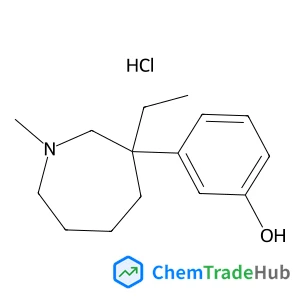
3-(3-Ethyl-1-methyl-3-azepanyl)phenol hydrochloride (1:1)
CAS Number:
59263-76-2
Molecular Formula:
C15H24ClNO
Luca Grisanti, Cristina Sissa, Francesca Terenziani, Anna Painelli, Dominique Roberto, Francesca Tessore, Renato Ugo, Silvio Quici, Ilaria Fortunati, Eleonora Garbin, Camilla Ferrante, Renato Bozio
The intensity of the two-photon absorption (TPA) spectrum of a terpyridine ligand acting as a D–π–A chromophore (D = donor and A = acceptor) is enhanced by a factor of about 2 upon coordination to ZnCl2. Based on an analysis of linear absorption and fluorescence spectra of both the ligand and its Zn(II) complex, we have defined essential-state models for the two species. Linear and TPA spectra of the ligand are well reproduced in terms of a two-state model accounting for the D–π–A ↔ D+–π–A− charge resonance. However, the enhancement of the TPA response of its Zn(II) complex can only be understood by extending the model to account for the active role of the “ZnCl2” moiety acting as a virtual Av acceptor group of a D–π–AAv structure. The virtual D+AAv− state of the relevant three-state model has negligible weight in the ground state but contributes to the first excited state. The resulting increase of the excited-state dipole moment is responsible for the enhancement of the TPA cross section, and also explains the increase of the second order nonlinear optical response upon coordination.
YoungAh Kwon, Junho Lee, Sungnam Park
DOI: 10.1039/C6CP08852J
Cristina Ortega-Moo, Rocio Durán, Bárbara Herrera, Soledad Gutiérrez-Oliva, Rubicelia Vargas
DOI: 10.1039/C7CP01304C
Francesco Nastasi, Giuseppina La Ganga, Sebastiano Campagna, Zois Syrgiannis, Francesco Rigodanza, Stefania Vitale, Antonino Licciardello
DOI: 10.1039/C7CP01597F
Khaleel I. Assaf, Abdussalam K. Qaroush, Ala'a F. Eftaiha
DOI: 10.1039/C7CP02087B
Xiaodan Xu, Lu Cai, Xiaoli Zheng, Qun Xu
DOI: 10.1039/C7CP01277B
Ryo Furuta, Naoyuki Kurake, Kenji Ishikawa, Keigo Takeda, Hiroshi Hashizume, Hiroki Kondo, Takayuki Ohta, Masafumi Ito, Makoto Sekine, Masaru Hori
DOI: 10.1039/C7CP00489C
Houyang Chen
DOI: 10.1039/C6CP08621G
Andrew A. Peterson, Rune Christensen, Alireza Khorshidi
DOI: 10.1039/C7CP00375G
Victor Gray, Ambra Dreos, Paul Erhart, Bo Albinsson, Kasper Moth-Poulsen, Maria Abrahamsson
DOI: 10.1039/C7CP01368J
Waste containing N-Methoxy-N-methyl-1,3-thiazole-5-carboxamide (CAS: 898825-89-3...
N-(4-Biphenylyl)dibenzo[b,d]furan-4-amine should be stored in a tightly sealed c...
The market for 3-Acetamido-5-amino-2,4,6-triiodobenzoic acid (CAS: 1713-07-1) is...
Benzyl 2-O-acetyl-3,4,6-tri-O-benzyl-beta-D-galactopyranoside (CAS: 61820-03-9) ...
2-Ethylpiperazine dihydrochloride (CAS: 438050-52-3) is regulated under the Glob...
1,1'-[1,3-Phenylenebis(methylene)]bis(3-methyl-1H-pyrrole-2,5-dione) (CAS: 11946...
Several alternatives can be used in the synthesis of 5-Fluoro-2-(1-pyrrolidinyl)...
Proper personal protective equipment (PPE) must be worn when handling this compo...
When handling 6-Bromoimidazo[1,2-a]pyridin-8-amine, it is important to wear appr...
Alternatives to (2S,4R)-4-(4-Nitrobenzyl)pyrrolidine-2-carboxylic acid hydrochlo...

Physical Chemistry Chemical Physics (PCCP) is an international journal co-owned by 19 physical chemistry and physics societies from around the world. This journal publishes original, cutting-edge research in physical chemistry, chemical physics and biophysical chemistry. To be suitable for publication in PCCP, articles must include significant innovation and/or insight into physical chemistry; this is the most important criterion that reviewers and Editors will judge against when evaluating submissions. The journal has a broad scope and welcomes contributions spanning experiment, theory, computation and data science. Topical coverage includes spectroscopy, dynamics, kinetics, statistical mechanics, thermodynamics, electrochemistry, catalysis, surface science, quantum mechanics, quantum computing and machine learning. Interdisciplinary research areas such as polymers and soft matter, materials, nanoscience, energy, surfaces/interfaces, and biophysical chemistry are welcomed if they demonstrate significant innovation and/or insight into physical chemistry. Joined experimental/theoretical studies are particularly appreciated when complementary and based on up-to-date approaches.