












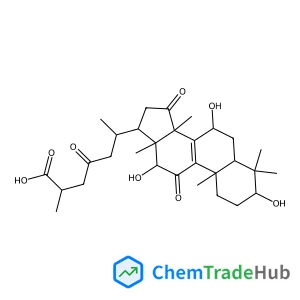
(3beta,7beta,12beta)-3,7,12-Trihydroxy-11,15,23-trioxolanost-8-en-26-oic acid
CAS Number:
98665-22-6
Molecular Formula:
C30H44O8
A graphical abstract is available for this content
Sebastian Tassoti, Martin Walenta, Alexander Pöcheim, Kathrin Buchberger, Olaf Kunert, Klaus Zangger
DOI: 10.1039/C9AN01364D
Ishaan Maitra, Camilo L. M. Morais, Katherine M. Ashton, Ravindra S. Date, Francis L. Martin
DOI: 10.1039/C9AN01749F
Manman Lin, Bin Xu, Huilu Yao, Aiguo Shen, Jiming Hu
DOI: 10.1039/C5AN02315G
Bruno Pagano, Nunzia Iaccarino, Anna Di Porzio, Antonio Randazzo, Jussara Amato
DOI: 10.1039/C9AN01463B
Zoë J. Ayres, Mark E. Newton, Julie V. Macpherson
DOI: 10.1039/C6AN00340K
Wen Yang, Jianniao Tian, Lijun Wang, Shui Fu, Hongyun Huang, Yanchun Zhao, Shulin Zhao
DOI: 10.1039/C6AN00184J
Mónica B. Mamián-López, Paola Corio, Marcia L. A. Temperini
DOI: 10.1039/C6AN00222F
Yao Qin, Daxiu Li, Ruo Yuan, Yun Xiang
DOI: 10.1039/C9AN01674K
Yusuke Niwa, Tatsumi Mizuta, Kenji Sueyoshi, Tatsuro Endo, Hideaki Hisamoto
DOI: 10.1039/C9AN01769K
When handling 4-(2-Furylmethyl)thiomorpholine 1,1-dioxide (CAS: 79206-94-3), it ...
When handling 4-Chloro-N-[2-(4-morpholinyl)ethyl]benzamide (CAS: 71320-77-9), it...
Waste containing this compound (CAS: 62921-74-8) should be handled according to ...
Waste containing (S)-Methyl 2-amino-3-cyclohexylpropanoate should be collected i...
This compound can be synthesized using a multi-step process involving the conjug...
There are several alternatives to (2E)-3-(3,4-Dichlorophenyl)acrylic acid in syn...
Ethyl 6-(2-nitrophenyl)imidazo[2,1-b][1,3]thiazole-3-carboxylate (CAS: 925437-84...
Waste containing 2-(1,3-Thiazol-2-yl)ethanamine (CAS: 18453-07-1) should be coll...
Methyl 5-iodo-2-methylbenzoate can be synthesized through the iodination of meth...
5-Chloro[1,2,4]triazolo[1,5-a]pyridine is commonly synthesized via the condensat...

Physical Chemistry Chemical Physics (PCCP) is an international journal co-owned by 19 physical chemistry and physics societies from around the world. This journal publishes original, cutting-edge research in physical chemistry, chemical physics and biophysical chemistry. To be suitable for publication in PCCP, articles must include significant innovation and/or insight into physical chemistry; this is the most important criterion that reviewers and Editors will judge against when evaluating submissions. The journal has a broad scope and welcomes contributions spanning experiment, theory, computation and data science. Topical coverage includes spectroscopy, dynamics, kinetics, statistical mechanics, thermodynamics, electrochemistry, catalysis, surface science, quantum mechanics, quantum computing and machine learning. Interdisciplinary research areas such as polymers and soft matter, materials, nanoscience, energy, surfaces/interfaces, and biophysical chemistry are welcomed if they demonstrate significant innovation and/or insight into physical chemistry. Joined experimental/theoretical studies are particularly appreciated when complementary and based on up-to-date approaches.

![5-Acetyl-2,3-dihydrobenzo[b]furan structure](https://static.chemtradehub.com/structs/908/90843-31-5-eea4.webp "5-Acetyl-2,3-dihydrobenzo[b]furan structure")




