












Spectroscopic and magnetic investigations of a spin-frustrated Mn-doped CoAl2O4 spinel
Literature Information
Publication Date
2018-12-07
DOI
10.1039/C8CP07140C
Impact Factor
3.676
Authors
Suman Kalyan Pradhan, Biswajit Dalal, Ankita Sarkar, Subodh Kumar De
View Original
Abstract
Single-phase polycrystalline spin-frustrated spinel oxides Co1−xMnxAl2O4 (0 ≤ x ≤ 0.3) have been prepared to investigate the optical and magnetic properties. Linear variation of the lattice parameter along with the characteristic hyperfine electron paramagnetic resonance (EPR) signal establish the fact that the Mn2+ ions are incorporated at Co2+ sites of the CoAl2O4 lattice. Optical absorption spectra reveal three absorption features in wavelength regions: 250–400 nm, 500–700 nm and 1000–1700 nm. The optical band gap associated with the d–d transition increases from 1.84 eV to 1.88 eV with 30% Mn substitution. Temperature dependent magnetization measurements indicate a clear transformation of the magnetic ground state from the collinear antiferromagnetic state (for x = 0) to the spin-glass-like state (for x = 0.1) to the cluster-glass-like state (for x = 0.2 and 0.3) with the increase of Mn concentration. In addition, our time dependent isothermal remanent magnetization (IRM) study further fortifies the above transformation of the magnetic ground state. The value of the magnetic frustration parameter moderately decreases with Mn substitution, but the compositional variation is not monotonous.
Related Literature
Development of type-I/type-II hybrid dye sensitizer with both pyridyl group and catechol unit as anchoring group for type-I/type-II dye-sensitized solar cell
Yousuke Ooyama, Kensuke Furue, Toshiaki Enoki, Masahiro Kanda, Yohei Adachi, Joji Ohshita
2016-10-21
Paper
DOI: 10.1039/C6CP06513A
Tunneling chemical exchange reaction D + HD → D2 + H in solid HD and D2 at temperatures below 1 K
S. Sheludiakov, J. Ahokas, J. Järvinen, L. Lehtonen, O. Vainio, S. Vasiliev, D. M. Lee, V. V. Khmelenko
2016-10-06
Paper
DOI: 10.1039/C6CP05486B
Formation of an interphase layer during deposition of cobalt onto tetraphenylporphyrin: a hard X-ray photoelectron spectroscopy (HAXPES) study
Min Chen, Han Zhou, Benedikt P. Klein, Malte Zugermeier, Claudio K. Krug, Hans-Jörg Drescher, Mihaela Gorgoi, Martin Schmid, J. Michael Gottfried
2016-10-17
Paper
DOI: 10.1039/C6CP05894A
Exchange potentials for semi-classical electrons
Judith Herzfeld, Solen Ekesan
2016-10-20
Paper
DOI: 10.1039/C6CP06100A
Size-dependent commensurability and its possible role in determining the frictional behavior of adsorbed systems
Paolo Restuccia, Mauro Ferrario, Pier Luigi Sivestrelli, Giampaolo Mistura
2016-09-26
Paper
DOI: 10.1039/C6CP05386F
Temperature dependence of acoustic vibrations of CdSe and CdSe–CdS core–shell nanocrystals measured by low-frequency Raman spectroscopy
A. Jolene Mork, Elizabeth M. Y. Lee, William A. Tisdale
2016-10-05
Paper
DOI: 10.1039/C6CP05683K
Combined influence of ectoine and salt: spectroscopic and numerical evidence for compensating effects on aqueous solutions
Frank Uhlig, Tihomir Solomun, Jens Smiatek
2016-09-22
Communication
DOI: 10.1039/C6CP05417J
Ultrafast multiexponential electron injection dynamics at a dye and ZnO QD interface: a combined spectroscopic and first principles study
Pushpendra Kumar, Suman Kalyan Pal
2016-09-30
Paper
DOI: 10.1039/C6CP04610J
Heteroleptic [Os(H)(CO)(N∧N)(tpp)2]+ and [Os(Cl)(CO)(N∧N)(tpp)2]+ complexes – comparative studies of their luminescence properties
Anna Kamecka, Kinga Suwińska, Andrzej Kapturkiewicz
2016-10-11
Paper
DOI: 10.1039/C6CP05856F
Calculating binding free energies of host–guest systems using the AMOEBA polarizable force field
David R. Bell, Rui Qi, Zhifeng Jing, Jin Yu Xiang, Christopher Mejias, Michael J. Schnieders, Jay W. Ponder, Pengyu Ren
2016-05-19
Paper
DOI: 10.1039/C6CP02509A
You might also like
Compound Q&A
Are there alternatives to 1-(4-Chlorophenyl)-N-hydroxymethanimine (CAS: 3848-36-0) in synthesis?
When considering alternatives to 1-(4-Chlorophenyl)-N-hydroxymethanimine (CAS: 3...
3848-36-01-(4-Chlorophenyl)-N...
Compound Q&A
How should (1R,9S,10S,12S,14E,16S,19R,20R,21S,22R)-3,9,21-Trihydroxy-5,10,12,14,16,20,22-heptamethyl-23,24-dioxatetracyclo[17.3.1.1~6,9~.0~2,7~]tetracosa-2,5,7,14-tetraen-4-one (CAS: 183202-73-5) be stored?
This compound should be stored in a cool, dry place away from direct sunlight. I...
183202-73-5(1R,9S,10S,12S,14E,1...
Compound Q&A
How is 3-(4-Bromophenyl)-5-(2-fluorophenyl)-1,2,4-oxadiazole (CAS: 419553-16-5) typically synthesized?
3-(4-Bromophenyl)-5-(2-fluorophenyl)-1,2,4-oxadiazole is synthesized through a m...
419553-16-53-(4-Bromophenyl)-5-...
Compound Q&A
How is 5-Chloro-2-(4-chlorophenyl)-4-methyl-6-[3-(1-piperidinyl)propoxy]pyrimidine (CAS: 1639220-19-1) typically synthesized?
5-Chloro-2-(4-chlorophenyl)-4-methyl-6-[3-(1-piperidinyl)propoxy]pyrimidine (CAS...
1639220-19-15-Chloro-2-(4-chloro...
Compound Q&A
What industries use 2-Chloro-4-(difluoromethoxy)pyridine (CAS: 1206978-15-5)?
2-Chloro-4-(difluoromethoxy)pyridine is used in the pharmaceutical industry for ...
1206978-15-52-Chloro-4-(difluoro...
Compound Q&A
What regulatory guidelines apply to 3-Chloro-6-methylpyridazine (CAS: 1121-79-5)?
3-Chloro-6-methylpyridazine (CAS: 1121-79-5) is classified under the Globally Ha...
1121-79-53-Chloro-6-methylpyr...
Compound Q&A
Are there alternatives to Methyl 4,5-dimethyl-2-nitrobenzoate in synthesis?
Several alternatives can be used in the synthesis of Methyl 4,5-dimethyl-2-nitro...
90922-74-0Methyl 4,5-dimethyl-...
Compound Q&A
Are there alternatives to (2E,2'E)-3,3'-(1,4-Phenylene)bisacrylaldehyde in synthesis?
Alternatives to (2E,2'E)-3,3'-(1,4-Phenylene)bisacrylaldehyde include other acry...
63405-68-5(2E,2'E)-3,3'-(1,4-P...
Compound Q&A
What is 3-Amino-5-chloropyridin-2-ol hydrochloride (CAS: 1261906-29-9)?
3-Amino-5-chloropyridin-2-ol hydrochloride is an organic compound with the CAS n...
1261906-29-93-Amino-5-chloropyri...
Compound Q&A
What precautions should be taken when handling 6,7-Difluoro-2,3-dihydro-4H-chromen-4-one (CAS: 1092349-93-3)?
When handling 6,7-Difluoro-2,3-dihydro-4H-chromen-4-one, it is essential to wear...
1092349-93-36,7-Difluoro-2,3-dih...
Source Journal
Physical Chemistry Chemical Physics

CiteScore:
5.5
Self-citation Rate:
10.3%
Articles per Year:
3036
Physical Chemistry Chemical Physics (PCCP) is an international journal co-owned by 19 physical chemistry and physics societies from around the world. This journal publishes original, cutting-edge research in physical chemistry, chemical physics and biophysical chemistry. To be suitable for publication in PCCP, articles must include significant innovation and/or insight into physical chemistry; this is the most important criterion that reviewers and Editors will judge against when evaluating submissions. The journal has a broad scope and welcomes contributions spanning experiment, theory, computation and data science. Topical coverage includes spectroscopy, dynamics, kinetics, statistical mechanics, thermodynamics, electrochemistry, catalysis, surface science, quantum mechanics, quantum computing and machine learning. Interdisciplinary research areas such as polymers and soft matter, materials, nanoscience, energy, surfaces/interfaces, and biophysical chemistry are welcomed if they demonstrate significant innovation and/or insight into physical chemistry. Joined experimental/theoretical studies are particularly appreciated when complementary and based on up-to-date approaches.
Recommended Compounds
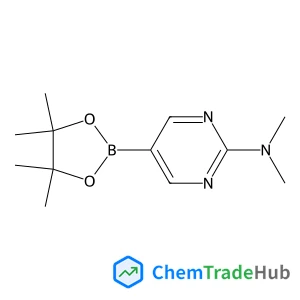
N,N-Dimethyl-5-(4,4,5,5-tetramethyl-1,3,2-dioxaborolan-2-yl)-2-pyrimidinamine
CAS Number:
1032759-30-0
Molecular Formula:
C12H20BN3O2
Recommended Suppliers





Disclaimer
This page provides academic journal information for reference and research purposes only. We are not affiliated with any journal publishers and do not handle publication submissions. For publication-related inquiries, please contact the respective journal publishers directly.
If you notice any inaccuracies in the information displayed, please contact us at support@chemtradehub.com. We will promptly review and address your concerns.