












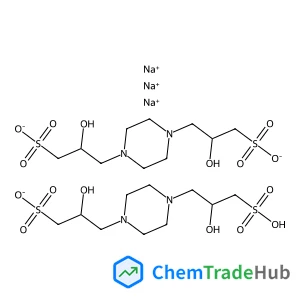
3,3'-(Piperazine-1,4-diyl)bis(2-hydroxypropane-1-sulfonic acid) Sodium Salt
CAS Number:
108321-08-0
Molecular Formula:
C20H41N4Na3O16S4
Zhaoqian Su, Yinghao Wu
Proteins carry out their diverse functions in cells by forming interactions with each other. The dynamics of these interactions are quantified by the measurement of association and dissociation rate constants. Relative to the efforts made to model the association of biomolecules, little has been studied to understand the principles of protein complex dissociation. Using the interaction between colicin E9 endonucleases and immunity proteins as a test system, here we develop a coarse-grained simulation method to explore the dissociation mechanisms of protein complexes. The interactions between proteins in the complex are described by the knowledge-based potential that was constructed by the statistics from available protein complexes in the structural database. Our study provides the supportive evidences to the dual recognition mechanism for the specificity of binding between E9 DNase and immunity proteins, in which the conserved residues of helix III of Im2 and Im9 proteins act as the anchor for binding, while the sequence variations in helix II make positive or negative contributions to specificity. Beyond that, we further suggest that this binding specificity is rooted in the process of complex dissociation instead of association. While we increased the flexibility of protein complexes, we further found that they are less prone to dissociation, suggesting that conformational fluctuations of protein complexes play important functional roles in regulating their binding and dissociation. Our studies therefore bring new insights to the molecule mechanisms of protein–protein interactions, while the method can serve as a new addition to a suite of existing computational tools for the simulations of protein complexes.
DOI: 10.1039/A901894H
DOI: 10.1039/A901854I
DOI: 10.1039/A808667B
DOI: 10.1039/A903594J
DOI: 10.1039/A904858H
3-Fluoro-2-methylbenzylamine is an organic compound with the CAS number 771573-3...
Tert-butyl 2-(oxetan-3-ylidene)acetate is considered safe for its intended uses ...
Proper personal protective equipment (PPE) such as gloves, goggles, and a lab co...
2-Ethyl-4-methyl-1,3-thiazole is commonly synthesized via the reaction of thiour...
This compound should be stored in a cool, dry place away from direct sunlight an...
L-Lysine Acetate Salt (CAS: 52315-92-1) is subject to various regulatory guideli...
6-Fluoro-3-hydroxy-2-pyrazinecarboxamide (CAS: 259793-96-9) is generally conside...
1,1'-Sulfonylbis(1H-imidazole) is a crystalline solid with a molecular weight of...
4-Methyl-7-nitro-1H-indole-3-carbonitrile (CAS: 289483-82-5) is primarily used i...
Waste containing 5-Bromo-3-indolyl-beta-galactoside (CAS: 97753-82-7) should be ...

Physical Chemistry Chemical Physics (PCCP) is an international journal co-owned by 19 physical chemistry and physics societies from around the world. This journal publishes original, cutting-edge research in physical chemistry, chemical physics and biophysical chemistry. To be suitable for publication in PCCP, articles must include significant innovation and/or insight into physical chemistry; this is the most important criterion that reviewers and Editors will judge against when evaluating submissions. The journal has a broad scope and welcomes contributions spanning experiment, theory, computation and data science. Topical coverage includes spectroscopy, dynamics, kinetics, statistical mechanics, thermodynamics, electrochemistry, catalysis, surface science, quantum mechanics, quantum computing and machine learning. Interdisciplinary research areas such as polymers and soft matter, materials, nanoscience, energy, surfaces/interfaces, and biophysical chemistry are welcomed if they demonstrate significant innovation and/or insight into physical chemistry. Joined experimental/theoretical studies are particularly appreciated when complementary and based on up-to-date approaches.
![(3R)-3-(3-Fluorophenyl)-3-({[(2-methyl-2-propanyl)oxy]carbonyl}amino)propanoic acid structure](https://static.chemtradehub.com/structs/500/500789-04-8-20dd.webp "(3R)-3-(3-Fluorophenyl)-3-({[(2-methyl-2-propanyl)oxy]carbonyl}amino)propanoic acid structure")
![2,4,5-Trichloro-7H-pyrrolo[2,3-d]pyrimidine structure](https://static.chemtradehub.com/structs/105/1053228-28-6-fba3.webp "2,4,5-Trichloro-7H-pyrrolo[2,3-d]pyrimidine structure")






