












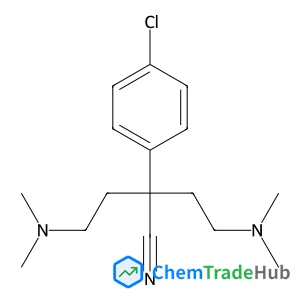
2-(4-Chlorophenyl)-4-(dimethylamino)-2-(2-(dimethylamino)ethyl)butanenitrile
CAS Number:
1246816-57-8
Molecular Formula:
C16H24ClN3
Ewa Mosiniewicz-Szablewska, Antonia R. Clavijo, Ana P. O. R. Castilho, Leonardo G. Paterno, Jarosław Więckowski, Maria A. G. Soler
This study reports on investigation of the magnetic properties of layer-by-layer (LbL) assembled nanofilms comprising polyvinyl alcohol (PVA) and citrate-coated magnetite (cit-MAG) nanoparticles deposited onto silicon (SF sample) and glass (GF sample) substrates. DC magnetization measurements were performed over the temperature range of 4 K to 300 K, in the applied magnetic field range of ±60 kOe. The magnetic data of the as-synthesized cit-MAG nanoparticles (F sample) are also collected for comparison. The three as-fabricated samples reveal perfect superparamagnetic (SPM) behavior only around room temperature; at temperatures lower than 200 K the SPM scaling is not observed and all samples behave as interacting superparamagnetic (ISPM) materials. The evolution from the ISPM to the SPM regime is marked by a steady decrease in the hysteretic properties of all samples, with the temperature-dependence of the coercivity decreasing slower than the T1/2 behavior predicted for non-interacting superparamagnetic particles. The modified Bloch's law used to assess information on nanoparticles’ surface spins gives the Bloch's exponent close to 2 (for the F and SF samples) and close to 1 (for the GF sample). Interestingly, the surface spin freezing temperature (Tf) is 8 ± 1 K for all samples. The magnetic behavior of all three samples can be described within the model picture of a core–shell structure for the cit-MAG nanoparticles; the core comprising magnetically-ordered spins whereas the shell behaving as a spin-glass-like system. However, the contribution of the shell magnetism to the effective magnetic properties is much more evident in the GF sample in which magnetic dipole–dipole interaction is three-times weaker than in the SF sample and two times weaker than in the F sample. In contrast, the strong magnetic dipole–dipole interaction in the SF sample affects the surface spins, hindering the onset of magnetically-ordered regions in the nanoparticle's shell, making the surface magnetism contribution negligible. The LbL-fabricated nanofilms herein reported and the presented analysis of their magnetic properties we envisage can support the engineering of magnetic nanofilms for multiple applications.
Bo Li, TianFu Liu, Jian Song, Dang Sheng Su
DOI: 10.1039/C5CP07969A
Allen D. Pauric, Ion C. Halalay, Gillian R. Goward
DOI: 10.1039/C5CP05811B
Chuanbao Cao, Jianhua Hou, Huazhang Zhai
DOI: 10.1039/C5CP07997G
Junghoon Oh, Yun Hee Chang, Yong-Hyun Kim, Sungjin Park
DOI: 10.1039/C6CP00582A
Takeshi Miki, Tiago Buckup, Marie S. Krause, June Southall, Richard J. Cogdell, Marcus Motzkus
DOI: 10.1039/C5CP07542D
Anna Pougin, Martin Dilla
DOI: 10.1039/C5CP07148H
Nan He, Zhen Hua Li
DOI: 10.1039/C6CP00186F
S. Mahlik, A. Lazarowska, J. Ueda, S. Tanabe, M. Grinberg
DOI: 10.1039/C5CP07732J
N. V. Suetin, S. A. Evlashin, A. V. Egorov, K. V. Mironovich, S. A. Dagesyan, L. V. Yashina, E. A. Goodilin, V. A. Krivchenko
DOI: 10.1039/C6CP01638C
Tridip Ranjan Chetia, Mohammad Shaad Ansari, Mohammad Qureshi
DOI: 10.1039/C5CP07687K
This compound is mainly used as an intermediate in the synthesis of antipsychoti...
Waste containing 1-(D-Ribofuranosyl)-1,4-dihydro-3-pyridinecarboxamide (CAS: 191...
2-Methyl-2-propanyl 3-bromo-3-(hydroxymethyl)-1-azetidinecarboxylate (CAS: 20079...
N-(4-Chloro-2-pyridinyl)acetamide (CAS: 245056-66-0) is a chemical compound with...
5-Chloro-2-hydroxybenzoic acid, also known as 5-chlorosalicylic acid, is an arom...
When handling 1,1-Dichloro-1-fluoroethane (CAS: 1717-00-6), it is important to u...
Fmoc-(2S,3R)-3-phenylpyrrolidine-2-carboxylic acid is a white crystalline solid ...
4-Amino-5-bromo-2-pyridinecarboxylic acid is primarily used as a precursor in th...
Handling this compound should be done with personal protective equipment (PPE) i...
When handling 8-bromo-2,2-dimethyl-3,4-dihydro-2H-1,4-benzoxazin-3-one, use prop...

Physical Chemistry Chemical Physics (PCCP) is an international journal co-owned by 19 physical chemistry and physics societies from around the world. This journal publishes original, cutting-edge research in physical chemistry, chemical physics and biophysical chemistry. To be suitable for publication in PCCP, articles must include significant innovation and/or insight into physical chemistry; this is the most important criterion that reviewers and Editors will judge against when evaluating submissions. The journal has a broad scope and welcomes contributions spanning experiment, theory, computation and data science. Topical coverage includes spectroscopy, dynamics, kinetics, statistical mechanics, thermodynamics, electrochemistry, catalysis, surface science, quantum mechanics, quantum computing and machine learning. Interdisciplinary research areas such as polymers and soft matter, materials, nanoscience, energy, surfaces/interfaces, and biophysical chemistry are welcomed if they demonstrate significant innovation and/or insight into physical chemistry. Joined experimental/theoretical studies are particularly appreciated when complementary and based on up-to-date approaches.
![Methyl 4-({[(2-methyl-2-propanyl)oxy]carbonyl}amino)bicyclo[2.2.2]octane-1-carboxylate structure](https://static.chemtradehub.com/structs/943/943845-74-7-b7e5.webp "Methyl 4-({[(2-methyl-2-propanyl)oxy]carbonyl}amino)bicyclo[2.2.2]octane-1-carboxylate structure")






