


Optimum driving energy for achieving balanced open-circuit voltage and short-circuit current density in organic bulk heterojunction solar cells
Literature Information
Publication Date
2018-11-07
DOI
10.1039/C8CP05145C
Impact Factor
3.676
Authors
Wenchao Yang, Yao Yao, Pengfei Guo, Haibin Sun, Yongsong Luo
View Original
Abstract
Organic bulk heterojunction solar cells generally suffer from a trade-off between the open circuit voltage (Voc) and the short circuit current density (Jsc) under a given donor/acceptor (D/A) interfacial energetic offset (or the so-called driving force). Here we theoretically investigate the optimum driving energy required for achieving the balanced Jsc and Voc simultaneously. To this end, the Jscversus the driving force ΔE curves are calculated under two different charge separation mechanisms by employing the drift-diffusion method. For the Marcus incoherent mechanism, the curve features a high plateau in a broad range of ΔE starting from 0.2 eV, which is due to the accumulation of undissociated excitons within their lifetime and signifies the possibility of obtaining a sizable Jsc under a ΔE value much smaller than the reorganization energy. After incorporating both the electron and hole transfer pathways into the device model, the calculated J–V curves are comparable to experimentally measured ones foractual blended systems of different driving forces. For the coherent mechanism, it is demonstrated that the maximum Jsc can also be achieved under the ΔE of 0.2 eV if a large proportion of the high-lying delocalized states are harvested through tuning the density of states for the charge transfer excitons to reduce the sub-gap states. This theoretical work revealed quantitatively the relationship between the interfacial energy offsets and device performance, and also provides some guidelines for identifying the macroscopic features of the actual charge separation mechanisms in bulk heterojunction solar cells.
Recommended Journals

Atomization and Sprays

Electroanalysis

Colloid Journal

Critical Reviews in Solid State and Materials Sciences

Herald of the Russian Academy of Sciences

Acta Metallurgica Sinica-English Letters

Polycyclic Aromatic Compounds

Journal of Asian Natural Products Research

Bioorganic & Medicinal Chemistry

Journal of the Indian Institute of Science
Related Literature
Investigation of copper precursors in the synthesis of higher alcohols from syngas over CuZnAl catalysts without promoters
Yong-Jun Liu, Lei Jia, Wei Huang
2018-06-26
Paper
DOI: 10.1039/C8CP02296H
Fluorescence anisotropy in indole under two-photon excitation in the spectral range 385–510 nm
M. E. Sasin, A. G. Smolin, K.-H. Gericke, E. Tokunaga, O. S. Vasyutinskii
2018-07-10
Paper
DOI: 10.1039/C8CP02708K
Non-covalent interactions for carbonaceous materials: impacts of doping, curving and their combination
Chang Zhu, Qian Wang, Jiena Yun, Qiaoli Hu, Gang Yang
2018-08-03
Paper
DOI: 10.1039/C8CP02286K
Half-metallic and magnetic semiconducting behaviors of metal-doped blue phosphorus nanoribbons from first-principles calculations
Shun-Jin Peng, Kai-Ming Wu, Kai-Lun Yao, Chee-Leung Mak, Chi-Hang Lam
2018-02-13
Paper
DOI: 10.1039/C7CP08635K
Improved fill factor in inverted planar perovskite solar cells with zirconium acetate as the hole-and-ion-blocking layer
Xuewen Zhang, Chunjun Liang, Mengjie Sun, Huimin Zhang, Chao Ji, Zebang Guo, Yajun Xu, Fulin Sun, Qi Song, Zhiqun He
2018-02-23
Communication
DOI: 10.1039/C8CP00563J
The quest for determining one-electron redox potentials of azulene-1-carbonitriles by calculation
Nicolai Ree, Cecilie Lindholm Andersen, Martin Drøhse Kilde, Ole Hammerich, Mogens Brøndsted Nielsen, Kurt V. Mikkelsen
2018-02-19
Paper
DOI: 10.1039/C7CP08687C
On the contribution of f electrons to the quadratic hyperpolarizability: the case of lanthanide terpyridyl complexes
Fatima Ibersiene, Camille Latouche, Claudine Katan, Abdou Boucekkine
2018-02-27
Communication
DOI: 10.1039/C8CP00853A
Coupling between the mesoscopic dynamics and shear stress of a room-temperature ionic liquid
2018-06-07
Paper
DOI: 10.1039/C8CP02814A
The molecular mechanism of the inhibition effects of PVCaps on the growth of sI hydrate: an unstable adsorption mechanism
Jiafang Xu, Liwen Li, Jinxiang Liu, Xiaopu Wang, Youguo Yan, Jun Zhang
2018-02-09
Paper
DOI: 10.1039/C8CP00010G
You might also like
Compound Q&A
How should waste containing N-Methoxy-N-methyl-1,3-thiazole-5-carboxamide (CAS: 898825-89-3) be handled?
Waste containing N-Methoxy-N-methyl-1,3-thiazole-5-carboxamide (CAS: 898825-89-3...
898825-89-3N-Methoxy-N-methyl-1...
Compound Q&A
How should N-(4-Biphenylyl)dibenzo[b,d]furan-4-amine (CAS: 1318338-47-4) be stored?
N-(4-Biphenylyl)dibenzo[b,d]furan-4-amine should be stored in a tightly sealed c...
1318338-47-4N-(4-Biphenylyl)dibe...
Compound Q&A
What is the market or research trend for 3-Acetamido-5-amino-2,4,6-triiodobenzoic acid (CAS: 1713-07-1)?
The market for 3-Acetamido-5-amino-2,4,6-triiodobenzoic acid (CAS: 1713-07-1) is...
1713-07-13-Acetamido-5-amino-...
Compound Q&A
How should Benzyl 2-O-acetyl-3,4,6-tri-O-benzyl-beta-D-galactopyranoside (CAS: 61820-03-9) be stored?
Benzyl 2-O-acetyl-3,4,6-tri-O-benzyl-beta-D-galactopyranoside (CAS: 61820-03-9) ...
61820-03-9Benzyl 2-O-acetyl-3,...
Compound Q&A
What regulatory guidelines apply to 2-Ethylpiperazine dihydrochloride (CAS: 438050-52-3)?
2-Ethylpiperazine dihydrochloride (CAS: 438050-52-3) is regulated under the Glob...
438050-52-32-Ethylpiperazine di...
Compound Q&A
What regulatory guidelines apply to 1,1'-[1,3-Phenylenebis(methylene)]bis(3-methyl-1H-pyrrole-2,5-dione) (CAS: 119462-56-5)?
1,1'-[1,3-Phenylenebis(methylene)]bis(3-methyl-1H-pyrrole-2,5-dione) (CAS: 11946...
119462-56-51,1'-[1,3-Phenyleneb...
Compound Q&A
Are there alternatives to 5-Fluoro-2-(1-pyrrolidinyl)pyridine (CAS: 1287217-79-1) in synthesis?
Several alternatives can be used in the synthesis of 5-Fluoro-2-(1-pyrrolidinyl)...
1287217-79-15-Fluoro-2-(1-pyrrol...
Compound Q&A
What precautions should be taken when handling 1-((2R,3R,4R,5R)-5-((bis(4-methoxyphenyl)(phenyl)methoxy)methyl)-4-hydroxy-3-methoxytetrahydrofuran-2-yl)-5-methylpyrimidine-2,4(1H,3H)-dione (CAS: 153631-19-7)?
Proper personal protective equipment (PPE) must be worn when handling this compo...
153631-19-71-((2R,3R,4R,5R)-5-(...
Compound Q&A
What precautions should be taken when handling 6-Bromoimidazo[1,2-a]pyridin-8-amine (CAS: 676371-00-9)?
When handling 6-Bromoimidazo[1,2-a]pyridin-8-amine, it is important to wear appr...
676371-00-96-Bromoimidazo[1,2-a...
Compound Q&A
Are there alternatives to (2S,4R)-4-(4-Nitrobenzyl)pyrrolidine-2-carboxylic acid hydrochloride (CAS: 1049740-22-8) in synthesis?
Alternatives to (2S,4R)-4-(4-Nitrobenzyl)pyrrolidine-2-carboxylic acid hydrochlo...
1049740-22-8(2S,4R)-4-(4-Nitrobe...
Source Journal
Physical Chemistry Chemical Physics

CiteScore:
5.5
Self-citation Rate:
10.3%
Articles per Year:
3036
Physical Chemistry Chemical Physics (PCCP) is an international journal co-owned by 19 physical chemistry and physics societies from around the world. This journal publishes original, cutting-edge research in physical chemistry, chemical physics and biophysical chemistry. To be suitable for publication in PCCP, articles must include significant innovation and/or insight into physical chemistry; this is the most important criterion that reviewers and Editors will judge against when evaluating submissions. The journal has a broad scope and welcomes contributions spanning experiment, theory, computation and data science. Topical coverage includes spectroscopy, dynamics, kinetics, statistical mechanics, thermodynamics, electrochemistry, catalysis, surface science, quantum mechanics, quantum computing and machine learning. Interdisciplinary research areas such as polymers and soft matter, materials, nanoscience, energy, surfaces/interfaces, and biophysical chemistry are welcomed if they demonstrate significant innovation and/or insight into physical chemistry. Joined experimental/theoretical studies are particularly appreciated when complementary and based on up-to-date approaches.
Recommended Compounds
![[(5-Methyl-1,3,4-thiadiazol-2-yl)sulfanyl]acetic acid structure](https://static.chemtradehub.com/structs/509/50918-26-8-4ce8.webp "[(5-Methyl-1,3,4-thiadiazol-2-yl)sulfanyl]acetic acid structure")
[(5-Methyl-1,3,4-thiadiazol-2-yl)sulfanyl]acetic acid
CAS Number:
50918-26-8
Molecular Formula:
C5H6N2O2S2

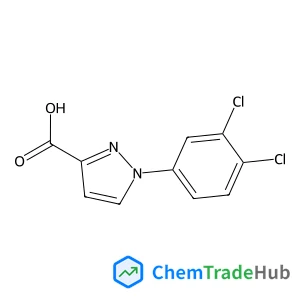
1-(3,4-Dichlorophenyl)-1H-pyrazole-3-carboxylic acid
CAS Number:
1152949-12-6
Molecular Formula:
C10H6Cl2N2O2
Recommended Suppliers







Disclaimer
This page provides academic journal information for reference and research purposes only. We are not affiliated with any journal publishers and do not handle publication submissions. For publication-related inquiries, please contact the respective journal publishers directly.
If you notice any inaccuracies in the information displayed, please contact us at support@chemtradehub.com. We will promptly review and address your concerns.