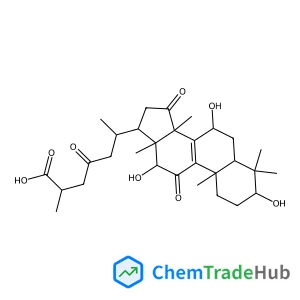
(3beta,7beta,12beta)-3,7,12-Trihydroxy-11,15,23-trioxolanost-8-en-26-oic acid
CAS Number:
98665-22-6
Molecular Formula:
C30H44O8
Feng Pan, Yajie Ren, Binbin Yao, Chuanghua Yang, Meng Ye, Yangyang Wang, Jingzhen Li, Xiuying Zhang, Jiahuan Yan
Recently, two-dimensional (2D) gallium nitride (GaN) was experimentally fabricated, and has promising applications in next-generation electronic and optoelectronic devices. A direct contact with metals to inject the carrier is often required for potential 2D GaN devices. Herein, the first systematic study on the interface properties of monolayer (ML) planar and buckled GaN with different metal electrodes (Al, Ti, Ag, Au, Sc, and Pt) in a field-effect transistor framework is presented using first-principles energy band calculations and quantum transport simulations. Because of moderate Fermi level pinning (electron pinning factor SeL = 0.63), ML planar GaN and the Ag electrode form an n-type lateral Schottky contact, while ML planar GaN and Ti, Al, and Au electrodes form a p-type lateral Schottky contact. The ML buckled GaN, Ag, Al, Ti, and Sc electrodes form a p-type lateral Schottky contact as a result of Fermi level pinning with a hole pinning factor of ShL = 0.75. Notably, a highly desirable n-type/p-type lateral ohmic contact is formed at the lateral interface of the ML planar GaN and Sc/Pt electrodes, and a p-type lateral ohmic contact is formed at the lateral interface of the ML buckled GaN and Pt/Au electrodes. Therefore, a low resistance contact can be realized in ML planar and buckled GaN devices.
Bao-Ying Wen, Xi Jin, Yue Li, Ya-Hao Wang, Chao-Yu Li, Miao-Miao Liang, Rajapandiyan Panneerselvam, Qing-Chi Xu, De-Yin Wu, Zhi-Lin Yang, Jian-Feng Li, Zhong-Qun Tian
DOI: 10.1039/C6AN90033J
Angela Shore
DOI: 10.1039/C9AN01163C
M. Omair Noor, Ulrich J. Krull
DOI: 10.1039/C6AN00129G
Xiaohu Liu, Peng Chen, Nhung Thi Tran, Jinling Zhang, Wei Sheng Chia, Bo Liedberg
DOI: 10.1039/C5AN02508G
Hui Hun Cho, Si Hyun Kim, Jun Hyuk Heo, Young Eel Moon, Young Hun Choi, Dong Cheol Lim, Kwon-Hoon Han
DOI: 10.1039/C6AN00744A
A. Bondarenko, Y. Zhu, L. Qiao, F. Cortés Salazar, H. Pick, H. H. Girault
DOI: 10.1039/C6AN00126B
Inês C. Santos
DOI: 10.1039/C6AN00131A
Yu Zong Chen
DOI: 10.1039/C6AN00678G
Claire V. Crowther, Viola Sanderlin, Mark A. Hayes, Gillian H. Gile
DOI: 10.1039/C9AN01186B
Ruizhi Feng, Yongqian Xu, Hongwei Zhao, Xuemei Duan, Shiguo Sun
DOI: 10.1039/C6AN00646A
When handling 4-(2-Furylmethyl)thiomorpholine 1,1-dioxide (CAS: 79206-94-3), it ...
When handling 4-Chloro-N-[2-(4-morpholinyl)ethyl]benzamide (CAS: 71320-77-9), it...
Waste containing this compound (CAS: 62921-74-8) should be handled according to ...
Waste containing (S)-Methyl 2-amino-3-cyclohexylpropanoate should be collected i...
This compound can be synthesized using a multi-step process involving the conjug...
There are several alternatives to (2E)-3-(3,4-Dichlorophenyl)acrylic acid in syn...
Ethyl 6-(2-nitrophenyl)imidazo[2,1-b][1,3]thiazole-3-carboxylate (CAS: 925437-84...
Waste containing 2-(1,3-Thiazol-2-yl)ethanamine (CAS: 18453-07-1) should be coll...
Methyl 5-iodo-2-methylbenzoate can be synthesized through the iodination of meth...
5-Chloro[1,2,4]triazolo[1,5-a]pyridine is commonly synthesized via the condensat...

Physical Chemistry Chemical Physics (PCCP) is an international journal co-owned by 19 physical chemistry and physics societies from around the world. This journal publishes original, cutting-edge research in physical chemistry, chemical physics and biophysical chemistry. To be suitable for publication in PCCP, articles must include significant innovation and/or insight into physical chemistry; this is the most important criterion that reviewers and Editors will judge against when evaluating submissions. The journal has a broad scope and welcomes contributions spanning experiment, theory, computation and data science. Topical coverage includes spectroscopy, dynamics, kinetics, statistical mechanics, thermodynamics, electrochemistry, catalysis, surface science, quantum mechanics, quantum computing and machine learning. Interdisciplinary research areas such as polymers and soft matter, materials, nanoscience, energy, surfaces/interfaces, and biophysical chemistry are welcomed if they demonstrate significant innovation and/or insight into physical chemistry. Joined experimental/theoretical studies are particularly appreciated when complementary and based on up-to-date approaches.
![N-[(Benzyloxy)carbonyl]serine structure](https://static.chemtradehub.com/structs/276/2768-56-1-77f7.webp "N-[(Benzyloxy)carbonyl]serine structure")