


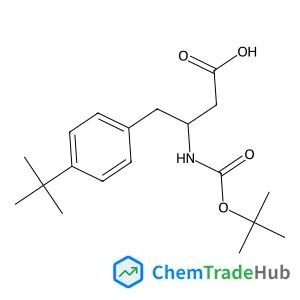
(S)-3-((tert-Butoxycarbonyl)amino)-4-(4-(tert-butyl)phenyl)butanoic acid
CAS Number:
403661-85-8
Molecular Formula:
C19H29NO4
Un-Hyok Kim
We report a theoretical study of the ion size effect on various properties in a soft nanochannel with pH-dependent charge density. We develop a free energy based mean-field theory taking into account the ion size as well as pH-dependence of a charged polyelectrolyte layer grafted on a rigid surface in an electrolyte. The influence of the ion size on properties in a soft nanochannel is evaluated by numerically calculating ion number densities and the electrostatic potential. We demonstrate that unlike in point-like ions, for finite sizes of ions, a uniform distribution of chargeable sites within the polyelectrolyte layer causes unphysical discontinuities in ion number densities not only for the hydrogen ion but also for other kinds of ions. It is shown that the same cubic spatial distribution of chargeable sites as for point-like ions is necessary to ensure continuity of the ion number density and zero ion transport at the polyelectrolyte layer–rigid solid interface. We find that considering finite ion size causes an increase in the electrostatic potential and electroosmotic velocity and a decrease in ion number densities. More importantly, we demonstrate that in the polyelectrolyte layer, the pH-dependence of the polyelectrolyte charge density makes accumulation of hydrogen ions stronger than for the other positive ion species in the electrolyte and such a tendency is further enhanced by considering finite ion size. In addition, we discuss how consideration of finite ion size affects the role of various parameters in electrostatic and electroosmotic properties.

Journal of Peptide Science

Chemical Communications

Organic Process Research & Development

Russian Journal of Coordination Chemistry

Russian Journal of Bioorganic Chemistry

Current Opinion in Solid State & Materials Science

Drug Discovery Today

Russian Journal of Applied Chemistry

Current Opinion in Colloid & Interface Science

Acta Materialia
Pravin S. Shirude, Liming Ying, Shankar Balasubramanian
DOI: 10.1039/B801465E
Szymon W. Przybylak, Floriana Tuna, Simon J. Teat, Richard E. P. Winpenny
DOI: 10.1039/B717277J
Veronica Gonzalez, Tom Wilson, Izumi Kurihara, Arata Imai, Jim A. Thomas, Joe Otsuki
DOI: 10.1039/B802073F
Peng Gao, Dirk Beckmann, Hoi Nok Tsao, Xinliang Feng, Volker Enkelmann, Wojciech Pisula, Klaus Müllen
DOI: 10.1039/B717608B
Suobo Zhang, Zhaohui Su
DOI: 10.1039/B801784K
Davide Pantarotto, Wesley R. Browne, Ben L. Feringa
DOI: 10.1039/B715310D
Yasuo Norikane, Ryuzi Katoh, Nobuyuki Tamaoki
DOI: 10.1039/B718813G
When handling 4-Methyl-6-(trifluoromethyl)quinoline (CAS: 40716-16-3), safety go...
4-(3,5-Difluorophenyl)aniline is an aromatic organic compound with the CAS numbe...
5-{[4-(Trifluoromethyl)phenyl]sulfanyl}-1,2,3-thiadiazole-4-carboxylic acid can ...
The market for 4-Benzylaniline hydrochloride (CAS: 6317-57-3) is steadily growin...
[3-(Diethylsulfamoyl)phenyl]boronic acid is generally considered safe when handl...
3-Bromo-2,5-dimethoxyaniline is mainly used in the pharmaceutical and chemical i...
N-Methyl-1-(5-methyl-1H-indol-3-yl)methanamine (CAS: 915922-67-7) is subject to ...
This compound is primarily used in the pharmaceutical industry for the synthesis...
2-Methyl-2-propanyl [(1S,3R)-3-aminocyclohexyl]carbamate (CAS: 1298101-47-9) sho...
Ethyl 2-bromo-4,4,4-trifluorobutanoate (CAS: 367-33-9) is utilized in the pharma...

Physical Chemistry Chemical Physics (PCCP) is an international journal co-owned by 19 physical chemistry and physics societies from around the world. This journal publishes original, cutting-edge research in physical chemistry, chemical physics and biophysical chemistry. To be suitable for publication in PCCP, articles must include significant innovation and/or insight into physical chemistry; this is the most important criterion that reviewers and Editors will judge against when evaluating submissions. The journal has a broad scope and welcomes contributions spanning experiment, theory, computation and data science. Topical coverage includes spectroscopy, dynamics, kinetics, statistical mechanics, thermodynamics, electrochemistry, catalysis, surface science, quantum mechanics, quantum computing and machine learning. Interdisciplinary research areas such as polymers and soft matter, materials, nanoscience, energy, surfaces/interfaces, and biophysical chemistry are welcomed if they demonstrate significant innovation and/or insight into physical chemistry. Joined experimental/theoretical studies are particularly appreciated when complementary and based on up-to-date approaches.
![N-{3-[Benzyl(methyl)amino]propyl}-9-chloro-5,6,7,8-tetrahydro-2-acridinecarboxamide structure](https://static.chemtradehub.com/structs/142/1426944-49-1-1e4c.webp "N-{3-[Benzyl(methyl)amino]propyl}-9-chloro-5,6,7,8-tetrahydro-2-acridinecarboxamide structure")
![6,7-Dihydro-5H-pyrrolo[1,2-a]imidazole-6-carboxylic acid structure](https://static.chemtradehub.com/structs/136/1369160-12-2-6524.webp "6,7-Dihydro-5H-pyrrolo[1,2-a]imidazole-6-carboxylic acid structure")



