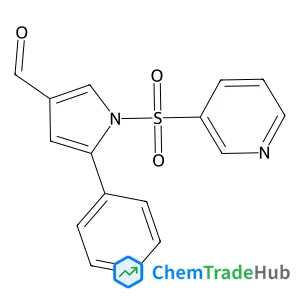
5-Phenyl-1-(pyridin-3-ylsulfonyl)-1H-pyrrole-3-carbaldehyde
CAS Number:
881676-90-0
Molecular Formula:
C16H12N2O3S
Vasilis Nikolaou, Fabian Plass, Aurélien Planchat, Asterios Charisiadis, Georgios Charalambidis, Panagiotis A. Angaridis, Fabrice Odobel, Athanassios G. Coutsolelos
Herein, the synthesis of three covalently linked donor–acceptor zinc porphyrin–fullerene (ZnP–C60) dyads (C60trZnPCOOH, C60trZnPtrCOOH and C60ZnPCOOH) is described, and their application as sensitizers in NiO-based dye-sensitized solar cells (DSCs) is discussed. To the best of our knowledge, this is the first example where covalently linked ZnP–C60 dyads have been used as chromophores in NiO-based DSCs. In an effort to examine whether the distance of the chromophore from the electron acceptor entity and/or the NiO surface affects the performance of the cells, a triazole ring was introduced as a spacer between ZnP and the two peripheral units C60 and –COOH. The triazole ring was inserted between ZnP and C60 in dyad C60trZnPCOOH, whereas both the anchoring group and C60 were connected to ZnP through triazole spacers in C60trZnPtrCOOH, and dyad C60ZnPCOOH did not contain any triazole linker. Photophysical investigation performed by ultrafast transient absorption spectroscopy in solution and on the NiO surface demonstrated that all the porphyrin–fullerene dyads exhibited long-lived charge-separated states due to electron shifts from the reduced porphyrin core to C60. The transient experiments performed in solution showed that the presence of triazole ring influenced the photophysical properties of the dyads C60trZnPCOOH and C60trZnPtrCOOH and in particular, increased the lifetime of the charge-separated states compared to that of the C60ZnPCOOH dyad. On the other hand, the corresponding studies on the NiO surface proved that the triazole spacer has a rather moderate impact on the charge separation (NiO–ZnP˙+–C60˙−) and charge recombination (NiO–3*ZnP–C60) rate constants. All three dyads exhibited enhanced performance in terms of photovoltaic measurements with more than threefold increase compared to the reference compound PhtrZnPCOOH in which the C60 acceptor is absent. Two different electrolytes were examined (I3−/I− and CoIII/II) and in most cases, the presence of the triazole ring enhanced their photovoltaic performance. The best performing dyad in I3−/I− was C60trZnPCOOH (PCE = 0.076%); in CoIII/II, the best performing dyad was C60trZnPtrCOOH (PCE = 0.074%).
Daly Davis, Y. Sajeev
DOI: 10.1039/C6CP05480C
Asmita Gupta, Manju Bansal
DOI: 10.1039/C6CP04617G
David R. Bell, Rui Qi, Zhifeng Jing, Jin Yu Xiang, Christopher Mejias, Michael J. Schnieders, Jay W. Ponder, Pengyu Ren
DOI: 10.1039/C6CP02509A
Yong Seok Hwang, Valery I. Levitas
DOI: 10.1039/C6CP03897B
Ian J. Nessler, Jacob M. Litman
DOI: 10.1039/C6CP02595A
Andrew G. Stack, Jose M. Borreguero, Timothy R. Prisk, Eugene Mamontov, Hsiu-Wen Wang, Lukas Vlcek, David J. Wesolowski
DOI: 10.1039/C6CP05836A
Masashi Tsuge, Mohammed Bahou, Yu-Jong Wu, Louis Allamandola
DOI: 10.1039/C6CP05701B
Frank Uhlig, Tihomir Solomun, Jens Smiatek
DOI: 10.1039/C6CP05417J
Carl P. Romao
DOI: 10.1039/C6CP06356J
When considering alternatives to 1-(4-Chlorophenyl)-N-hydroxymethanimine (CAS: 3...
This compound should be stored in a cool, dry place away from direct sunlight. I...
3-(4-Bromophenyl)-5-(2-fluorophenyl)-1,2,4-oxadiazole is synthesized through a m...
5-Chloro-2-(4-chlorophenyl)-4-methyl-6-[3-(1-piperidinyl)propoxy]pyrimidine (CAS...
2-Chloro-4-(difluoromethoxy)pyridine is used in the pharmaceutical industry for ...
3-Chloro-6-methylpyridazine (CAS: 1121-79-5) is classified under the Globally Ha...
Several alternatives can be used in the synthesis of Methyl 4,5-dimethyl-2-nitro...
Alternatives to (2E,2'E)-3,3'-(1,4-Phenylene)bisacrylaldehyde include other acry...
3-Amino-5-chloropyridin-2-ol hydrochloride is an organic compound with the CAS n...
When handling 6,7-Difluoro-2,3-dihydro-4H-chromen-4-one, it is essential to wear...

Physical Chemistry Chemical Physics (PCCP) is an international journal co-owned by 19 physical chemistry and physics societies from around the world. This journal publishes original, cutting-edge research in physical chemistry, chemical physics and biophysical chemistry. To be suitable for publication in PCCP, articles must include significant innovation and/or insight into physical chemistry; this is the most important criterion that reviewers and Editors will judge against when evaluating submissions. The journal has a broad scope and welcomes contributions spanning experiment, theory, computation and data science. Topical coverage includes spectroscopy, dynamics, kinetics, statistical mechanics, thermodynamics, electrochemistry, catalysis, surface science, quantum mechanics, quantum computing and machine learning. Interdisciplinary research areas such as polymers and soft matter, materials, nanoscience, energy, surfaces/interfaces, and biophysical chemistry are welcomed if they demonstrate significant innovation and/or insight into physical chemistry. Joined experimental/theoretical studies are particularly appreciated when complementary and based on up-to-date approaches.