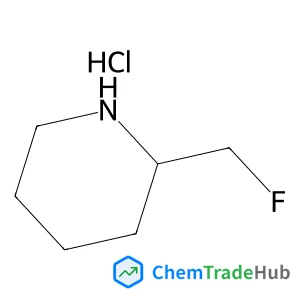
(2S)-2-(Fluoromethyl)piperidine hydrochloride (1:1)
CAS Number:
886216-73-5
Molecular Formula:
C6H13ClFN
Pure methane (CH4) ices processed by energetic electrons under ultra-high vacuum conditions to simulate secondary electrons formed via galactic cosmic rays (GCRs) penetrating interstellar ice mantles have been shown to produce an array of complex hydrocarbons with the general formulae: CnH2n+2 (n = 4–8), CnH2n (n = 3–9), CnH2n−2 (n = 3–9), CnH2n−4 (n = 4–9), and CnH2n−6 (n = 6–7). By monitoring the in situ chemical evolution of the ice combined with temperature programmed desorption (TPD) studies and tunable single photon ionization coupled to a reflectron time-of-flight mass spectrometer, specific isomers of C3H4, C3H6, C4H4, and C4H6 were probed. These experiments confirmed the synthesis of methylacetylene (CH3CCH), propene (CH3CHCH2), cyclopropane (c-C3H6), vinylacetylene (CH2CHCCH), 1-butyne (HCCC2H5), 2-butyne (CH3CCCH3), 1,2-butadiene (H2CCCH(CH3)), and 1,3-butadiene (CH2CHCHCH2) with yields of 2.17 ± 0.95 × 10⁻⁴, 3.7 ± 1.5 × 10⁻³, 1.23 ± 0.77 × 10⁻⁴, 1.28 ± 0.65 × 10⁻⁴, 4.01 ± 1.98 × 10⁻⁵, 1.97 ± 0.98 × 10⁻⁴, 1.90 ± 0.84 × 10⁻⁵, and 1.41 ± 0.72 × 10⁻⁴ molecules eV−1, respectively. Mechanistic studies exploring the formation routes of methylacetylene, propene, and vinylacetylene were also conducted, and revealed the additional formation of the 1,2,3-butatriene isomer. Several of the above isomers, methylacetylene, propene, vinylacetylene, and 1,3-butadiene, have repeatedly been shown to be important precursors in the formation of polycyclic aromatic hydrocarbons (PAHs), but until now their interstellar synthesis has remained elusive.
Peter B. Hitchcock, Gareth J. Rowlands, Rakesh Parmar
DOI: 10.1039/B507394D
Jean-Paul Lellouche, Senthil Govindaraji, Augustine Joseph, Jyongsik Jang, Kyung Jin Lee
DOI: 10.1039/B502483H
Yanfei Shen, Yuanjian Zhang, Qixian Zhang, Tianyan You, Ari Ivaska
DOI: 10.1039/B507688A
Frank Hauke, Andrew J. Myles, Julius Rebek Jr.
DOI: 10.1039/B506048F
Nagendra K. Sharma, Krishna N. Ganesh
DOI: 10.1039/B506870C
Patrick J. Hrdlicka, T. Santhosh Kumar, Jesper Wengel
DOI: 10.1039/B506986F
Katsuhiro Maeda, Yasuaki Matsushita, Muneyoshi Ezaka
DOI: 10.1039/B507863F
James J. Murphy, Kotohiro Nomura
DOI: 10.1039/B506877K
Jing Yang, Daniel Lévy, Wei Deng, Patrick Keller, Min-Hui Li
DOI: 10.1039/B508034G
Waste containing N-Methoxy-N-methyl-1,3-thiazole-5-carboxamide (CAS: 898825-89-3...
N-(4-Biphenylyl)dibenzo[b,d]furan-4-amine should be stored in a tightly sealed c...
The market for 3-Acetamido-5-amino-2,4,6-triiodobenzoic acid (CAS: 1713-07-1) is...
Benzyl 2-O-acetyl-3,4,6-tri-O-benzyl-beta-D-galactopyranoside (CAS: 61820-03-9) ...
2-Ethylpiperazine dihydrochloride (CAS: 438050-52-3) is regulated under the Glob...
1,1'-[1,3-Phenylenebis(methylene)]bis(3-methyl-1H-pyrrole-2,5-dione) (CAS: 11946...
Several alternatives can be used in the synthesis of 5-Fluoro-2-(1-pyrrolidinyl)...
Proper personal protective equipment (PPE) must be worn when handling this compo...
When handling 6-Bromoimidazo[1,2-a]pyridin-8-amine, it is important to wear appr...
Alternatives to (2S,4R)-4-(4-Nitrobenzyl)pyrrolidine-2-carboxylic acid hydrochlo...

Physical Chemistry Chemical Physics (PCCP) is an international journal co-owned by 19 physical chemistry and physics societies from around the world. This journal publishes original, cutting-edge research in physical chemistry, chemical physics and biophysical chemistry. To be suitable for publication in PCCP, articles must include significant innovation and/or insight into physical chemistry; this is the most important criterion that reviewers and Editors will judge against when evaluating submissions. The journal has a broad scope and welcomes contributions spanning experiment, theory, computation and data science. Topical coverage includes spectroscopy, dynamics, kinetics, statistical mechanics, thermodynamics, electrochemistry, catalysis, surface science, quantum mechanics, quantum computing and machine learning. Interdisciplinary research areas such as polymers and soft matter, materials, nanoscience, energy, surfaces/interfaces, and biophysical chemistry are welcomed if they demonstrate significant innovation and/or insight into physical chemistry. Joined experimental/theoretical studies are particularly appreciated when complementary and based on up-to-date approaches.
![4-[(2-{2-[2-(2-Aminoethoxy)ethoxy]ethoxy}ethyl)amino]-2-(2,6-dioxo-3-piperidinyl)-1H-isoindole-1,3(2H)-dione structure](https://static.chemtradehub.com/structs/209/2093416-31-8-3162.webp "4-[(2-{2-[2-(2-Aminoethoxy)ethoxy]ethoxy}ethyl)amino]-2-(2,6-dioxo-3-piperidinyl)-1H-isoindole-1,3(2H)-dione structure")
![[5-fluoro-2-(morpholine-4-carbonyl)phenyl]boronic acid structure](https://static.chemtradehub.com/structs/121/1217501-26-2-505c.webp "[5-fluoro-2-(morpholine-4-carbonyl)phenyl]boronic acid structure")