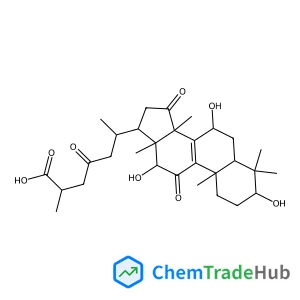
(3beta,7beta,12beta)-3,7,12-Trihydroxy-11,15,23-trioxolanost-8-en-26-oic acid
CAS Number:
98665-22-6
Molecular Formula:
C30H44O8
Malte Döntgen, Brandon Rotavera, Rebecca L. Caravan, Oliver Welz, John D. Savee, David L. Osborn, Dudley E. Shallcross, Carl J. Percival, Craig A. Taatjes
Methyl vinyl ketone (MVK) and methacrolein (MACR) are important intermediate products in atmospheric degradation of volatile organic compounds, especially of isoprene. This work investigates the reactions of the smallest Criegee intermediate, CH2OO, with its co-products from isoprene ozonolysis, MVK and MACR, using multiplexed photoionization mass spectrometry (MPIMS), with either tunable synchrotron radiation from the Advanced Light Source or Lyman-α (10.2 eV) radiation for photoionization. CH2OO was produced via pulsed laser photolysis of CH2I2 in the presence of excess O2. Time-resolved measurements of reactant disappearance and of product formation were performed to monitor reaction progress; first order rate coefficients were obtained from exponential fits to the CH2OO decays. The bimolecular reaction rate coefficients at 300 K and 4 Torr are k(CH2OO + MVK) = (5.0 ± 0.4) × 10−13 cm3 s−1 and k(CH2OO + MACR) = (4.4 ± 1.0) × 10−13 cm3 s−1, where the stated ±2σ uncertainties are statistical uncertainties. Adduct formation is observed for both reactions and is attributed to the formation of a secondary ozonides (1,2,4-trioxolanes), supported by master equation calculations of the kinetics and the agreement between measured and calculated adiabatic ionization energies. Kinetics measurements were also performed for a possible bimolecular CH2OO + CO reaction and for the reaction of CH2OO with CF3CHCH2 at 300 K and 4 Torr. For CH2OO + CO, no reaction is observed and an upper limit is determined: k(CH2OO + CO) < 2 × 10⁻¹⁶ cm3 s−1. For CH2OO + CF3CHCH2, an upper limit of k(CH2OO + CF3CHCH2) < 2 × 10⁻¹⁴ cm3 s−1 is obtained.
Xian Wang, Quan-Lan Liao, Shuai Zhao, Wei-Hua Huang, Yu-Qi Feng
DOI: 10.1039/C9AN01566C
Claire V. Crowther, Viola Sanderlin, Mark A. Hayes, Gillian H. Gile
DOI: 10.1039/C9AN01186B
Yuan Yu, Jie Shen, Jinfang Zhi
DOI: 10.1039/C5AN02478A
Bartolomeo Della Ventura, Martina Banchelli, Riccardo Funari, Anna Illiano, Marella De Angelis, Paola Taroni, Angela Amoresano, Paolo Matteini, Raffaele Velotta
DOI: 10.1039/C9AN00443B
Madalena C. C. Areias, Kenichi Shimizu, Richard G. Compton
DOI: 10.1039/C6AN00550K
Xiao Fan, Qiaoli Yue, Yanyan Li, Yingya Liu, Lu-Lu Qu, Yingnan Cao
DOI: 10.1039/C5AN02543E
Hiroki Segawa, Takao Fukuoka, Tamitake Itoh, Yuichi Imai, Yuko T. Iwata, Tadashi Yamamuro, Kenji Kuwayama, Kenji Tsujikawa, Tatsuyuki Kanamori, Hiroyuki Inoue
DOI: 10.1039/C9AN01512D
Han Zhao, Ying Yan, Mingjian Chen, Tingting Hu, Kefeng Wu, Haisheng Liu, Changbei Ma
DOI: 10.1039/C9AN01659G
Xia Cheng, Caili Xu, Qian Chen, Yi Wang, Yun Zhang, Guangyin Fan
DOI: 10.1039/C9AN01480B
Fubing Xiao, Hui Tan, Yan Wu, Shuzhen Liao, Zhaoyang Wu, Guoli Shen, Ruqin Yu
DOI: 10.1039/C6AN00504G
When handling 4-(2-Furylmethyl)thiomorpholine 1,1-dioxide (CAS: 79206-94-3), it ...
When handling 4-Chloro-N-[2-(4-morpholinyl)ethyl]benzamide (CAS: 71320-77-9), it...
Waste containing this compound (CAS: 62921-74-8) should be handled according to ...
Waste containing (S)-Methyl 2-amino-3-cyclohexylpropanoate should be collected i...
This compound can be synthesized using a multi-step process involving the conjug...
There are several alternatives to (2E)-3-(3,4-Dichlorophenyl)acrylic acid in syn...
Ethyl 6-(2-nitrophenyl)imidazo[2,1-b][1,3]thiazole-3-carboxylate (CAS: 925437-84...
Waste containing 2-(1,3-Thiazol-2-yl)ethanamine (CAS: 18453-07-1) should be coll...
Methyl 5-iodo-2-methylbenzoate can be synthesized through the iodination of meth...
5-Chloro[1,2,4]triazolo[1,5-a]pyridine is commonly synthesized via the condensat...

Physical Chemistry Chemical Physics (PCCP) is an international journal co-owned by 19 physical chemistry and physics societies from around the world. This journal publishes original, cutting-edge research in physical chemistry, chemical physics and biophysical chemistry. To be suitable for publication in PCCP, articles must include significant innovation and/or insight into physical chemistry; this is the most important criterion that reviewers and Editors will judge against when evaluating submissions. The journal has a broad scope and welcomes contributions spanning experiment, theory, computation and data science. Topical coverage includes spectroscopy, dynamics, kinetics, statistical mechanics, thermodynamics, electrochemistry, catalysis, surface science, quantum mechanics, quantum computing and machine learning. Interdisciplinary research areas such as polymers and soft matter, materials, nanoscience, energy, surfaces/interfaces, and biophysical chemistry are welcomed if they demonstrate significant innovation and/or insight into physical chemistry. Joined experimental/theoretical studies are particularly appreciated when complementary and based on up-to-date approaches.