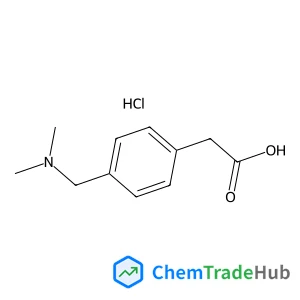
4-(Dimethylaminomethyl)phenylacetic acid hydrochloride
CAS Number:
99985-52-1
Molecular Formula:
C11H16ClNO2
Sandra C.C. Nunes, Tânia F. G. G. Cova, Rita S. Dias, Alberto A. C. C. Pais
Adsorption of polyions onto charged surfaces has long been recognized as a crucial phenomenon in biological and technological applications. An intuitive model relating polyelectrolyte adsorption with the imposed features of polarizable surfaces of different compositions and charges is proposed based on Monte Carlo simulations using a coarse-grained approach. The excellent performance of the equation allows simultaneously describing a wide range of adsorption regimes and accounting for specific non-monotonic trends. For a constant surface charge density, the surface composition governs adsorption, promoting variations exceeding 100%. Adsorption increases with the number of attractive charges in the surface until reaching a maximum, decreasing thereafter due to the presence of polyanion-like charged particles. The presence of crowders hampers adsorption. These results can be used to efficiently predict and modulate the interaction between charged macromolecules and different substrates with direct implications in de novo designs of vehicles and biomedical devices.

Environmental Toxicology and Pharmacology

Journal of Enzyme inhibition and Medicinal Chemistry

Mini-Reviews in Medicinal Chemistry

European Journal of Organic Chemistry

Faraday Discussions

Green Chemistry

Coloration Technology

Current Pharmaceutical Biotechnology

Physical Chemistry Chemical Physics

Photochemical & Photobiological Sciences
Lilian K. Ellis-Gibbings, William G. Fortune, Bridgette Cooper, Jonathan Tennyson, Stephen D. Price
DOI: 10.1039/D1CP01328A
Xiaoqian Qiu, Yiren Wang, Yong Jiang
DOI: 10.1039/D1CP00156F
Ryuta X. Suzuki, Hikari Tada, Sae Hirano, Takahiko Ban, Manoranjan Mishra, Risa Takeda, Yuichiro Nagatsu
DOI: 10.1039/D0CP05810F
Hyungshick Park, Chung Bin Park, Bong June Sung
DOI: 10.1039/D1CP00952D
Andres Jaramillo-Botero, Xue-hai Ju, William A. Goddard, III
DOI: 10.1039/D0CP05767C
Lauri Partanen, Simon Alberti, Kari Laasonen
DOI: 10.1039/D1CP00684C
Jan Valenta, Michael Greben, Goutam Pramanik, Petr Cigler
DOI: 10.1039/D0CP06467J
Ren-Hao Cheng, Honghao Cai, Yu-Ren Huang, Xiaohong Cui, Zhong Chen, Hsuan-Ying Chen, Shangwu Ding
DOI: 10.1039/C9CP05978D
DOI: 10.1039/D1CP01254A
Mariah L. Parker, Jiwen Jian, John K. Gibson
DOI: 10.1039/D1CP01362A
Waste containing N-Methoxy-N-methyl-1,3-thiazole-5-carboxamide (CAS: 898825-89-3...
N-(4-Biphenylyl)dibenzo[b,d]furan-4-amine should be stored in a tightly sealed c...
The market for 3-Acetamido-5-amino-2,4,6-triiodobenzoic acid (CAS: 1713-07-1) is...
Benzyl 2-O-acetyl-3,4,6-tri-O-benzyl-beta-D-galactopyranoside (CAS: 61820-03-9) ...
2-Ethylpiperazine dihydrochloride (CAS: 438050-52-3) is regulated under the Glob...
1,1'-[1,3-Phenylenebis(methylene)]bis(3-methyl-1H-pyrrole-2,5-dione) (CAS: 11946...
Several alternatives can be used in the synthesis of 5-Fluoro-2-(1-pyrrolidinyl)...
Proper personal protective equipment (PPE) must be worn when handling this compo...
When handling 6-Bromoimidazo[1,2-a]pyridin-8-amine, it is important to wear appr...
Alternatives to (2S,4R)-4-(4-Nitrobenzyl)pyrrolidine-2-carboxylic acid hydrochlo...
Physical Chemistry Chemical Physics (PCCP) is an international journal co-owned by 19 physical chemistry and physics societies from around the world. This journal publishes original, cutting-edge research in physical chemistry, chemical physics and biophysical chemistry. To be suitable for publication in PCCP, articles must include significant innovation and/or insight into physical chemistry; this is the most important criterion that reviewers and Editors will judge against when evaluating submissions. The journal has a broad scope and welcomes contributions spanning experiment, theory, computation and data science. Topical coverage includes spectroscopy, dynamics, kinetics, statistical mechanics, thermodynamics, electrochemistry, catalysis, surface science, quantum mechanics, quantum computing and machine learning. Interdisciplinary research areas such as polymers and soft matter, materials, nanoscience, energy, surfaces/interfaces, and biophysical chemistry are welcomed if they demonstrate significant innovation and/or insight into physical chemistry. Joined experimental/theoretical studies are particularly appreciated when complementary and based on up-to-date approaches.