












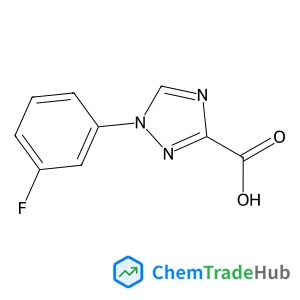
1-(3-Fluorophenyl)-1H-1,2,4-triazole-3-carboxylic acid
CAS Number:
1292369-51-7
Molecular Formula:
C9H6FN3O2
Hyungshick Park, Chung Bin Park, Bong June Sung
Organic ionic plastic crystals (OIPCs) are the crystals of electrolytes with a long-range translational order. The rotational modes of ions in OIPCs are, however, activated even in solid phases such that the diffusion of dopants such as lithium ions may be facilitated. OIPCs have been, therefore, considered as good candidates for solid electrolytes. Recent experiments and theoretical studies have suggested that both the translational and the rotational diffusion of ions are quite heterogeneous: the diffusion of some ions are quite fast while other ions of the same kind hardly diffuse, either rotationally or translationally. Such dynamic heterogeneity would be a key to the transport mechanism of dopants in solid state electrolytes. In this work, we investigate the effects of defects on the dynamic heterogeneity of OIPCs. We perform atomistic molecular dynamics simulation of 1,3-dimethylimidazolium hexafluorophosphate ([MMIM][PF6]) with a pair of cation and anion vacancies. At low temperature, vacancies undergo hopping motions toward each other and form a charge-neutral cluster. At high temperature, two vacancies act like a loosely bonded molecule and diffuse together via hopping motions. We find that the translational diffusion of ions is correlated strongly with the vacancy diffusion and becomes heterogeneous when the vacancies hop. The rotation of ions also becomes active when the ions are close to vacancies such that the rotational dynamic heterogeneity strengthens.
Hyuksang Kwon, Junhee Hahn
DOI: 10.1039/C5CP04207K
DOI: 10.1039/C6CP03044K
Mark T. Sims, Laurence C. Abbott, Stephen J. Cowling, John W. Goodby, John N. Moore
DOI: 10.1039/C6CP03823A
Ting Gao, Wen-Juan Tian, Hui Bai, Su-Yan Zhang, Hai-Ru Li, Chang-Qing Miao, Yue-Wen Mu, Hai-Gang Lu, Si-Dian Li
DOI: 10.1039/C5CP03178H
Shogo Amemori, Nobuo Kimizuka
DOI: 10.1039/C5CP02733K
A. Maxut, B. Nozière, B. Fenet, H. Mechakra
DOI: 10.1039/C5CP03113C
Chandan Sahu, Deepanwita Ghosh, Kaushik Sen, Abhijit K. Das
DOI: 10.1039/C5CP02442K
Sara Laporte, Fabio Finocchi, Lorenzo Paulatto, Marc Blanchard, Etienne Balan, François Guyot, Antonino Marco Saitta
DOI: 10.1039/C5CP02097B
Chunshuang Yan, Gang Chen, Jingxue Sun, Xin Zhou, Chade Lv
DOI: 10.1039/C6CP02660E
DOI: 10.1039/C6CP02830F
Waste containing N-Methoxy-N-methyl-1,3-thiazole-5-carboxamide (CAS: 898825-89-3...
N-(4-Biphenylyl)dibenzo[b,d]furan-4-amine should be stored in a tightly sealed c...
The market for 3-Acetamido-5-amino-2,4,6-triiodobenzoic acid (CAS: 1713-07-1) is...
Benzyl 2-O-acetyl-3,4,6-tri-O-benzyl-beta-D-galactopyranoside (CAS: 61820-03-9) ...
2-Ethylpiperazine dihydrochloride (CAS: 438050-52-3) is regulated under the Glob...
1,1'-[1,3-Phenylenebis(methylene)]bis(3-methyl-1H-pyrrole-2,5-dione) (CAS: 11946...
Several alternatives can be used in the synthesis of 5-Fluoro-2-(1-pyrrolidinyl)...
Proper personal protective equipment (PPE) must be worn when handling this compo...
When handling 6-Bromoimidazo[1,2-a]pyridin-8-amine, it is important to wear appr...
Alternatives to (2S,4R)-4-(4-Nitrobenzyl)pyrrolidine-2-carboxylic acid hydrochlo...

Physical Chemistry Chemical Physics (PCCP) is an international journal co-owned by 19 physical chemistry and physics societies from around the world. This journal publishes original, cutting-edge research in physical chemistry, chemical physics and biophysical chemistry. To be suitable for publication in PCCP, articles must include significant innovation and/or insight into physical chemistry; this is the most important criterion that reviewers and Editors will judge against when evaluating submissions. The journal has a broad scope and welcomes contributions spanning experiment, theory, computation and data science. Topical coverage includes spectroscopy, dynamics, kinetics, statistical mechanics, thermodynamics, electrochemistry, catalysis, surface science, quantum mechanics, quantum computing and machine learning. Interdisciplinary research areas such as polymers and soft matter, materials, nanoscience, energy, surfaces/interfaces, and biophysical chemistry are welcomed if they demonstrate significant innovation and/or insight into physical chemistry. Joined experimental/theoretical studies are particularly appreciated when complementary and based on up-to-date approaches.
![4-Chloro-2-{[(2-chlorophenoxy)acetyl]amino}benzoic acid structure](https://static.chemtradehub.com/structs/351/351424-20-9-9467.webp "4-Chloro-2-{[(2-chlorophenoxy)acetyl]amino}benzoic acid structure")
![2-Methylbenzo[h]quinoline structure](https://static.chemtradehub.com/structs/605/605-88-9-ac43.webp "2-Methylbenzo[h]quinoline structure")




