












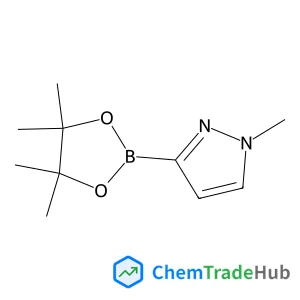
1-Methyl-3-(4,4,5,5-tetramethyl-1,3,2-dioxaborolan-2-yl)-1H-pyrazole
CAS Number:
1020174-04-2
Molecular Formula:
C10H17BN2O2
Alberto Monteiro Dos Santos, Lorenzo Cianni, Daniela De Vita, Fabiana Rosini, Andrei Leitão, Charles A. Laughton, Jerônimo Lameira, Carlos A. Montanari
Chagas disease affects millions of people in Latin America. This disease is caused by the protozoan parasite Trypanossoma cruzi. The cysteine protease cruzain is a key enzyme for the survival and propagation of this parasite lifecycle. Nitrile-based inhibitors are efficient inhibitors of cruzain that bind by forming a covalent bond with this enzyme. Here, three nitrile-based inhibitors dubbed Neq0409, Neq0410 and Neq0570 were synthesized, and the thermodynamic profile of the bimolecular interaction with cruzain was determined using isothermal titration calorimetry (ITC). The result suggests the inhibition process is enthalpy driven, with a detrimental contribution of entropy. In addition, we have used hybrid Quantum Mechanical/Molecular Mechanical (QM/MM) and Molecular Dynamics (MD) simulations to investigate the reaction mechanism of reversible covalent modification of cruzain by Neq0409, Neq0410 and Neq0570. The computed free energy profile shows that the nucleophilic attack of Cys25 on the carbon C1 of inhibitiors and the proton transfer from His162 to N1 of the dipeptidyl nitrile inhibitor take place in a single step. The calculated free energy of the inhibiton reaction is in agreement with covalent experimental binding. Altogether, the results reported here suggests that nitrile-based inhibitors are good candidates for the development of reversible covalent inhibitors of cruzain and other cysteine proteases.
V. Prakash Reddy, Ramesh Alleti, Meher K. Perambuduru, Urs Welz-Biermann, Herwig Buchholz, G. K. Surya Prakash
DOI: 10.1039/B414254C
Albert Escuer, Franz A. Mautner, Mohamed A. S. Goher, Morsy A. M. Abu-Youssef, Ramon Vicente
DOI: 10.1039/B413665A
Derrick L. J. Clive, Maolin Yu, Zhiyong Li
DOI: 10.1039/B413481H
Eunice L. P. Tan, Resmi C. Panicker
DOI: 10.1039/B415506H
Nakia Maulucci, Francesco De Riccardis, Cinzia Barbara Botta, Agostino Casapullo, Elena Cressina, Massimo Fregonese, Paolo Tecilla, Irene Izzo
DOI: 10.1039/B415908J
Shuwei Li, Nishanth Marthandan, Dawn Bowerman, Harold R. Garner, Thomas Kodadek
DOI: 10.1039/B415578E
Delphine Faure, Julien Gravier, Thomas Labrot, Bernard Desbat, Reiko Oda, Dario M. Bassani
DOI: 10.1039/B416287K
Stephan Müller
DOI: 10.1039/B413616K
M. Carmen Carreño, M. Jesús Sanz-Cuesta, María Ribagorda
DOI: 10.1039/B414666B
When handling 4-(2-Furylmethyl)thiomorpholine 1,1-dioxide (CAS: 79206-94-3), it ...
When handling 4-Chloro-N-[2-(4-morpholinyl)ethyl]benzamide (CAS: 71320-77-9), it...
Waste containing this compound (CAS: 62921-74-8) should be handled according to ...
Waste containing (S)-Methyl 2-amino-3-cyclohexylpropanoate should be collected i...
This compound can be synthesized using a multi-step process involving the conjug...
There are several alternatives to (2E)-3-(3,4-Dichlorophenyl)acrylic acid in syn...
Ethyl 6-(2-nitrophenyl)imidazo[2,1-b][1,3]thiazole-3-carboxylate (CAS: 925437-84...
Waste containing 2-(1,3-Thiazol-2-yl)ethanamine (CAS: 18453-07-1) should be coll...
Methyl 5-iodo-2-methylbenzoate can be synthesized through the iodination of meth...
5-Chloro[1,2,4]triazolo[1,5-a]pyridine is commonly synthesized via the condensat...

Physical Chemistry Chemical Physics (PCCP) is an international journal co-owned by 19 physical chemistry and physics societies from around the world. This journal publishes original, cutting-edge research in physical chemistry, chemical physics and biophysical chemistry. To be suitable for publication in PCCP, articles must include significant innovation and/or insight into physical chemistry; this is the most important criterion that reviewers and Editors will judge against when evaluating submissions. The journal has a broad scope and welcomes contributions spanning experiment, theory, computation and data science. Topical coverage includes spectroscopy, dynamics, kinetics, statistical mechanics, thermodynamics, electrochemistry, catalysis, surface science, quantum mechanics, quantum computing and machine learning. Interdisciplinary research areas such as polymers and soft matter, materials, nanoscience, energy, surfaces/interfaces, and biophysical chemistry are welcomed if they demonstrate significant innovation and/or insight into physical chemistry. Joined experimental/theoretical studies are particularly appreciated when complementary and based on up-to-date approaches.



![1,2-Diphenyl-4-[2-(phenylsulfinyl)ethyl]-3,5-pyrazolidinedione structure](https://static.chemtradehub.com/structs/57-/57-96-5-efcc.webp "1,2-Diphenyl-4-[2-(phenylsulfinyl)ethyl]-3,5-pyrazolidinedione structure")




