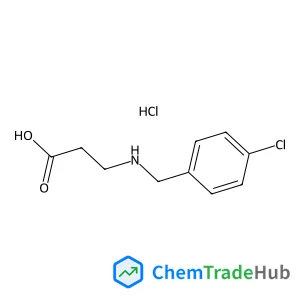
N-(4-Chlorobenzyl)-beta-alanine hydrochloride (1:1)
CAS Number:
1172479-10-5
Molecular Formula:
C10H13Cl2NO2
Aleksander P. Stupak, Thomas Blaudeck, Eduard I. Zenkevich, Stefan Krause, Christian von Borczyskowski
Nanoassemblies formed via self-assembly based on colloidal CdSe quantum dots (QDs) and porphyrin (H2P) dye molecules show Fluorescence Resonant Energy Transfer (FRET) and non-FRET quenching of QD photoluminescence (PL). We present a procedure to unravel and quantify these two relaxation pathways via dynamic and static PL quenching experiments. Accordingly, FRET amounts at maximum to 10% of the total quenching efficiency. Since the degree of ligand coverage is inhomogeneously distributed across the QD ensemble PL quantum yields vary broadly. The attachment of H2P molecules occurs preferentially to those QDs with low ligand coverage. Along with that, nanoassembly formation deviates strongly from Poisson statistics. Like FRET, non-FRET depends on the QD size. We assign non-FRET quenching to the formation of specific new Cd2+ trap states following depletion of several ligands by the spacious dye molecules. While FRET follows quantitatively the Förster model, non-FRET appears on time scales of 1–3 ns in new and enhanced non-radiative near-band-edge QD PL decay channels caused by a trapping of the electrons in long-lived intra-gap states which then manifests itself in a subsequent weak PL emission. We assign the related intra-band emission to a recombination of deep-trap electrons and shallow-trap holes.

Critical Reviews in Solid State and Materials Sciences

Acta Metallurgica Sinica-English Letters

Biocatalysis and Biotransformation

Journal of the Indian Institute of Science

Medicinal Chemistry Research

NDT & E International

Bioorganic & Medicinal Chemistry

Main Group Chemistry

Journal of Asian Natural Products Research

Colloid Journal
Jun Huang, Tao Jiang, Buxing Han, Haixiang Gao, Yanhong Chang, Guoying Zhao, Weize Wu
DOI: 10.1039/B302750C
Jie-Peng Zhang, Yan-Yong Lin, Xiao-Lan Yu, Xiao-Ming Chen
DOI: 10.1039/B401691B
Sandro Fracasso, Sebastiano Campagna, Scolastica Serroni, Rama Konduri, Frederick M. MacDonnell
DOI: 10.1039/B302962J
Stephanie A. Bejune, David R. McMillin
DOI: 10.1039/B402330G
Pankaj Pathak, Mohammed J. Meziani, Yin Li, LaShonda T. Cureton, Ya-Ping Sun
DOI: 10.1039/B400326H
Soon Bong Park, Howard Alper
DOI: 10.1039/B402477J
Yoko Tanaka, Masaru Yamashita
DOI: 10.1039/B402427C
Andrew P. Jarvis, Jürgen Liebig, Bert Hölldobler
DOI: 10.1039/B403186E
Xunjin Zhu, Wai-Kwok Wong, Wing-Kit Lo, Wai-Yeung Wong
DOI: 10.1039/B415609A
Karim M. Awenat, Philip J. Davis, Mark G. Moloney, Warren Ebenezer
DOI: 10.1039/B414856H
Waste containing N-Methoxy-N-methyl-1,3-thiazole-5-carboxamide (CAS: 898825-89-3...
N-(4-Biphenylyl)dibenzo[b,d]furan-4-amine should be stored in a tightly sealed c...
The market for 3-Acetamido-5-amino-2,4,6-triiodobenzoic acid (CAS: 1713-07-1) is...
Benzyl 2-O-acetyl-3,4,6-tri-O-benzyl-beta-D-galactopyranoside (CAS: 61820-03-9) ...
2-Ethylpiperazine dihydrochloride (CAS: 438050-52-3) is regulated under the Glob...
1,1'-[1,3-Phenylenebis(methylene)]bis(3-methyl-1H-pyrrole-2,5-dione) (CAS: 11946...
Several alternatives can be used in the synthesis of 5-Fluoro-2-(1-pyrrolidinyl)...
Proper personal protective equipment (PPE) must be worn when handling this compo...
When handling 6-Bromoimidazo[1,2-a]pyridin-8-amine, it is important to wear appr...
Alternatives to (2S,4R)-4-(4-Nitrobenzyl)pyrrolidine-2-carboxylic acid hydrochlo...

Physical Chemistry Chemical Physics (PCCP) is an international journal co-owned by 19 physical chemistry and physics societies from around the world. This journal publishes original, cutting-edge research in physical chemistry, chemical physics and biophysical chemistry. To be suitable for publication in PCCP, articles must include significant innovation and/or insight into physical chemistry; this is the most important criterion that reviewers and Editors will judge against when evaluating submissions. The journal has a broad scope and welcomes contributions spanning experiment, theory, computation and data science. Topical coverage includes spectroscopy, dynamics, kinetics, statistical mechanics, thermodynamics, electrochemistry, catalysis, surface science, quantum mechanics, quantum computing and machine learning. Interdisciplinary research areas such as polymers and soft matter, materials, nanoscience, energy, surfaces/interfaces, and biophysical chemistry are welcomed if they demonstrate significant innovation and/or insight into physical chemistry. Joined experimental/theoretical studies are particularly appreciated when complementary and based on up-to-date approaches.
![4-Chloro-2-{[(2-chlorophenoxy)acetyl]amino}benzoic acid structure](https://static.chemtradehub.com/structs/351/351424-20-9-9467.webp "4-Chloro-2-{[(2-chlorophenoxy)acetyl]amino}benzoic acid structure")