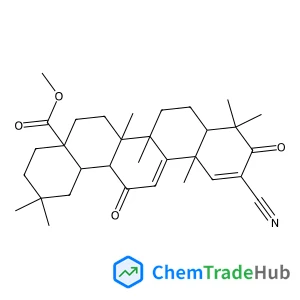
Methyl 2-cyano-3,12-dioxooleana-1,9(11)-dien-28-oate
CAS Number:
218600-53-4
Molecular Formula:
C32H43NO4
Jiaxin Fan, Sean Li
The interactions between metals and two-dimensional materials, in particular, the adsorption energies, strongly determine the performances of rechargeable batteries. Previously, it has been demonstrated that heterostructures of two dimensional (2D) materials can lead to enhanced metal adsorptions, which were ascribed to the existence of ‘synergistic’ effects amongst metal atoms and two different 2D materials. However, further investigations are still required to reveal the physical mechanisms behind the contribution of these possible ‘synergistic’ effects for metal intercalations in 2D heterostructures. Here, we selected MoS2/graphene as a prototypical system, and we examined the adsorption and intercalation thermochemistry of monovalent atoms (Li, Na and K) and multivalent atoms (Mg, Ca and Al) using density-functional theory (DFT) calculations. The synergistic effects arising from charge polarizations in these systems were quantified using the three-body interaction energy terms. Our results show strong system dependencies whereby the interactions between the Mg or Ca atom with the MoS2/graphene heterostructures might exhibit cooperative bindings. Nevertheless, metal adsorptions on top of the graphene surface were all found to be anti-cooperative in this case. Our results suggest that enhancement of metal adsorptions using 2D heterostructures is predominantly driven by increasing dispersion interactions due to increases in the interaction surface areas.
Yingchao Liu, Feiyi Wang, Qiang Fei, Ben Shi, Jiancai An, Chunchang Zhao, Chen-Ho Tung
DOI: 10.1039/C6AN00369A
Bartolomeo Della Ventura, Martina Banchelli, Riccardo Funari, Anna Illiano, Marella De Angelis, Paola Taroni, Angela Amoresano, Paolo Matteini, Raffaele Velotta
DOI: 10.1039/C9AN00443B
Golbarg Mohammadi Roozbahani, Youwen Zhang, Xiaohan Chen, Mona Hoseini Soflaee, Xiyun Guan
DOI: 10.1039/C9AN01784D
Hiroki Segawa, Takao Fukuoka, Tamitake Itoh, Yuichi Imai, Yuko T. Iwata, Tadashi Yamamuro, Kenji Kuwayama, Kenji Tsujikawa, Tatsuyuki Kanamori, Hiroyuki Inoue
DOI: 10.1039/C9AN01512D
Dongpo Xu, Mingxia Gao, Chunhui Deng, Xiangmin Zhang
DOI: 10.1039/C6AN00361C
Jonathan Sjögren, Fredrik Olsson, Alain Beck
DOI: 10.1039/C6AN00071A
A. Bondarenko, Y. Zhu, L. Qiao, F. Cortés Salazar, H. Pick, H. H. Girault
DOI: 10.1039/C6AN00126B
Luca Guerrini
DOI: 10.1039/C9AN02040C
Julie V. Macpherson
DOI: 10.1039/C9AN01437C
When handling 4-(2-Furylmethyl)thiomorpholine 1,1-dioxide (CAS: 79206-94-3), it ...
When handling 4-Chloro-N-[2-(4-morpholinyl)ethyl]benzamide (CAS: 71320-77-9), it...
Waste containing this compound (CAS: 62921-74-8) should be handled according to ...
Waste containing (S)-Methyl 2-amino-3-cyclohexylpropanoate should be collected i...
This compound can be synthesized using a multi-step process involving the conjug...
There are several alternatives to (2E)-3-(3,4-Dichlorophenyl)acrylic acid in syn...
Ethyl 6-(2-nitrophenyl)imidazo[2,1-b][1,3]thiazole-3-carboxylate (CAS: 925437-84...
Waste containing 2-(1,3-Thiazol-2-yl)ethanamine (CAS: 18453-07-1) should be coll...
Methyl 5-iodo-2-methylbenzoate can be synthesized through the iodination of meth...
5-Chloro[1,2,4]triazolo[1,5-a]pyridine is commonly synthesized via the condensat...

Physical Chemistry Chemical Physics (PCCP) is an international journal co-owned by 19 physical chemistry and physics societies from around the world. This journal publishes original, cutting-edge research in physical chemistry, chemical physics and biophysical chemistry. To be suitable for publication in PCCP, articles must include significant innovation and/or insight into physical chemistry; this is the most important criterion that reviewers and Editors will judge against when evaluating submissions. The journal has a broad scope and welcomes contributions spanning experiment, theory, computation and data science. Topical coverage includes spectroscopy, dynamics, kinetics, statistical mechanics, thermodynamics, electrochemistry, catalysis, surface science, quantum mechanics, quantum computing and machine learning. Interdisciplinary research areas such as polymers and soft matter, materials, nanoscience, energy, surfaces/interfaces, and biophysical chemistry are welcomed if they demonstrate significant innovation and/or insight into physical chemistry. Joined experimental/theoretical studies are particularly appreciated when complementary and based on up-to-date approaches.
![[4-(Heptyloxy)phenyl]boronic acid structure](https://static.chemtradehub.com/structs/136/136370-19-9-ad33.webp "[4-(Heptyloxy)phenyl]boronic acid structure")