













Thermodiffusion of repulsive charged nanoparticles – the interplay between single-particle and thermoelectric contributions
Literature Information
Publication Date
2018-05-23
DOI
10.1039/C8CP02558D
Impact Factor
3.676
Authors
M. Kouyaté, G. Demouchy, G. Mériguet, R. Aquino, E. Dubois, S. Nakamae, M. Roger, J. Depeyrot, R. Perzynski
View Original
Abstract
Thermodiffusion of different ferrite nanoparticles (NPs), ∼10 nm in diameter, is explored in tailor-made aqueous dispersions stabilized by electrostatic interparticle interactions. In the dispersions, electrosteric repulsion is the dominant force, which is tuned by an osmotic-stress technique, i.e. controlling of osmotic pressure Π, pH and ionic strength. It is then possible to map Π and the NPs’ osmotic compressibility χ in the dispersion with a Carnahan–Starling formalism of effective hard spheres (larger than the NPs’ core). The NPs are here dispersed with two different surface ionic species, either at pH ∼ 2 or 7, leading to a surface charge, either positive or negative. Their Ludwig–Soret ST coefficient together with their mass diffusion Dm coefficient are determined experimentally by forced Rayleigh scattering. All probed NPs display a thermophilic behavior (ST < 0) regardless of the ionic species used to cover the surface. We determine the NPs’ Eastman entropy of transfer and the Seebeck (thermoelectric) contribution to the measured Ludwig–Soret coefficient in these ionic dispersions. The NPs’ Eastman entropy of transfer ŜNP is interpreted through the electrostatic and hydration contributions of the ionic shell surrounding the NPs.
Related Literature
A kinetic study of the CH2OO Criegee intermediate self-reaction, reaction with SO2 and unimolecular reaction using cavity ring-down spectroscopy
Rabi Chhantyal-Pun, Anthony Davey, Dudley E. Shallcross, Carl J. Percival, Andrew J. Orr-Ewing
2014-12-22
Paper
DOI: 10.1039/C4CP04198D
Voronoi dipole moments for the simulation of bulk phase vibrational spectra
Martin Thomas, Martin Brehm, Barbara Kirchner
2014-12-15
Paper
DOI: 10.1039/C4CP05272B
Relaxation of a hydrophilic polymer induced by moisture desorption through the glass transition
2014-12-11
Paper
DOI: 10.1039/C4CP04966G
ReaxFF molecular dynamics simulations on lithiated sulfur cathode materials
Md Mahbubul Islam, Alireza Ostadhossein, Oleg Borodin, A. Todd Yeates, William W. Tipton, Richard G. Hennig, Nitin Kumar, Adri C. T. van Duin
2014-12-16
Paper
DOI: 10.1039/C4CP04532G
Controlled direct growth of Al2O3-doped HfO2 films on graphene by H2O-based atomic layer deposition
Li Zheng, Xinhong Cheng, Yuehui Yu, Yahong Xie, Xiaolong Li, Zhongjian Wang
2014-12-11
Paper
DOI: 10.1039/C4CP04957H
Benchmark thermochemistry of chloramines, bromamines, and bromochloramines: halogen oxidants stabilized by electron correlation
Daniela Trogolo, J. Samuel Arey
2015-01-02
Paper
DOI: 10.1039/C4CP03987D
A practical guide to using boron doped diamond in electrochemical research
2014-12-18
Perspective
DOI: 10.1039/C4CP04022H
Liquid crystal seed nucleates liquid–solid phase change in ceria nanoparticles
Thi X. T. Sayle, Lewis W. L. Sayle, Dean C. Sayle
2015-01-02
Paper
DOI: 10.1039/C4CP05499G
Abstraction and addition kinetics of C2H radicals with CH4, C2H6, C3H8, C2H4, and C3H6: CVT/SCT/ISPE and hybrid meta-DFT methods
Manas Ranjan Dash, B. Rajakumar
2014-12-09
Paper
DOI: 10.1039/C4CP04677C
You might also like
Compound Q&A
What precautions should be taken when handling 4-(2-Furylmethyl)thiomorpholine 1,1-dioxide (CAS: 79206-94-3)?
When handling 4-(2-Furylmethyl)thiomorpholine 1,1-dioxide (CAS: 79206-94-3), it ...
79206-94-34-(2-Furylmethyl)thi...
Compound Q&A
What precautions should be taken when handling 4-Chloro-N-[2-(4-morpholinyl)ethyl]benzamide (CAS: 71320-77-9)?
When handling 4-Chloro-N-[2-(4-morpholinyl)ethyl]benzamide (CAS: 71320-77-9), it...
71320-77-94-Chloro-N-[2-(4-mor...
Compound Q&A
How should waste containing 2-[2-(2-Methoxyethoxy)ethoxy]ethyl 4-methylbenzenesulfonate (CAS: 62921-74-8) be handled?
Waste containing this compound (CAS: 62921-74-8) should be handled according to ...
62921-74-82-[2-(2-Methoxyethox...
Compound Q&A
How should waste containing (S)-Methyl 2-amino-3-cyclohexylpropanoate be handled?
Waste containing (S)-Methyl 2-amino-3-cyclohexylpropanoate should be collected i...
40056-18-6(S)-Methyl 2-amino-3...
Compound Q&A
How is 5-({4-[(2S,4R)-4-Hydroxy-2-methyltetrahydro-2H-pyran-4-yl]-2-thienyl}sulfanyl)-1-methyl-1,3-dihydro-2H-indol-2-one (CAS: 166882-70-8) typically synthesized?
This compound can be synthesized using a multi-step process involving the conjug...
166882-70-85-({4-[(2S,4R)-4-Hyd...
Compound Q&A
Are there alternatives to (2E)-3-(3,4-Dichlorophenyl)acrylic acid (CAS: 7312-27-8) in synthesis?
There are several alternatives to (2E)-3-(3,4-Dichlorophenyl)acrylic acid in syn...
7312-27-8(2E)-3-(3,4-Dichloro...
Compound Q&A
How should Ethyl 6-(2-nitrophenyl)imidazo[2,1-b][1,3]thiazole-3-carboxylate (CAS: 925437-84-9) be stored?
Ethyl 6-(2-nitrophenyl)imidazo[2,1-b][1,3]thiazole-3-carboxylate (CAS: 925437-84...
925437-84-9Ethyl 6-(2-nitrophen...
Compound Q&A
How should waste containing 2-(1,3-Thiazol-2-yl)ethanamine (CAS: 18453-07-1) be handled?
Waste containing 2-(1,3-Thiazol-2-yl)ethanamine (CAS: 18453-07-1) should be coll...
18453-07-12-(1,3-Thiazol-2-yl)...
Compound Q&A
How is Methyl 5-iodo-2-methylbenzoate (CAS: 103440-54-6) typically synthesized?
Methyl 5-iodo-2-methylbenzoate can be synthesized through the iodination of meth...
103440-54-6Methyl 5-iodo-2-meth...
Compound Q&A
How is 5-Chloro[1,2,4]triazolo[1,5-a]pyridine (CAS: 1427399-34-5) typically synthesized?
5-Chloro[1,2,4]triazolo[1,5-a]pyridine is commonly synthesized via the condensat...
1427399-34-55-Chloro[1,2,4]triaz...
Source Journal
Physical Chemistry Chemical Physics

CiteScore:
5.5
Self-citation Rate:
10.3%
Articles per Year:
3036
Physical Chemistry Chemical Physics (PCCP) is an international journal co-owned by 19 physical chemistry and physics societies from around the world. This journal publishes original, cutting-edge research in physical chemistry, chemical physics and biophysical chemistry. To be suitable for publication in PCCP, articles must include significant innovation and/or insight into physical chemistry; this is the most important criterion that reviewers and Editors will judge against when evaluating submissions. The journal has a broad scope and welcomes contributions spanning experiment, theory, computation and data science. Topical coverage includes spectroscopy, dynamics, kinetics, statistical mechanics, thermodynamics, electrochemistry, catalysis, surface science, quantum mechanics, quantum computing and machine learning. Interdisciplinary research areas such as polymers and soft matter, materials, nanoscience, energy, surfaces/interfaces, and biophysical chemistry are welcomed if they demonstrate significant innovation and/or insight into physical chemistry. Joined experimental/theoretical studies are particularly appreciated when complementary and based on up-to-date approaches.
Recommended Compounds
![[4-(Heptyloxy)phenyl]boronic acid structure](https://static.chemtradehub.com/structs/136/136370-19-9-ad33.webp "[4-(Heptyloxy)phenyl]boronic acid structure")
![5-Acetyl-2,3-dihydrobenzo[b]furan structure](https://static.chemtradehub.com/structs/908/90843-31-5-eea4.webp "5-Acetyl-2,3-dihydrobenzo[b]furan structure")
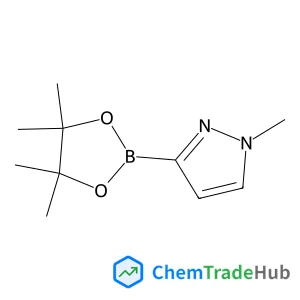
1-Methyl-3-(4,4,5,5-tetramethyl-1,3,2-dioxaborolan-2-yl)-1H-pyrazole
CAS Number:
1020174-04-2
Molecular Formula:
C10H17BN2O2
Recommended Suppliers







Disclaimer
This page provides academic journal information for reference and research purposes only. We are not affiliated with any journal publishers and do not handle publication submissions. For publication-related inquiries, please contact the respective journal publishers directly.
If you notice any inaccuracies in the information displayed, please contact us at support@chemtradehub.com. We will promptly review and address your concerns.