












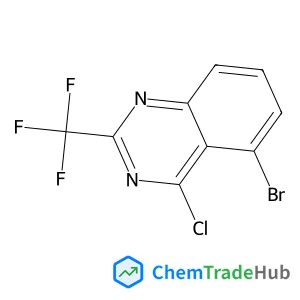
5-Bromo-4-chloro-2-(trifluoromethyl)quinazoline
CAS Number:
2089311-03-3
Molecular Formula:
C9H3BrClF3N2
M. Taguchi, N. Schwalb, Y. Rong, N. Garland, M. Tan, H. Yamaguchi, J. C. Claussen, E. S. McLamore
For the first time, we combine pulsed electrodeposition with out-of-phase pulsed sonication for controlled synthesis of fractal nanoplatinum structures as the transducer layer in electrochemical sensing. We develop and test this technique, called bimodal pulsed sonoelectrodeposition (pulSED), as a simple approach for creating highly conductive transducer nanometals for use in sensing and biosensing. We first compared the efficiency of pulSED nanoplatinum to other pulsed electrodeposition techniques, and then explored the effect of duty cycle and plating time on electroactive surface area and nanoparticle size/morphology. The developed pulSED nanoplatinum displayed fractal features with a relatively homogenous size distribution (26.31 ± 1.3 nm) and extremely high electroactive surface (0.28 ± 0.04 cm2) relative to other electroplating techniques (up to one order of magnitude higher). A high duty cycle (900 mHz) promotes formation of stable nanostructures (including fractal nanostructures) and reduces amorphous structure formation due to bubble cavitation and enhanced mass transport of metal ions to the electrode surface. To demonstrate the applicability of the pulSED technique, non-enzymatic and enzymatic sensors were developed for measuring hydrogen peroxide and glucose. The sensitivity for non-enzymatic peroxide sensing (3335 ± 305 μA cm−2 mM−1), non-enzymatic glucose sensing (73 ± 14 μA cm−2 mM−1) and enzymatic glucose biosensing (155 ± 25 μA cm−2 mM−1) was higher than, or similar to, other nanomaterial-mediated amperometric sensors reported in the literature. The pulSED technique is a one pot method for tunable synthesis of nanometal structures as a transducer layer in electrochemical sensing and biosensing that requires no precursors or capping agents, and can be carried out at room temperature with inexpensive hardware.
P. Yadav, M. Saliba, M. Saski, S. M. Zakeeruddin, M. Grätzel
DOI: 10.1039/C7SE00094D
Ryohei Mori
DOI: 10.1039/C7SE00087A
Kevin A. Bush, James A. Raiford, Eli J. Wolf, Simon A. Swifter, Caleb C. Boyd, Hsin-Ping Wang, Michael F. Toney, Stacey F. Bent
DOI: 10.1039/C8SE00314A
Junkai Han, Shuangwen Li, Peng Long, Chen Cao, Yu Cao, Weizhe Wang
DOI: 10.1039/C8SE00185E
Xing Guo, Bingjuan Zhang, Zhenhua Lin, Jie Su, Zhou Yang, Chunfu Zhang, Jingjing Chang, Shengzhong (Frank) Liu, Yue Hao
DOI: 10.1039/C8SE00233A
Meidan Ye, Xiaoyue Gao, Xiaodan Hong, Qun Liu, Chunfeng He
DOI: 10.1039/C7SE00137A
Waste containing 6-Chloro-5-(2'-hydroxy-3'-methoxy-4-biphenylyl)-3-(3-methoxyphe...
(3alpha,5alpha)-3-Hydroxypregnane-11,20-dione is primarily used in the pharmaceu...
The market for 4-Amino-6-chloro-2-pyridinecarboxylic acid (CAS: 546141-56-4) is ...
Alternatives to (2-Benzoylethyl)trimethylammonium chloride (CAS: 24472-88-6) in ...
N-[4-Nitro-3-(trifluoromethyl)phenyl]acetamide (CAS: 393-12-4) is generally safe...
Alternative reagents such as other phosphates or similar functional groups can b...
There are alternatives to N,N'-Bis(3-aminopropyl)-1,3-propanediamine (CAS: 4605-...
When handling Aluminium trihexadecanoate, it is important to use appropriate per...
(1,1-Dioxido-3-oxo-1,2-benzothiazol-2(3H)-yl)acetic acid is a chemical compound ...
Several alternatives to 5,5-dimethyloxolan-2-one (CAS: 3123-97-5) can be used in...

Analyst publishes analytical and bioanalytical research that reports premier fundamental discoveries and inventions, and the applications of those discoveries, unconfined by traditional discipline barriers.
![2-morpholino-2-[2-(trifluoromethyl)pyrimidin-5-yl]ethanamine structure](https://static.chemtradehub.com/structs/119/1192570-20-9-2810.webp "2-morpholino-2-[2-(trifluoromethyl)pyrimidin-5-yl]ethanamine structure")
![Benzo[b]naphtho[2,1-d]thiophene structure](https://static.chemtradehub.com/structs/239/239-35-0-ff90.webp "Benzo[b]naphtho[2,1-d]thiophene structure")




