












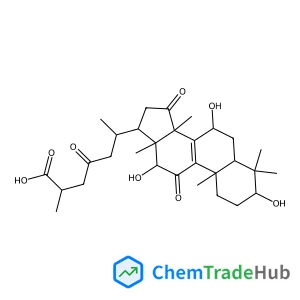
(3beta,7beta,12beta)-3,7,12-Trihydroxy-11,15,23-trioxolanost-8-en-26-oic acid
CAS Number:
98665-22-6
Molecular Formula:
C30H44O8
Ying-Tao Liu, Xue Yin, Xiao-Yong Lai, Xin Wang
Two-photon photodynamic therapy (TP-PDT) is a very promising treatment that has drawn much attention in recent years due to its ability to penetrate deeper into tissues and minimize the damage to normal cells. Here, the properties of three highly water soluble Ru(II) and Zn(II) polypyridyl complexes as photosensitizers (PSs) were examined, including the one-photon and two-photon absorption (OPA and TPA) spectra, singlet–triplet energy gap (ΔH–L), TPA cross-section and spin–orbit coupling constant via Density Function Theory (DFT) and Time-Dependent Density Functional Theory (TD-DFT). Their potential therapeutic use as photosensitizers in TP-PDT is proposed, where the reasoning is as follows: first, they possess strong absorption in the therapeutic window; second, the vertical excitation energy is greater than 0.98 eV, which can generate a singlet oxygen species and the remarkable coupling between the S1 and T1 states. Moreover, the spin–orbit matrix elements are greater than 0.24 cm−1 for Ru-bpy and Zn-tpy, indicating that the intersystem spin crossing processes are efficient. It is expected that these complexes will be applied to PSs in TP-PDT, and we hope this research can serve as a guideline for the development of efficient two-photon PSs.
Haichang Zhang, Shuo Zhang, Yifan Mao, Kewei Liu, Yu-Ming Chen, Zhang Jiang, Joseph Strzalka, Wenjun Yang, Chien-Lung Wang, Yu Zhu
DOI: 10.1039/C7PY00616K
Leon M. Lillie, William B. Tolman, Theresa M. Reineke
DOI: 10.1039/C7PY00575J
Haibo Wu, Zhiming Wang, Lei Tao
DOI: 10.1039/C7PY01718A
Diana Kalden, Matthias Westerhausen
DOI: 10.1039/C7PY00881C
Raman Hlushko, Hanna Hlushko, Svetlana A. Sukhishvili
DOI: 10.1039/C7PY01973D
Manuel Hartweg, Elham Radvar, Dominic Collis, Mehedi Reza, Janne Ruokolainen, Robert Rambo, Ian W. Hamley, Helena S. Azevedo, C. Remzi Becer
DOI: 10.1039/C7PY01953J
Xiaodong Liu, Yuanyuan Ni, Jian Wu, Hongjuan Jiang, Zhengbiao Zhang, Lifen Zhang, Zhenping Cheng
DOI: 10.1039/C7PY02008B
When handling 4-(2-Furylmethyl)thiomorpholine 1,1-dioxide (CAS: 79206-94-3), it ...
When handling 4-Chloro-N-[2-(4-morpholinyl)ethyl]benzamide (CAS: 71320-77-9), it...
Waste containing this compound (CAS: 62921-74-8) should be handled according to ...
Waste containing (S)-Methyl 2-amino-3-cyclohexylpropanoate should be collected i...
This compound can be synthesized using a multi-step process involving the conjug...
There are several alternatives to (2E)-3-(3,4-Dichlorophenyl)acrylic acid in syn...
Ethyl 6-(2-nitrophenyl)imidazo[2,1-b][1,3]thiazole-3-carboxylate (CAS: 925437-84...
Waste containing 2-(1,3-Thiazol-2-yl)ethanamine (CAS: 18453-07-1) should be coll...
Methyl 5-iodo-2-methylbenzoate can be synthesized through the iodination of meth...
5-Chloro[1,2,4]triazolo[1,5-a]pyridine is commonly synthesized via the condensat...

Physical Chemistry Chemical Physics (PCCP) is an international journal co-owned by 19 physical chemistry and physics societies from around the world. This journal publishes original, cutting-edge research in physical chemistry, chemical physics and biophysical chemistry. To be suitable for publication in PCCP, articles must include significant innovation and/or insight into physical chemistry; this is the most important criterion that reviewers and Editors will judge against when evaluating submissions. The journal has a broad scope and welcomes contributions spanning experiment, theory, computation and data science. Topical coverage includes spectroscopy, dynamics, kinetics, statistical mechanics, thermodynamics, electrochemistry, catalysis, surface science, quantum mechanics, quantum computing and machine learning. Interdisciplinary research areas such as polymers and soft matter, materials, nanoscience, energy, surfaces/interfaces, and biophysical chemistry are welcomed if they demonstrate significant innovation and/or insight into physical chemistry. Joined experimental/theoretical studies are particularly appreciated when complementary and based on up-to-date approaches.
![5-Acetyl-2,3-dihydrobenzo[b]furan structure](https://static.chemtradehub.com/structs/908/90843-31-5-eea4.webp "5-Acetyl-2,3-dihydrobenzo[b]furan structure")




