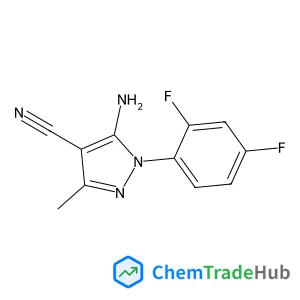
5-Amino-1-(2,4-difluorophenyl)-3-methyl-1H-pyrazole-4-carbonitrile
CAS Number:
1020057-92-4
Molecular Formula:
C11H8F2N4
Yanzhou Wang, Panpan Gao, Xiaoxu Wang, Jinrong Huo, Lu Li, Yajing Zhang, Alex A. Volinsky, Ping Qian, Yanjing Su
The pursuit of catalysts to promote effective water oxidization to produce oxygen has become a research subject of high priority for water splitting. Here, first-principles calculations are employed to study the water-splitting oxygen evolution reaction (OER) on ∼1.5 nm diameter Au13@Ni120P50 core–shell nanoclusters. Water splitting to produce oxygen proceeds in four intermediate reaction steps (OH*, O*, OOH* and O2). Adsorption configurations and adsorption energies for the species involved in OER on both Au13@Ni120P50 cluster and Ni12P5(001) supported by Au are presented. In addition, thermodynamic free energy diagrams and kinetic potential energy changes are systematically discussed. We show that the third intermediate reaction (O* reacting with H2O to produce OOH*) of the four elementary steps is the reaction-determining step, which accords with previous results. Also, the catalytic performance of OER for Au13@Ni120P50 is better than that for Ni12P5(001) supported by Au in terms of reactive overpotential (0.74 vs. 1.58 V) and kinetic energy barrier (2.18 vs. 3.17 eV). The optimal kinetic pathway for OER is further explored carefully for the Au13@Ni120P50 cluster. The low thermodynamic overpotential and kinetic energy barrier make Au13@Ni120P50 promising for industrial applications as a good OER electrocatalyst candidate.
Giuseppina Raffaini, Fabio Ganazzoli
DOI: 10.1039/B604540E
Antti Lignell, Leonid Khriachtchev, Hanna Lignell, Markku Räsänen
DOI: 10.1039/B603822K
Elena Malkin, Irina Malkin, Olga L. Malkina, Vladimir G. Malkin, Martin Kaupp
DOI: 10.1039/B607044B
Prabha Jayapal, Mahesh Sundararajan, Ian H. Hillier, Neil A. Burton
DOI: 10.1039/B608069C
DOI: 10.1039/B600530F
Christopher J. Pursell, Leon F. Phillips
DOI: 10.1039/B608369B
Ethyl 4-chlorothieno[2,3-b]pyridine-5-carboxylate (CAS: 59713-58-5) can be synth...
5-Methyl-1H-indole-3-carbaldehyde (CAS: 52562-50-2) is subject to various regula...
(1,3-Dimethyl-2,4-dioxo-1,2,3,4-tetrahydro-5-pyrimidinyl)boronic acid is a white...
Waste containing Sulfocostunolide A (CAS: 1016983-51-9) should be handled with c...
When handling Murraxocin (CAS: 88478-44-8), ensure proper personal protective eq...
Formvar (CAS: 63148-64-1) is an alkyd resin characterized by a high molecular we...
(S)-4-benzyl-2-((benzyloxy)methyl)morpholine is generally safe when handled with...
Methyl 1-(5-bromo-2-pyrimidinyl)cyclopropanecarboxylate (CAS: 1447607-69-3) is p...
2-Methyl-1-phenyl-1-propanamine hydrochloride (CAS: 24290-47-9) is generally con...
3-(4-Bromophenyl)-2-methylpropanoic acid is synthesized through a multi-step pro...

Physical Chemistry Chemical Physics (PCCP) is an international journal co-owned by 19 physical chemistry and physics societies from around the world. This journal publishes original, cutting-edge research in physical chemistry, chemical physics and biophysical chemistry. To be suitable for publication in PCCP, articles must include significant innovation and/or insight into physical chemistry; this is the most important criterion that reviewers and Editors will judge against when evaluating submissions. The journal has a broad scope and welcomes contributions spanning experiment, theory, computation and data science. Topical coverage includes spectroscopy, dynamics, kinetics, statistical mechanics, thermodynamics, electrochemistry, catalysis, surface science, quantum mechanics, quantum computing and machine learning. Interdisciplinary research areas such as polymers and soft matter, materials, nanoscience, energy, surfaces/interfaces, and biophysical chemistry are welcomed if they demonstrate significant innovation and/or insight into physical chemistry. Joined experimental/theoretical studies are particularly appreciated when complementary and based on up-to-date approaches.
![2-Methyl-2-propanyl 1,6-diazaspiro[3.4]octane-6-carboxylate structure](https://static.chemtradehub.com/structs/115/1158749-79-1-81ee.webp "2-Methyl-2-propanyl 1,6-diazaspiro[3.4]octane-6-carboxylate structure")