












Removing interference-based effects from the infrared transflectance spectra of thin films on metallic substrates: a fast and wave optics conform solution
Literature Information
Publication Date
2018-06-04
DOI
10.1039/C8AN00526E
Impact Factor
4.616
Authors
Susanne Pahlow, Uwe Hübner
View Original
Abstract
A hybrid formalism combining elements from Kramers–Kronig based analyses and dispersion analysis was developed, which allows removing interference-based effects in the infrared spectra of layers on highly reflecting substrates. In order to enable a highly convenient application, the correction procedure is fully automatized and usually requires less than a minute with non-optimized software on a typical office PC. The formalism was tested with both synthetic and experimental spectra of poly(methyl methacrylate) on gold. The results confirmed the usefulness of the formalism: apparent peak ratios as well as the interference fringes in the original spectra were successfully corrected. Accordingly, the introduced formalism makes it possible to use inexpensive and robust highly reflecting substrates for routine infrared spectroscopic investigations of layers or films the thickness of which is limited by the imperative that reflectance absorbance must be smaller than about 1. For thicker films the formalism is still useful, but requires estimates for the optical constants.
Related Literature
Surface plasmon resonance study of the interaction of N-methyl mesoporphyrin IX with G-quadruplex DNA
M. Perenon, H. Bonnet, T. Lavergne, J. Dejeu, E. Defrancq
2020-02-06
Paper
DOI: 10.1039/C9CP06321H
One-electron oxidation of ds(5′-GGG-3′) and ds(5′-G(8OG)G-3′) and the nature of hole distribution: a density functional theory (DFT) study
Anil Kumar, Amitava Adhikary, Michael D. Sevilla, David M. Close
2020-02-03
Paper
DOI: 10.1039/C9CP06244K
Symmetry and 1H NMR chemical shifts of short hydrogen bonds: impact of electronic and nuclear quantum effects
Shengmin Zhou, Lu Wang
2020-01-08
Paper
DOI: 10.1039/C9CP06840F
Lithium migration pathways at the composite interface of LiBH4 and two-dimensional MoS2 enabling superior ionic conductivity at room temperature
Zhixiang Liu, Mengyuan Xiang, Yao Zhang, Huaiyu Shao, Yunfeng Zhu, Xinli Guo, Liquan Li, Hui Wang, Wanqiang Liu
2020-01-27
Paper
DOI: 10.1039/C9CP06090A
Ti2O3/TiO2 heterophase junctions with enhanced charge separation and spatially separated active sites for photocatalytic CO2 reduction
Min Xu, Rui Yan, Haonan Li, Ning Sun, Yang Qu
2020-02-04
Paper
DOI: 10.1039/C9CP05147C
Correction: Calculation of vibrationally resolved absorption and fluorescence spectra of the rylenes
Jonas Greiner, Dage Sundholm
2020-02-07
Correction
DOI: 10.1039/D0CP90033H
Mirror symmetry origin of Dirac cone formation in rectangular two-dimensional materials
Xuming Qin, Yi Liu, Gui Yang, Dongqiu Zhao
2020-03-02
Paper
DOI: 10.1039/D0CP00244E
Computational approaches to studying methylated H4K20 recognition by DNA repair factor 53BP1
Zhendong Li, Jingxiao Bao
2020-02-06
Paper
DOI: 10.1039/C9CP05635A
You might also like
Compound Q&A
What is the market or research trend for N-(4-Methoxybenzyl)-2-pyridinamine (CAS: 52818-63-0)?
N-(4-Methoxybenzyl)-2-pyridinamine (CAS: 52818-63-0) is increasingly being used ...
52818-63-0N-(4-Methoxybenzyl)-...
Compound Q&A
What precautions should be taken when handling Ethyl 4-(2-chlorophenyl)-1,3-thiazole-2-carboxylate (CAS: 1050507-06-6)?
When handling Ethyl 4-(2-chlorophenyl)-1,3-thiazole-2-carboxylate, appropriate p...
1050507-06-6Ethyl 4-(2-chlorophe...
Compound Q&A
What regulatory guidelines apply to diethyldiselane (CAS: 628-39-7)?
Diethyldiselane (CAS: 628-39-7) is classified under the Globally Harmonized Syst...
628-39-7Diethyldiselane
Compound Q&A
What is the market or research trend for oxocopper (CAS: 12053-18-8)?
The market for oxocopper (CAS: 12053-18-8) is primarily driven by its use in cat...
12053-18-8oxocopper; oxo-(oxoc...
Compound Q&A
What is the market or research trend for 5-{[(2-Methyl-2-propanyl)oxy]carbonyl}-5-azaspiro[2.4]heptane-7-carboxylic acid?
The market for 5-{[(2-Methyl-2-propanyl)oxy]carbonyl}-5-azaspiro[2.4]heptane-7-c...
1268519-54-55-{[(2-Methyl-2-prop...
Compound Q&A
What is 2-(1-Pyrrolidinyl)-4-pyridinamine (CAS: 35981-63-6)?
2-(1-Pyrrolidinyl)-4-pyridinamine is a chemical compound with the CAS number 359...
35981-63-62-(1-Pyrrolidinyl)-4...
Compound Q&A
What are the physical and chemical properties of 2-(3-Pyridinyl)-1-azabicyclo[2.2.2]octane (CAS: 91556-75-1)?
2-(3-Pyridinyl)-1-azabicyclo[2.2.2]octane (CAS: 91556-75-1) is a crystalline sol...
91556-75-12-(3-Pyridinyl)-1-az...
Compound Q&A
How is (S)-Alpha-allyl-proline hydrochloride (CAS: 129704-91-2) typically synthesized?
(S)-Alpha-allyl-proline hydrochloride is usually synthesized via a Wittig reacti...
129704-91-2(S)-Alpha-allyl-prol...
Compound Q&A
What is 3-Methyl-1,2-oxazole-5-carboxylic acid (CAS: 4857-42-5)?
3-Methyl-1,2-oxazole-5-carboxylic acid (CAS: 4857-42-5) is an organic compound w...
4857-42-53-Methyl-1,2-oxazole...
Compound Q&A
How is Lys-SMCC-DM1 (CAS: 1281816-04-3) typically synthesized?
Lys-SMCC-DM1 is synthesized via a multi-step process involving the coupling of S...
1281816-04-3Lys-SMCC-DM1
Source Journal
Analyst

CiteScore:
7.8
Self-citation Rate:
5.6%
Articles per Year:
653
Analyst publishes analytical and bioanalytical research that reports premier fundamental discoveries and inventions, and the applications of those discoveries, unconfined by traditional discipline barriers.
Recommended Compounds
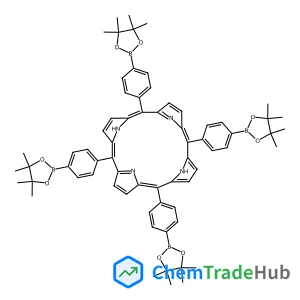
5,10,15,20-tetrakis(4-boronic acid pinacol ester phenyl) porphyrin
CAS Number:
1332748-00-1
Molecular Formula:
C68H74B4N4O8
![6,7-Dihydro-5H-pyrrolo[1,2-a]imidazole-6-carboxylic acid structure](https://static.chemtradehub.com/structs/136/1369160-12-2-6524.webp "6,7-Dihydro-5H-pyrrolo[1,2-a]imidazole-6-carboxylic acid structure")
6,7-Dihydro-5H-pyrrolo[1,2-a]imidazole-6-carboxylic acid
CAS Number:
1369160-12-2
Molecular Formula:
C7H8N2O2
Recommended Suppliers





Disclaimer
This page provides academic journal information for reference and research purposes only. We are not affiliated with any journal publishers and do not handle publication submissions. For publication-related inquiries, please contact the respective journal publishers directly.
If you notice any inaccuracies in the information displayed, please contact us at support@chemtradehub.com. We will promptly review and address your concerns.