



Automatic high-pressure hydrogen generation from formic acid in the presence of nano-Pd heterogeneous catalysts at mild temperatures
Literature Information
Publication Date
2017-05-17
DOI
10.1039/C7SE00131B
Impact Factor
6.367
Authors
Heng Zhong, Masayuki Iguchi, Fu-Zhan Song, Maya Chatterjee, Takayuki Ishizaka, Ikuhiro Nagao, Qiang Xu, Hajime Kawanami
View Original
Abstract
High-pressure hydrogen is of great interest in the industrial utilization of hydrogen energy, especially for hydrogen fuel cell vehicles. In this work, a method of automatic high-pressure H2 generation by the decomposition of formic acid, a recently renowned hydrogen storage material, in the presence of a heterogeneous catalyst (palladium nano-particles on a graphene oxide catalyst (Pd/PDA–rGO)) was proposed. This catalyst can effectively catalyze the decomposition of formic acid to produce high-pressure H2 and CO2 over 35 MPa without any detectable formation of CO or other by-products. For example, a 36.3 MPa total gas pressure was successfully achieved using an aqueous solution of 6.7 mol L−1 formic acid and 6.7 mol L−1 sodium formate at 80 °C. This research provided a preliminary study on the automatic high-pressure hydrogen gas generation by the decomposition of formic acid without any compression facilities in the presence of a heterogeneous catalyst, which can be easily separated from the reaction process, for hydrogen energy utilization.
Recommended Journals

Current Opinion in Colloid & Interface Science

Russian Chemical Bulletin

Chemistry Education Research and Practice

Saudi Pharmaceutical Journal

Russian Journal of Applied Chemistry

Journal of Peptide Science

Organic Process Research & Development

Current Opinion in Solid State & Materials Science

Russian Journal of General Chemistry

Chemical Communications
Related Literature
Electronic structures of intermolecular hydrogen bond contacts with solute in aqueous solution: glycine as a working prototype
Zijing Lin
2016-05-31
Paper
DOI: 10.1039/C5CP07968C
Mechanisms of charge accumulation in the dark operation of perovskite solar cells
Teresa S. Ripolles, Ajay K. Baranwal, Koji Nishinaka, Yuhei Ogomi, Germà Garcia-Belmonte, Shuzi Hayase
2016-04-28
Paper
DOI: 10.1039/C6CP01427E
Electronic state-lifetime interference in resonant Auger spectra: a tool to disentangle overlapping core-excited states
Gildas Goldsztejn, Denis Céolin, Rajesh K. Kushawaha, Ralph Püttner
2016-05-06
Paper
DOI: 10.1039/C6CP01998F
Solvent-induced desorption of alkanethiol ligands from Au nanoparticles
Yuanyuan Huang, Wei Liu, Hao Cheng, Tao Yao, Lina Yang, Jie Bao, Ting Huang, Zhihu Sun, Yong Jiang, Shiqiang Wei
2016-05-17
Paper
DOI: 10.1039/C6CP00480F
The nature of excited states in dipolar donor/fullerene complexes for organic solar cells: evolution with the donor stack size
Yuanping Yi
2016-05-20
Paper
DOI: 10.1039/C6CP02296K
Charge carrier kinetics of carbon nitride colloid: a femtosecond transient absorption spectroscopy study
Huiyu Zhang, Yaping Chen, Rong Lu, Ruiyu Li, Anchi Yu
2016-05-05
Paper
DOI: 10.1039/C6CP01600F
Low electron-polar optical phonon scattering as a fundamental aspect of carrier mobility in methylammonium lead halide CH3NH3PbI3 perovskites
A. Filippetti, A. Mattoni, C. Caddeo, M. I. Saba, P. Delugas
2016-05-09
Paper
DOI: 10.1039/C6CP01402J
Quasiparticle and excitonic gaps of one-dimensional carbon chains
E. Mostaani, N. D. Drummond, C. J. Lambert
2016-04-12
Paper
DOI: 10.1039/C5CP07891A
Enhanced electrical properties and field emission characteristics of AZO/ZnO-nanowire core–shell structures
Jheng-Ming Huang, Shang-You Tsai, Ching-Shun Ku, Chih-Ming Lin, San-Yuan Chen
2016-05-09
Paper
DOI: 10.1039/C6CP01011C
You might also like
Compound Q&A
Is 4-Benzyl-2,2-dimethylmorpholine (CAS: 84761-04-6) safe?
4-Benzyl-2,2-dimethylmorpholine is generally considered safe when handled under ...
84761-04-64-Benzyl-2,2-dimethy...
Compound Q&A
What is (5,6-Dimethoxy-3-pyridinyl)boronic acid (CAS: 1346526-61-1)?
(5,6-Dimethoxy-3-pyridinyl)boronic acid is a chemical compound with the molecula...
1346526-61-1(5,6-Dimethoxy-3-pyr...
Compound Q&A
How is 1,1,3,3-Tetramethyl-1,3-bis(2-methyl-2-propanyl)disiloxane (CAS: 67875-55-2) typically synthesized?
1,1,3,3-Tetramethyl-1,3-bis(2-methyl-2-propanyl)disiloxane is synthesized throug...
67875-55-21,1,3,3-Tetramethyl-...
Compound Q&A
What are the main uses of (2R,4S)-1-Boc-4-methylpyrrolidine-2-carboxylic acid (CAS: 1018818-04-6)?
(2R,4S)-1-Boc-4-methylpyrrolidine-2-carboxylic acid is primarily used as a build...
1018818-04-6(2R,4S)-1-Boc-4-meth...
Compound Q&A
What precautions should be taken when handling 2,3-Dichloroacrylonitrile (CAS: 22410-58-8)?
When handling 2,3-Dichloroacrylonitrile, it is crucial to wear appropriate perso...
22410-58-82,3-Dichloroacryloni...
Compound Q&A
How should (S)-1-(o-Tolyl)ethanamine hydrochloride (CAS: 1332832-16-2) be stored?
(S)-1-(o-Tolyl)ethanamine hydrochloride should be stored in a cool, dry place to...
1332832-16-2(S)-1-(o-Tolyl)ethan...
Compound Q&A
What are the physical and chemical properties of Benzyl [1-(hydroxyamino)-1-imino-2-methyl-2-propanyl]carbamate (CAS: 518047-98-8)?
Benzyl [1-(hydroxyamino)-1-imino-2-methyl-2-propanyl]carbamate (CAS: 518047-98-8...
518047-98-8Benzyl [1-(hydroxyam...
Compound Q&A
What industries use 2-Methyloxazole-5-carbaldehyde (CAS: 885273-42-7)?
2-Methyloxazole-5-carbaldehyde is used in the pharmaceutical industry for the sy...
885273-42-72-Methyloxazole-5-ca...
Compound Q&A
What is the market or research trend for 2-Methyl-2-propanyl 4-[(1S)-1-hydroxyethyl]-1-piperidinecarboxylate (CAS: 389889-82-1)?
The market for 2-Methyl-2-propanyl 4-[(1S)-1-hydroxyethyl]-1-piperidinecarboxyla...
389889-82-12-Methyl-2-propanyl ...
Compound Q&A
Is 1-Butyl-3-methylpyridinium bromide (CAS: 26576-85-2) safe?
1-Butyl-3-methylpyridinium bromide is generally considered safe for laboratory u...
26576-85-21-Butyl-3-methylpyri...
Source Journal
Recommended Compounds


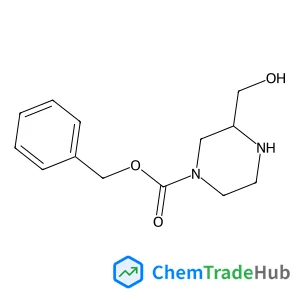
Benzyl 3-(hydroxymethyl)-1-piperazinecarboxylate
CAS Number:
191739-40-9
Molecular Formula:
C13H18N2O3
Recommended Suppliers





Disclaimer
This page provides academic journal information for reference and research purposes only. We are not affiliated with any journal publishers and do not handle publication submissions. For publication-related inquiries, please contact the respective journal publishers directly.
If you notice any inaccuracies in the information displayed, please contact us at support@chemtradehub.com. We will promptly review and address your concerns.