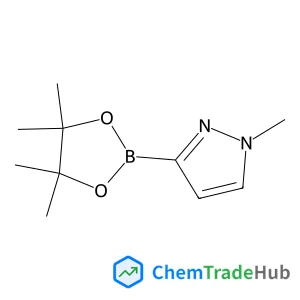
1-Methyl-3-(4,4,5,5-tetramethyl-1,3,2-dioxaborolan-2-yl)-1H-pyrazole
CAS Number:
1020174-04-2
Molecular Formula:
C10H17BN2O2
Jacob N. Lockhart, Anthony B. Hmelo, Eva Harth
Surface immobilization of multiple enzymes plays an increasingly important role in biosensor development. Traditional nanofabrication methods require multiple fabrication steps and complex syntheses which often result in limited enzyme density, modest spatial control and decreased enzyme activity over time and repeated uses, particularly when extensive synthetic modifications are applied. We employed electron beam lithography to crosslink poly(glycidol) with pre-loaded enzyme nanogels, which contain crosslinked poly(glycidol), on a silicon surface to enhance the stability and robustness of synergistic enzymes. As proof-of-concept, we immobilized three enzymes β-galactosidase, glucose oxidase, and horseradish peroxidase with and without nanogel pre-entrapment, and bioactivity was investigated via colorimetric determination with lactose substrate and o-phenylenediamine indicator. The resulting enzyme nanogel device exhibited 71% retention of bioactivity after 30 days and 5-fold higher chromogenic output compared with 32% from free enzyme devices.

Pharmacological Reviews

Science Progress

Science

Kinetics and Catalysis

European Journal of Wood and Wood Products

Journal of Medicinal Chemistry

Planta Medica

Journal of Physics and Chemistry of Solids

Proceedings of the National Academy of Sciences of the United States of America

Israel Journal of Chemistry
DOI: 10.1039/A901888C
DOI: 10.1039/A902689D
Paul W. Percival, Khashayar Ghandi, Jean-Claude Brodovitch, Brenda Addison-Jones, Iain McKenzie
DOI: 10.1039/B005762M
DOI: 10.1039/B002375M
Udo Bakowsky, Willi Rettig, Gerd Bendas, Jan Vogel, Heike Bakowsky, Catalin Harnagea, Ulrich Rothe
DOI: 10.1039/B003727N
DOI: 10.1039/A902617G
Olivier Marie, Frédéric Thibault-Starzyk, Jean-Claude Lavalley
DOI: 10.1039/B005901N
Gerardo Palazzo, Antonia Mallardi, Mauro Giustini, Mario Della Monica, Giovanni Venturoli
DOI: 10.1039/B003905P
When handling 4-(2-Furylmethyl)thiomorpholine 1,1-dioxide (CAS: 79206-94-3), it ...
When handling 4-Chloro-N-[2-(4-morpholinyl)ethyl]benzamide (CAS: 71320-77-9), it...
Waste containing this compound (CAS: 62921-74-8) should be handled according to ...
Waste containing (S)-Methyl 2-amino-3-cyclohexylpropanoate should be collected i...
This compound can be synthesized using a multi-step process involving the conjug...
There are several alternatives to (2E)-3-(3,4-Dichlorophenyl)acrylic acid in syn...
Ethyl 6-(2-nitrophenyl)imidazo[2,1-b][1,3]thiazole-3-carboxylate (CAS: 925437-84...
Waste containing 2-(1,3-Thiazol-2-yl)ethanamine (CAS: 18453-07-1) should be coll...
Methyl 5-iodo-2-methylbenzoate can be synthesized through the iodination of meth...
5-Chloro[1,2,4]triazolo[1,5-a]pyridine is commonly synthesized via the condensat...

Polymer Chemistry welcomes submissions in all areas of polymer science that have a strong focus on macromolecular chemistry. Manuscripts may cover a broad range of fields, yet no direct application focus is required.