












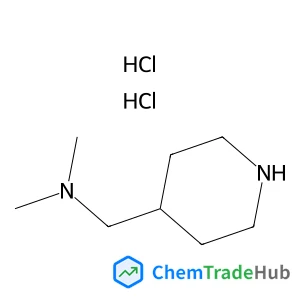
N,N-dimethyl(piperidin-4-yl)methanamine hydrochloride
CAS Number:
172281-72-0
Molecular Formula:
C8H20Cl2N2
Yang Kang, Xin Ju, Lu Wang, Li-Sheng Ding, Gui-Ting Liu, Sheng Zhang, Bang-Jing Li
A pH and glutathione (GSH) dual bio-relevant triggered supramolecular system is constructed through the non-covalent host–guest interactions between the adamantane (ADA) on camptothecin (CPT) and β-cyclodextrin (β-CD) on the side chain of the backbone of hyaluronic acid (HA). The obtained non-covalent supramolecular β-CD-g-OX-HA/ADA-CPT complex could further self-assemble into a stable uniform sphere micellar structure with constant drug loading content in the extracellular environment but is cleaved in the cytosol of the cancer cells due to the acidic environment and the presence of a high concentration of GSH, resulting in a synergistic-fast pH and GSH triggered drug releasing behavior. The cytotoxicity of the supramolecular β-CD-g-OX-HA/ADA-CPT micelles was investigated using Hep G2 cancer cells by MTT assays, which displayed that supramolecular β-CD-g-OX-HA/ADA-CPT micelles had exhibited enhanced cellular proliferation inhibition against Hep G2 cancer cells compared to the free CPT, while the β-CD-g-OX-HA had good cell compatibility. In vivo studies of the β-CD-g-OX-HA/ADA-CPT micelles showed a higher in vivo efficacy without side effects and also confirmed the compatibility of the β-CD-g-OX-HA. It is anticipated that this supramolecular complex will give the possibility to fabricate new types of bio-relevant triggered nanocarriers for cancer therapy.
Nadine Hauptmann, Christian Hamann, Richard Berndt
DOI: 10.1039/C3CP51023A
Andreas Borgschulte, Noris Gallandat, Benjamin Probst, Riccardo Suter, Elsa Callini, Davide Ferri, Yadira Arroyo, Rolf Erni, Hans Geerlings, Andreas Züttel
DOI: 10.1039/C3CP51408K
Hongmin Ma, Picheng Gao, Dawei Fan, Guobao Li, Dan Wu, Bin Du, Qin Wei
DOI: 10.1039/C3CP50341K
Hyeon Su Jeong, Sang Cheon Youn, Yun Ho Kim, Hee-Tae Jung
DOI: 10.1039/C3CP00052D
Jien-Lian Chen, Chang-Yu Yang, Hsiao-Jing Lin, Wei-Ping Hu
DOI: 10.1039/C3CP50447F
Yi-Min Wei, Jing-Hong Liang, Zhao-Bin Chen, Xiao-Shun Zhou, Bing-Wei Mao, Oscar A. Oviedo, Ezequiel P. M. Leiva
DOI: 10.1039/C3CP50473E
V. G. Khamaganov, J. N. Crowley
DOI: 10.1039/C3CP50291K
Bo Yang, Yulong Wang, Yifang Zhao, X.-M. Cao
DOI: 10.1039/C3CP51375K
Siv G. Aalbergsjø, Eli O. Hole, Einar Sagstuen
DOI: 10.1039/C3CP50789K
Yoshihiro Ogi, Hiroshi Kohguchi
DOI: 10.1039/C3CP51680F
Ethyl 4-chlorothieno[2,3-b]pyridine-5-carboxylate (CAS: 59713-58-5) can be synth...
5-Methyl-1H-indole-3-carbaldehyde (CAS: 52562-50-2) is subject to various regula...
(1,3-Dimethyl-2,4-dioxo-1,2,3,4-tetrahydro-5-pyrimidinyl)boronic acid is a white...
Waste containing Sulfocostunolide A (CAS: 1016983-51-9) should be handled with c...
When handling Murraxocin (CAS: 88478-44-8), ensure proper personal protective eq...
Formvar (CAS: 63148-64-1) is an alkyd resin characterized by a high molecular we...
(S)-4-benzyl-2-((benzyloxy)methyl)morpholine is generally safe when handled with...
Methyl 1-(5-bromo-2-pyrimidinyl)cyclopropanecarboxylate (CAS: 1447607-69-3) is p...
2-Methyl-1-phenyl-1-propanamine hydrochloride (CAS: 24290-47-9) is generally con...
3-(4-Bromophenyl)-2-methylpropanoic acid is synthesized through a multi-step pro...

Polymer Chemistry welcomes submissions in all areas of polymer science that have a strong focus on macromolecular chemistry. Manuscripts may cover a broad range of fields, yet no direct application focus is required.
![Imidazo[1,5-a]pyrazine structure](https://static.chemtradehub.com/structs/274/274-49-7-d749.webp "Imidazo[1,5-a]pyrazine structure")
![2-(Methylsulfonyl)-2,4,5,6-tetrahydropyrrolo[3,4-c]pyrazole structure](https://static.chemtradehub.com/structs/122/1226781-80-1-09d5.webp "2-(Methylsulfonyl)-2,4,5,6-tetrahydropyrrolo[3,4-c]pyrazole structure")
![9,9'-Spirobi[fluoren]-2-amine structure](https://static.chemtradehub.com/structs/118/118951-68-1-0d14.webp "9,9'-Spirobi[fluoren]-2-amine structure")




