












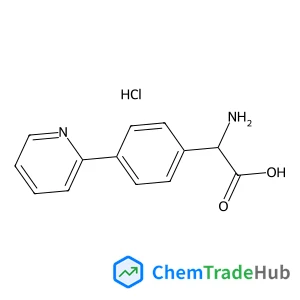
2-Amino-2-(4-(pyridin-2-YL)phenyl)acetic acid hydrochloride
CAS Number:
1135818-89-1
Molecular Formula:
C13H13ClN2O2
O. Stephen Ojo, Brunello Nardone, Stefania F. Musolino, Andrew R. Neal, Liam Wilson, Tomas Lebl, Alexandra M. Z. Slawin, David B. Cordes, James E. Taylor, Andrew D. Smith, Nicholas J. Westwood
Alternative sources of potential feedstock chemicals are of increasing importance as the availability of oil decreases. The biopolymer lignin is viewed as a source of useful mono-aromatic compounds as exemplified by the industrial scale production of vanillin from this biomass. Alternative lignin-derived aromatics are available in pure form but to date examples of the use of these types of compounds are rare. Here we address this issue by reporting the conversion of an aromatic keto-alcohol to the anti- and syn-isomers of Descurainolide A. The key step involves a rhodium-catalyzed allylic substitution reaction. Enantio-enriched allylic alcohols were generated via an isothiourea-catalyzed kinetic resolution enabling access to both the (2R,3R) and (2S,3S) enantiomers of anti-Descurainolide A. In addition we show that the lignin-derived keto-alcohols can be converted into unnatural amino acid derivatives of tyrosine. Finally, these amino acids were incorporated into cyclic peptide scaffolds through the use of both chemical and an enzyme-mediated macrocylisation.
Julien Scalbert, Frederic C. Meunier, Cecile Daniel, Yves Schuurman
DOI: 10.1039/C1CP22620G
Bin Zhang, Xudong Chen, Zhenguo Chi, Jin Yang, Jiemei Ou, Ming Qiu Zhang, Dehao Li, Dong Wang, Mingkai Liu, Juying Zhou
DOI: 10.1039/C2CP23953A
F. Zhang, F. Roosen-Runge, M. W. A. Skoda, R. M. J. Jacobs, M. Wolf, Ph. Callow, H. Frielinghaus, V. Pipich, S. Prévost, F. Schreiber
DOI: 10.1039/C2CP23460B
Chi-Feng Lin, Bing-Hong Lin, Shun-Wei Liu, Wei-Feng Hsu, Mi Zhang, Tien-Lung Chiu, Mau-Kuo Wei, Jiun-Haw Lee
DOI: 10.1039/C2CP00033D
Richard M. Forck, Christoph C. Pradzynski, Sabine Wolff, Thomas Zeuch
DOI: 10.1039/C2CP23301K
Jialin Li, Qun Zhang, Yang Chen, Cunshun Huang, Xueming Yang
DOI: 10.1039/C2CP22385F
Xu Zhang, Yi Chen
DOI: 10.1039/C2CP23265K
Uttam Anand, Lisha Kurup, Saptarshi Mukherjee
DOI: 10.1039/C2CP00001F
Ronen Kreizman, Osip Schwartz, Zvicka Deutsch, Stella Itzhakov, Alla Zak, Sidney R. Cohen, Reshef Tenne, Dan Oron
DOI: 10.1039/C2CP24043B
(3.beta.)-3-Hydroxy-N,N-dimethyl-chol-5-en-24-amide (CAS: 79066-03-8) is primari...
5-(Aminomethyl)-2-methoxyphenol (CAS: 89702-89-6) is classified under GHS as a s...
Thieno[2,3-c]pyridin-7(6H)-one (CAS: 28981-13-7) is a heterocyclic organic compo...
1-[(6-Methoxy-3-pyridinyl)methyl]-4-piperidinamine dihydrochloride is generally ...
[(2E)-3-Phenyl-2-propen-1-yl]phosphonic acid (CAS: 146404-58-2) is regulated und...
6-Bromo-7-methoxyquinoline (CAS: 1620515-86-7) falls under the scope of the Glob...
This compound is primarily used in the pharmaceutical industry for the developme...
1-Ethyl-7-[2-methyl-6-(4H-1,2,4-triazol-3-yl)-3-pyridinyl]-3,5-dihydropyrazino[2...
Alternative reagents such as 2-[(dimethylamino)methyl]phenylboronic acid or rela...
3-(Piperidin-4-yloxy)pyridine (CAS: 310881-48-2) is an organic compound with the...

Organic & Biomolecular Chemistry (OBC) publishes original and high impact research and reviews in organic chemistry. We welcome research that shows new or significantly improved protocols or methodologies in total synthesis, synthetic methodology or physical and theoretical organic chemistry as well as research that shows a significant advance in the organic chemistry or molecular design aspects of chemical biology, catalysis, supramolecular and macromolecular chemistry, theoretical chemistry, mechanism-oriented physical organic chemistry, medicinal chemistry or natural products. Articles published in the journal should report new work which makes a highly-significant impact in the field. Routine and incremental work is generally not suitable for publication in the journal. More details about key areas of our scope are below. In all cases authors should include in their article clear rationale for why their research has been carried out.
![5,7-Dihydroxy-3-(4-hydroxyphenyl)-6-[(1R,6R)-3-methyl-6-prop-1-en-2-ylcyclohex-2-en-1-yl]chromen-4-one structure](https://static.chemtradehub.com/structs/191/1914963-20-4-2b05.webp "5,7-Dihydroxy-3-(4-hydroxyphenyl)-6-[(1R,6R)-3-methyl-6-prop-1-en-2-ylcyclohex-2-en-1-yl]chromen-4-one structure")
![(3E)-3-[4-Hydroxy-3,5-bis(2-methyl-2-propanyl)benzylidene]dihydro-2(3H)-furanone structure](https://static.chemtradehub.com/structs/102/102271-49-8-cba7.webp "(3E)-3-[4-Hydroxy-3,5-bis(2-methyl-2-propanyl)benzylidene]dihydro-2(3H)-furanone structure")
![Bis(N,N''-dimethylpiperazine)tetra[copper(I) iodide] structure](https://static.chemtradehub.com/structs/140/1401708-91-5-2b86.webp "Bis(N,N''-dimethylpiperazine)tetra[copper(I) iodide] structure")





