












Metal-free oxidative para-acylation of unprotected anilines with N-heteroarylmethanes
Literature Information
Publication Date
2017-10-25
DOI
10.1039/C7OB02490H
Impact Factor
3.876
Authors
Min Liu, Xue Chen, Tieqiao Chen, Qing Xu, Shuang-Feng Yin
View Original
Abstract
A selective oxidative para-acylation of unprotected anilines with methyl groups in N-heteroarylmethanes was achieved. This transformation proceeds under mild metal-free reaction conditions to produce the corresponding valuable diarylmethanones in good to high yields, featuring high site-selectivity, high functional-group-tolerance, gram-scale synthesis and easy product-derivation. Preliminary mechanistic studies revealed that the present oxidative para-acylation would take place via a Friedel–Crafts-type process of in situ imines and the steric hindrance might be the key issue for the high regio-selectivity.
Related Literature
NH4[BPO4F]: A novel open-framework ammonium fluorinated borophosphate with a zeolite-like structure related to gismondine topology
Man-Rong Li, Wei Liu, Ming-Hui Ge, Hao-Hong Chen, Xin-Xin Yang, Jing-Tai Zhao
2004-04-29
Communication
DOI: 10.1039/B402966F
K6Cd4Sn3Se13: A polar open-framework compound based on the partially destroyed supertetrahedral [Cd4Sn4Se17]10− cluster
Nan Ding, Duck-Young Chung, Mercouri G. Kanatzidis
2004-04-23
Communication
DOI: 10.1039/B402686A
Novel biocompatible hydrogel-based amperometric sensor for nitric oxide gas detection: towards a non-invasive device
Corinne Wartelle, Fethi Bedioui
2004-05-07
Communication
DOI: 10.1039/B402735C
Efficient synthesis of a nucleoside-diphospho-exo-glycal displaying time-dependent inactivation of UDP-galactopyranose mutase
Audrey Caravano, Stéphane P. Vincent, Pierre Sinaÿ
2004-04-23
Communication
DOI: 10.1039/B402469A
Kinetics of chalconeoxidation by peroxide anion catalysed by poly-l-leucine
Giacomo Carrea, Stefano Colonna, Alastair D. Meek, Gianluca Ottolina, Stanley M. Roberts
2004-05-17
Communication
DOI: 10.1039/B401497A
Nano-complex formation of cyclodextrin and azobenzene using supercritical carbon dioxide
Min Wu, Yoshiaki Yuguchi, Takako Kumagai, Takashi Endo, Takahiro Hirotsu
2004-05-10
Communication
DOI: 10.1039/B400289J
Insertion of (E)-(1,2-dihalovinyl)lithium and (2-haloethynyl)lithium into zirconacycles
David Norton, Richard J. Whitby, Ed Griffen
2004-04-23
Communication
DOI: 10.1039/B403337J
Design, synthesis, characterization, and fluorescent studies of the first zinc-quinolate polymer
Amy Meyers, Clint South, Marcus Weck
2004-04-27
Communication
DOI: 10.1039/B402289K
Washing-free electrochemical DNA detection using double-stranded probes and competitive hybridization reaction
Kyuwon Kim, Haesik Yang, Se Ho Park, Dae-Sik Lee, Sung-Jin Kim, Yong Taik Lim, Youn Tae Kim
2004-05-28
Communication
DOI: 10.1039/B402914C
Molecularly imprinted polymer sensor arrays
Nathaniel T. Greene, Stephen L. Morgan, Ken D. Shimizu
2004-04-28
Communication
DOI: 10.1039/B401677G
You might also like
Compound Q&A
What precautions should be taken when handling 2-Chloro-1,2-bis(4-methylphenyl)ethanone (CAS: 71193-32-3)?
When handling 2-Chloro-1,2-bis(4-methylphenyl)ethanone (CAS: 71193-32-3), it is ...
71193-32-32-Chloro-1,2-bis(4-m...
Compound Q&A
What industries use 4-Ethoxy-3-(5-methyl-4-oxo-7-propyl-1,4-dihydroimidazo[5,1-f][1,2,4]triazin-2-yl)benzenesulfonyl chloride (CAS: 224789-26-8)?
4-Ethoxy-3-(5-methyl-4-oxo-7-propyl-1,4-dihydroimidazo[5,1-f][1,2,4]triazin-2-yl...
224789-26-84-Ethoxy-3-(5-methyl...
Compound Q&A
How should Methyl 3-Oxo-4-Androsten-17-Carboxylate (CAS: 2681-55-2) be stored?
Methyl 3-Oxo-4-Androsten-17-Carboxylate (CAS: 2681-55-2) should be stored in a c...
2681-55-2Methyl 3-Oxo-4-Andro...
Compound Q&A
What are the main uses of (R)-3-Amino-4-(3-hexylphenylamino)-4-oxobutylphosphonic acid (CAS: 909725-61-7)?
(R)-3-Amino-4-(3-hexylphenylamino)-4-oxobutylphosphonic acid is primarily used i...
909725-61-7(R)-3-Amino-4-(3-hex...
Compound Q&A
What regulatory guidelines apply to 2-Methyl-2-propanyl 3-amino-3-carbamoyl-1-azetidinecarboxylate (CAS: 1254120-14-3)?
2-Methyl-2-propanyl 3-amino-3-carbamoyl-1-azetidinecarboxylate (CAS: 1254120-14-...
1254120-14-32-Methyl-2-propanyl ...
Compound Q&A
Are there alternatives to (E)-4-(tert-Butoxy)-4-oxobut-2-enoic acid (CAS: 135355-96-3) in synthesis?
There are alternative reagents that can be used in synthesis instead of (E)-4-(t...
135355-96-3(E)-4-(tert-Butoxy)-...
Compound Q&A
What are the physical and chemical properties of [2-(3-Chlorophenyl)-1,3-thiazol-4-yl]methanol (CAS: 121202-20-8)?
[2-(3-Chlorophenyl)-1,3-thiazol-4-yl]methanol (CAS: 121202-20-8) is a crystallin...
121202-20-8[2-(3-Chlorophenyl)-...
Compound Q&A
What is the market or research trend for Methyl (2S)-[(4S)-2,2-dimethyl-1,3-dioxolan-4-yl]{[(4-methylphenyl)sulfonyl]oxy}acetate (CAS: 166249-17-8)?
The market and research trends for Methyl (2S)-[(4S)-2,2-dimethyl-1,3-dioxolan-4...
166249-17-8Methyl (2S)-[(4S)-2,...
Compound Q&A
What is the market or research trend for 1-Bromo-2-isocyanatoethane (CAS: 42865-19-0)?
The market for 1-Bromo-2-isocyanatoethane (CAS: 42865-19-0) is driven by its use...
42865-19-01-Bromo-2-isocyanato...
Compound Q&A
What are the main uses of 4-Nitro-D-phenylalanine hydrochloride (CAS: 147065-06-3)?
4-Nitro-D-phenylalanine hydrochloride (CAS: 147065-06-3) is primarily used in re...
147065-06-34-Nitro-D-phenylalan...
Source Journal
Organic & Biomolecular Chemistry

CiteScore:
3.4
Self-citation Rate:
10.3%
Articles per Year:
1041
Organic & Biomolecular Chemistry (OBC) publishes original and high impact research and reviews in organic chemistry. We welcome research that shows new or significantly improved protocols or methodologies in total synthesis, synthetic methodology or physical and theoretical organic chemistry as well as research that shows a significant advance in the organic chemistry or molecular design aspects of chemical biology, catalysis, supramolecular and macromolecular chemistry, theoretical chemistry, mechanism-oriented physical organic chemistry, medicinal chemistry or natural products. Articles published in the journal should report new work which makes a highly-significant impact in the field. Routine and incremental work is generally not suitable for publication in the journal. More details about key areas of our scope are below. In all cases authors should include in their article clear rationale for why their research has been carried out.
Recommended Compounds
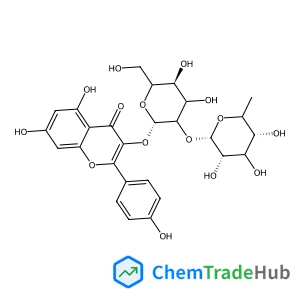
5,7-Dihydroxy-2-(4-hydroxyphenyl)-4-oxo-4H-chromen-3-yl 2-O-(6-deoxy-alpha-L-mannopyranosyl)-beta-D-glucopyranoside
CAS Number:
32602-81-6
Molecular Formula:
C27H30O15
![2-Hydroxy-4-[({[(4-methylphenyl)sulfonyl]oxy}acetyl)amino]benzoic acid structure](https://static.chemtradehub.com/structs/501/501919-59-1-579f.webp "2-Hydroxy-4-[({[(4-methylphenyl)sulfonyl]oxy}acetyl)amino]benzoic acid structure")
2-Hydroxy-4-[({[(4-methylphenyl)sulfonyl]oxy}acetyl)amino]benzoic acid
CAS Number:
501919-59-1
Molecular Formula:
C16H15NO7S
Recommended Suppliers






Disclaimer
This page provides academic journal information for reference and research purposes only. We are not affiliated with any journal publishers and do not handle publication submissions. For publication-related inquiries, please contact the respective journal publishers directly.
If you notice any inaccuracies in the information displayed, please contact us at support@chemtradehub.com. We will promptly review and address your concerns.