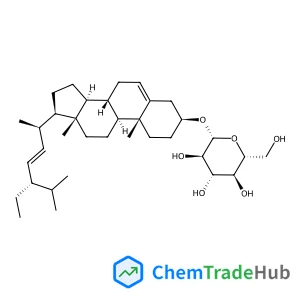
(3beta,22E)-Stigmasta-5,22-dien-3-yl beta-D-glucopyranoside
CAS Number:
19716-26-8
Molecular Formula:
C35H58O6
Jingke Fu, Xiaohong Huo, Bowen Li
Synergistic catalysis is gaining increasing attention due to its advantages over traditional catalytic methodologies, such as improved catalytic activity, broader substrate scope, increased selectivity and lower cost. Methodologies involving the synergistic combination of metal catalysts and organocatalysts have been intensively studied. Given the clear benefits of bimetallic catalyst systems consisting of two distinct metal catalysts, cooperative bimetallic catalysis has proved to be successful for a number of difficult asymmetric transformations. This review highlights the recent advances in bimetallic systems for catalytic asymmetric allylic substitution reactions. Strategies using a chiral metal catalyst and the cooperative effect of a second achiral metal catalyst for asymmetric transformations are discussed. Additionally, several challenging asymmetric reactions realized by employing two different chiral metal catalysts in a synergistic manner are also covered.
Thea Welzel, Wolfgang Meyer-Zaika, Matthias Epple
DOI: 10.1039/B402521K
Isabelle Gener, Philippe Ayrault, Michel Guisnet
DOI: 10.1039/B409964H
Panagiotis Manesiotis, Andrew J. Hall, Marco Emgenbroich, Milena Quaglia, Ersilia De Lorenzi, Börje Sellergren
DOI: 10.1039/B407870E
Martina H. Stenzel, Thomas P. Davis, Christopher Barner-Kowollik
DOI: 10.1039/B404763J
Xuefeng Zhu, Haihui Wang, Weishen Yang
DOI: 10.1039/B400857J
Nicole Brausch, Andreas Metlen, Peter Wasserscheid
DOI: 10.1039/B403464C
Gema Blanco-Brieva, Encarnación Cano-Serrano, Jose M. Campos-Martin, Jose L. G. Fierro
DOI: 10.1039/B402530J
Stephen G. Davies, Gesine J. Hermann, Miles J. Sweet, Andrew D. Smith
DOI: 10.1039/B401293C
Ji Ma, Sidney M. Hecht
DOI: 10.1039/B402925A
Edwin C. Constable, Catherine E. Housecroft, Markus Neuburger, Sebastien Reymann, Sylvia Schaffner
DOI: 10.1039/B402376E
When handling 2-Chloro-1,2-bis(4-methylphenyl)ethanone (CAS: 71193-32-3), it is ...
4-Ethoxy-3-(5-methyl-4-oxo-7-propyl-1,4-dihydroimidazo[5,1-f][1,2,4]triazin-2-yl...
Methyl 3-Oxo-4-Androsten-17-Carboxylate (CAS: 2681-55-2) should be stored in a c...
(R)-3-Amino-4-(3-hexylphenylamino)-4-oxobutylphosphonic acid is primarily used i...
2-Methyl-2-propanyl 3-amino-3-carbamoyl-1-azetidinecarboxylate (CAS: 1254120-14-...
There are alternative reagents that can be used in synthesis instead of (E)-4-(t...
[2-(3-Chlorophenyl)-1,3-thiazol-4-yl]methanol (CAS: 121202-20-8) is a crystallin...
The market and research trends for Methyl (2S)-[(4S)-2,2-dimethyl-1,3-dioxolan-4...
The market for 1-Bromo-2-isocyanatoethane (CAS: 42865-19-0) is driven by its use...
4-Nitro-D-phenylalanine hydrochloride (CAS: 147065-06-3) is primarily used in re...

Organic & Biomolecular Chemistry (OBC) publishes original and high impact research and reviews in organic chemistry. We welcome research that shows new or significantly improved protocols or methodologies in total synthesis, synthetic methodology or physical and theoretical organic chemistry as well as research that shows a significant advance in the organic chemistry or molecular design aspects of chemical biology, catalysis, supramolecular and macromolecular chemistry, theoretical chemistry, mechanism-oriented physical organic chemistry, medicinal chemistry or natural products. Articles published in the journal should report new work which makes a highly-significant impact in the field. Routine and incremental work is generally not suitable for publication in the journal. More details about key areas of our scope are below. In all cases authors should include in their article clear rationale for why their research has been carried out.