












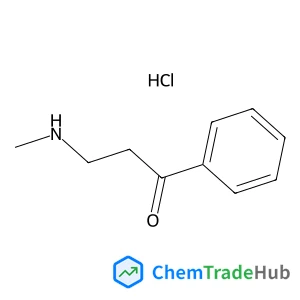
3-(Methylamino)-1-phenyl-1-propanone hydrochloride (1:1)
CAS Number:
2538-50-3
Molecular Formula:
C10H14ClNO
F. Nici, G. Oliviero, A. P. Falanga, S. D'Errico, M. Marzano, D. Musumeci, D. Montesarchio, S. Noppen, C. Pannecouque, G. Piccialli, N. Borbone
By combining the ability of short G-rich oligodeoxyribonucleotides (ODNs) containing the sequence 5′CGGA3′ to form higher order G-quadruplex (G4) complexes with the tetra-end-linked (TEL) concept to produce aptamers targeting the HIV envelope glycoprotein 120 (gp120), three new TEL-ODNs (1–3) having the sequence 5′CGGAGG3′ were synthesized with the aim of studying the effect of G4 dimerization on their anti-HIV activity. Furthermore, in order to investigate the effect of the groups at the 5′ position, the 5′ ends of 1–3 were left uncapped (1) or capped with either the lipophilic dimethoxytrityl (DMT) (2) or the hydrophilic glucosyl-4-phosphate (3) moieties. The here reported results demonstrate that only the DMT-substituted TEL-ODN 2 is effective in protecting human MT-4 cell cultures from HIV infection (76% max protection), notwithstanding all the three new aptamers proved to be capable of forming stable higher order dimeric G4s when annealed in K+-containing buffer, thus suggesting that the recognition of a hydrophobic pocket on the target glycoprotein by the aptamers represents a main structural feature for triggering their anti-HIV activity.
S. M. Souvi, N. Berkaïne, M. E. Alikhani, L. Manceron
DOI: 10.1039/B910056C
Valentina Domenici
DOI: 10.1039/B902168J
Tibor Pasinszki, Gábor Bazsó, Melinda Krebsz, György Tarczay
DOI: 10.1039/B913204J
A. Ghoufi, V. Lachet
DOI: 10.1039/B823295D
Sandra Monti, Stefano Ottani, Francesco Manoli, Ilse Manet, Francesco Scagnolari, Barbara Zambelli, Giancarlo Marconi
DOI: 10.1039/B906021A
Jianbo Liu, Scott L. Anderson
DOI: 10.1039/B908328F
L. Marleny Rodriguez Albelo, A. Rabdel Ruiz-Salvador, Dewi W. Lewis, Ariel Gómez, Pierre Mialane, Jérome Marrot, Anne Dolbecq, Alvaro Sampieri, Caroline Mellot-Draznieks
DOI: 10.1039/C004234J
Wei Chen, Yongcai Qiu, Shihe Yang
DOI: 10.1039/C000584C
Wei-Chun Lin, Szu-Hsian Lee, Ying-Yu Chen, Yu-Chin Lin, Che-Hung Kuo
DOI: 10.1039/B902044F
Waste containing N-Methoxy-N-methyl-1,3-thiazole-5-carboxamide (CAS: 898825-89-3...
N-(4-Biphenylyl)dibenzo[b,d]furan-4-amine should be stored in a tightly sealed c...
The market for 3-Acetamido-5-amino-2,4,6-triiodobenzoic acid (CAS: 1713-07-1) is...
Benzyl 2-O-acetyl-3,4,6-tri-O-benzyl-beta-D-galactopyranoside (CAS: 61820-03-9) ...
2-Ethylpiperazine dihydrochloride (CAS: 438050-52-3) is regulated under the Glob...
1,1'-[1,3-Phenylenebis(methylene)]bis(3-methyl-1H-pyrrole-2,5-dione) (CAS: 11946...
Several alternatives can be used in the synthesis of 5-Fluoro-2-(1-pyrrolidinyl)...
Proper personal protective equipment (PPE) must be worn when handling this compo...
When handling 6-Bromoimidazo[1,2-a]pyridin-8-amine, it is important to wear appr...
Alternatives to (2S,4R)-4-(4-Nitrobenzyl)pyrrolidine-2-carboxylic acid hydrochlo...

Organic & Biomolecular Chemistry (OBC) publishes original and high impact research and reviews in organic chemistry. We welcome research that shows new or significantly improved protocols or methodologies in total synthesis, synthetic methodology or physical and theoretical organic chemistry as well as research that shows a significant advance in the organic chemistry or molecular design aspects of chemical biology, catalysis, supramolecular and macromolecular chemistry, theoretical chemistry, mechanism-oriented physical organic chemistry, medicinal chemistry or natural products. Articles published in the journal should report new work which makes a highly-significant impact in the field. Routine and incremental work is generally not suitable for publication in the journal. More details about key areas of our scope are below. In all cases authors should include in their article clear rationale for why their research has been carried out.
![4-{2-[4-(2-Methyl-2-propanyl)phenyl]ethoxy}quinazoline structure](https://static.chemtradehub.com/structs/120/120928-09-8-d3db.webp "4-{2-[4-(2-Methyl-2-propanyl)phenyl]ethoxy}quinazoline structure")





