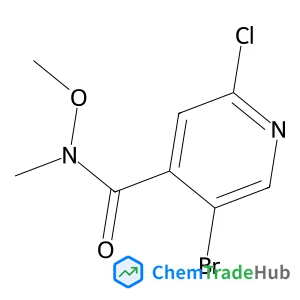
5-Bromo-2-chloro-N-methoxy-N-methylisonicotinamide
CAS Number:
1256790-08-5
Molecular Formula:
C8H8BrClN2O2
Suguru Ito, Manami Okuno, Masatoshi Asami
Chiral anionic species are ubiquitous and play important roles in biological systems. Despite the recent advancements in synthetic anion receptors bearing urea functionalities, urea-based chiral solvating agents (CSAs) that can separate the NMR signals of racemic anions remain limited. Herein, three dibenzofuran-based C2-symmetric chiral bisureas were synthesized from the reaction of (R,R)-4,6-bis(1-aminopropyl)dibenzo[b,d]furan with phenyl isocyanate, phenyl thioisocyanate, or tosyl isocyanate. The chiral anion recognition properties of these bisureas were examined by 1H NMR spectroscopy using DL-tetrabutylammonium mandelate (TBAM) as a model substrate. A clear baseline separation of the enantiomeric signals of the benzylic proton of TBAM was achieved upon mixing with 0.5 equivalents of bis(phenylurea). In contrast to previous urea-based chiral anion receptors that differentiate the enantiomers of chiral anions by forming 1 : 1 host–guest complexes, a high chiral recognition ability of chiral bis(phenylurea) was achieved owing to the generation of an equilibrium between free guests, 1 : 1 host–guest complexes, and 1 : 2 host–guest complexes. Chiral bis(phenylurea) was also successfully employed in the separation of the enantiomeric 1H NMR signals of various racemic anions.

New Journal of Chemistry

Journal of Peptide Science

Russian Journal of General Chemistry

Organic Process Research & Development

Russian Journal of Bioorganic Chemistry

Drug Discovery Today

Saudi Pharmaceutical Journal

Russian Journal of Organic Chemistry

Russian Journal of Coordination Chemistry

Russian Journal of Applied Chemistry
Chad M. Huelsman, Phillip E. Savage
DOI: 10.1039/C2CP23910H
Krithika Venkataramani, Thomas N. Jensen, Stig Helveg, Michael Reichling, Flemming Besenbacher, Jeppe V. Lauritsen
DOI: 10.1039/C2CP22712F
Chang-Soo Lee, Liudmila Larina, Young-Min Shin, Essam A. Al-Ammar, Byung Tae Ahn
DOI: 10.1039/C2CP40355B
Takashi Tachikawa, Shi-Cong Cui, Mamoru Fujitsuka, Tetsuro Majima
DOI: 10.1039/C2CP23317G
Oleksandr A. Kucherak, Ludovic Richert, Yves Mély, Andrey S. Klymchenko
DOI: 10.1039/C2CP23037B
Thomas Steinbrecher, Mario S. Mommer, Yuki Nagata, Marcus Elstner
DOI: 10.1039/C2CP23489K
M. Erko, D. Wallacher, A. Hoell, T. Hauß, I. Zizak, O. Paris
DOI: 10.1039/C2CP24075K
Alexandra Nemkevich, Ben Corry, Mark A. Spackman
DOI: 10.1039/C2CP23384C
Yavuz Dede, Ilker Ozkan
DOI: 10.1039/C2CP23127A
(3.beta.)-3-Hydroxy-N,N-dimethyl-chol-5-en-24-amide (CAS: 79066-03-8) is primari...
5-(Aminomethyl)-2-methoxyphenol (CAS: 89702-89-6) is classified under GHS as a s...
Thieno[2,3-c]pyridin-7(6H)-one (CAS: 28981-13-7) is a heterocyclic organic compo...
1-[(6-Methoxy-3-pyridinyl)methyl]-4-piperidinamine dihydrochloride is generally ...
[(2E)-3-Phenyl-2-propen-1-yl]phosphonic acid (CAS: 146404-58-2) is regulated und...
6-Bromo-7-methoxyquinoline (CAS: 1620515-86-7) falls under the scope of the Glob...
This compound is primarily used in the pharmaceutical industry for the developme...
1-Ethyl-7-[2-methyl-6-(4H-1,2,4-triazol-3-yl)-3-pyridinyl]-3,5-dihydropyrazino[2...
Alternative reagents such as 2-[(dimethylamino)methyl]phenylboronic acid or rela...
3-(Piperidin-4-yloxy)pyridine (CAS: 310881-48-2) is an organic compound with the...

Organic & Biomolecular Chemistry (OBC) publishes original and high impact research and reviews in organic chemistry. We welcome research that shows new or significantly improved protocols or methodologies in total synthesis, synthetic methodology or physical and theoretical organic chemistry as well as research that shows a significant advance in the organic chemistry or molecular design aspects of chemical biology, catalysis, supramolecular and macromolecular chemistry, theoretical chemistry, mechanism-oriented physical organic chemistry, medicinal chemistry or natural products. Articles published in the journal should report new work which makes a highly-significant impact in the field. Routine and incremental work is generally not suitable for publication in the journal. More details about key areas of our scope are below. In all cases authors should include in their article clear rationale for why their research has been carried out.