












Density minimum of confined water at low temperatures: a combined study by small-angle scattering of X-rays and neutrons
Literature Information
Publication Date
2012-01-23
DOI
10.1039/C2CP24075K
Impact Factor
3.676
Authors
M. Erko, D. Wallacher, A. Hoell, T. Hauß, I. Zizak, O. Paris
View Original
Abstract
A simple explanation is given for the low-temperature density minimum of water confined within cylindrical pores of ordered nanoporous materials of different pore size. The experimental evidence is based on combined data from in-situ small-angle scattering of X-rays (SAXS) and neutrons (SANS), corroborated by additional wide-angle X-ray scattering (WAXS). The combined scattering data cannot be described by a homogeneous density distribution of water within the pores, as was originally suggested from SANS data alone. A two-step density model reveals a wall layer covering approximately two layers of water molecules with higher density than the residual core water in the central part of the pores. The temperature-induced changes of the scattering signal from both X-rays and neutrons are consistent with a minimum of the average water density. We show that the temperature at which this minimum occurs depends monotonically on the pore size. Therefore we attribute this minimum to a liquid–solid transition of water influenced by confinement. For water confined in the smallest pores of only 2 nm in diameter, the density minimum is explained in terms of a structural transition of the surface water layer closest to the hydrophilic pore walls.
Related Literature
Ab initio based kinetic Monte Carlo analysis to unravel the propagation kinetics in vinyl acetate pulsed laser polymerization
Gilles B. Desmet, Yoshi W. Marien, Paul H. M. Van Steenberge, Marie-Françoise Reyniers, Guy B. Marin
2017-10-30
Paper
DOI: 10.1039/C7PY01008G
Polyurethane with an ionic liquid crosslinker: a new class of super shape memory-like polymers
Prasanta Kumar Behera, Prantik Mondal, Nikhil K. Singha
2018-06-12
Paper
DOI: 10.1039/C8PY00549D
Grafting-from lipase: utilization of a common amino acid residue as a new grafting site
Boyle Cheng
2018-08-17
Paper
DOI: 10.1039/C8PY01026A
Swelling properties of thermoresponsive/hydrophilic co-networks with functional crosslinked domain structures
Shohei Ida, Hironobu Kitanaka, Tatsuya Ishikawa, Shokyoku Kanaoka, Yoshitsugu Hirokawa
2018-01-03
Paper
DOI: 10.1039/C7PY01793F
Highly efficient luminescent side-chain polymers with short-spacer attached tetraphenylethylene AIEgens via RAFT polymerization capable of naked eye explosive detection
Qian Li, Xiao Li, Zhongying Wu, Yuhao Sun, Jianglin Fang, Dongzhong Chen
2018-07-02
Paper
DOI: 10.1039/C8PY00710A
Cd2+ coordination: an efficient structuring switch for polypeptide polymers
2018-06-13
Communication
DOI: 10.1039/C8PY00810H
Simultaneous superior lubrication and high load bearing by the dynamic weak interaction of a lubricant with mechanically strong bilayer porous hydrogels
Meirong Cai, Bo Yu, Feng Zhou
2017-10-03
Communication
DOI: 10.1039/C7PY01532A
You might also like
Compound Q&A
What are the main uses of (3.beta.)-3-Hydroxy-N,N-dimethyl-chol-5-en-24-amide (CAS: 79066-03-8)?
(3.beta.)-3-Hydroxy-N,N-dimethyl-chol-5-en-24-amide (CAS: 79066-03-8) is primari...
79066-03-8(3.beta.)-3-Hydroxy-...
Compound Q&A
What regulatory guidelines apply to 5-(aminomethyl)-2-methoxyphenol (CAS: 89702-89-6)?
5-(Aminomethyl)-2-methoxyphenol (CAS: 89702-89-6) is classified under GHS as a s...
89702-89-65-(aminomethyl)-2-me...
Compound Q&A
What is Thieno[2,3-c]pyridin-7(6H)-one (CAS: 28981-13-7)?
Thieno[2,3-c]pyridin-7(6H)-one (CAS: 28981-13-7) is a heterocyclic organic compo...
28981-13-7Thieno[2,3-c]pyridin...
Compound Q&A
Is 1-[(6-Methoxy-3-pyridinyl)methyl]-4-piperidinamine dihydrochloride (CAS: 1185311-28-7) safe?
1-[(6-Methoxy-3-pyridinyl)methyl]-4-piperidinamine dihydrochloride is generally ...
1185311-28-71-[(6-Methoxy-3-pyri...
Compound Q&A
What regulatory guidelines apply to [(2E)-3-Phenyl-2-propen-1-yl]phosphonic acid (CAS: 146404-58-2)?
[(2E)-3-Phenyl-2-propen-1-yl]phosphonic acid (CAS: 146404-58-2) is regulated und...
146404-58-2[(2E)-3-Phenyl-2-pro...
Compound Q&A
What regulatory guidelines apply to 6-Bromo-7-methoxyquinoline (CAS: 1620515-86-7)?
6-Bromo-7-methoxyquinoline (CAS: 1620515-86-7) falls under the scope of the Glob...
1620515-86-76-Bromo-7-methoxyqui...
Compound Q&A
What industries use (2R)-1-(1-Benzofuran-2-yl)-N-propyl-2-pentanamine (CAS: 260550-89-8)?
This compound is primarily used in the pharmaceutical industry for the developme...
260550-89-8(2R)-1-(1-Benzofuran...
Compound Q&A
What are the main uses of 1-Ethyl-7-[2-methyl-6-(4H-1,2,4-triazol-3-yl)-3-pyridinyl]-3,5-dihydropyrazino[2,3-b]pyrazin-2(1H)-one (CAS: 1228013-15-7)?
1-Ethyl-7-[2-methyl-6-(4H-1,2,4-triazol-3-yl)-3-pyridinyl]-3,5-dihydropyrazino[2...
1228013-15-71-Ethyl-7-[2-methyl-...
Compound Q&A
Are there alternatives to {5-(Acryloylamino)-2-[(dimethylamino)methyl]phenyl}boronic acid (CAS: 1217500-78-1) in synthesis?
Alternative reagents such as 2-[(dimethylamino)methyl]phenylboronic acid or rela...
1217500-78-1{5-(Acryloylamino)-2...
Compound Q&A
What is 3-(Piperidin-4-yloxy)pyridine (CAS: 310881-48-2)?
3-(Piperidin-4-yloxy)pyridine (CAS: 310881-48-2) is an organic compound with the...
310881-48-23-(Piperidin-4-yloxy...
Source Journal
Physical Chemistry Chemical Physics

CiteScore:
5.5
Self-citation Rate:
10.3%
Articles per Year:
3036
Physical Chemistry Chemical Physics (PCCP) is an international journal co-owned by 19 physical chemistry and physics societies from around the world. This journal publishes original, cutting-edge research in physical chemistry, chemical physics and biophysical chemistry. To be suitable for publication in PCCP, articles must include significant innovation and/or insight into physical chemistry; this is the most important criterion that reviewers and Editors will judge against when evaluating submissions. The journal has a broad scope and welcomes contributions spanning experiment, theory, computation and data science. Topical coverage includes spectroscopy, dynamics, kinetics, statistical mechanics, thermodynamics, electrochemistry, catalysis, surface science, quantum mechanics, quantum computing and machine learning. Interdisciplinary research areas such as polymers and soft matter, materials, nanoscience, energy, surfaces/interfaces, and biophysical chemistry are welcomed if they demonstrate significant innovation and/or insight into physical chemistry. Joined experimental/theoretical studies are particularly appreciated when complementary and based on up-to-date approaches.
Recommended Compounds
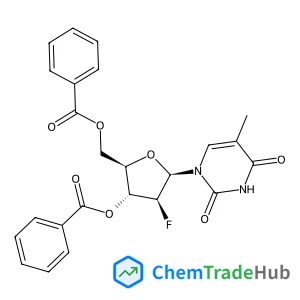
1-(3',5'-Di-O-benzoyl-2'-deoxy-2'-fluoro-b-D-arabinofuranosyl)thymine
CAS Number:
97614-47-6
Molecular Formula:
C24H21FN2O7
Recommended Suppliers





Disclaimer
This page provides academic journal information for reference and research purposes only. We are not affiliated with any journal publishers and do not handle publication submissions. For publication-related inquiries, please contact the respective journal publishers directly.
If you notice any inaccuracies in the information displayed, please contact us at support@chemtradehub.com. We will promptly review and address your concerns.