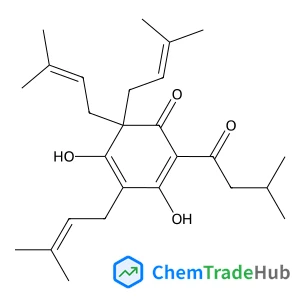
3,5-Dihydroxy-4-(3-methylbutanoyl)-2,6,6-tris(3-methyl-2-buten-1-yl)-2,4-cyclohexadien-1-one
CAS Number:
468-28-0
Molecular Formula:
C26H38O4
Jean-Michel Guigner
The precision synthesis and self-assembly of amphiphilic copolypeptides containing a recombinant elastin-like polypeptide (ELP) block used as a macroinitiator for the ring opening polymerization (ROP) of γ-benzyl-L-glutamate (γ-BLG NCA) are herein presented. The molecular weight of the resulting PBLG-b-ELP block copolypeptides was precisely controlled without the use of complex initiator or demanding experimental setup. Diblock copolypeptides were obtained with an excellent control of the polymerization highlighted by the dispersity below 1.04. These amphiphilic hybrid synthetic/recombinant copolypeptides were self-assembled in water and the nanoparticles obtained were characterized by a combination of dynamic light scattering and electron microscopy. A variety of morphologies, namely polymersomes, inter-connected worm-like micelles and spherical micelles, were evidenced depending on the hydrophilic ratio of the diblocks as well as the self-assembly procedure.
Sophie H. Dale, Mark R. J. Elsegood, Simon J. Richards
DOI: 10.1039/B402922D
Paul A. Midgley
DOI: 10.1039/B315513G
Stephen G. Davies, Gesine J. Hermann, Miles J. Sweet, Andrew D. Smith
DOI: 10.1039/B401293C
Yasuo Iida, Kyuichi Yasui, Toru Tuziuti, Manickam Sivakumar, Yoshishige Endo
DOI: 10.1039/B410015H
Narcis Avarvari, Marc Fourmigué
DOI: 10.1039/B403168G
Nan Ding, Duck-Young Chung, Mercouri G. Kanatzidis
DOI: 10.1039/B402686A
Banu Kesanli, Wenbin Lin
DOI: 10.1039/B406697A
Julie Grumelard, Andreas Taubert, Wolfgang Meier
DOI: 10.1039/B405671J
Kazuhisa Fujimoto, Natsuko Oimoto, Kahori Katsuno, Masahiko Inouye
DOI: 10.1039/B403615H
Francis D'Souza, Suresh Gadde, Melvin E. Zandler, Mitsunari Itou, Yasuyuki Araki, Osamu Ito
DOI: 10.1039/B407985J
When handling 2-Chloro-1,2-bis(4-methylphenyl)ethanone (CAS: 71193-32-3), it is ...
4-Ethoxy-3-(5-methyl-4-oxo-7-propyl-1,4-dihydroimidazo[5,1-f][1,2,4]triazin-2-yl...
Methyl 3-Oxo-4-Androsten-17-Carboxylate (CAS: 2681-55-2) should be stored in a c...
(R)-3-Amino-4-(3-hexylphenylamino)-4-oxobutylphosphonic acid is primarily used i...
2-Methyl-2-propanyl 3-amino-3-carbamoyl-1-azetidinecarboxylate (CAS: 1254120-14-...
There are alternative reagents that can be used in synthesis instead of (E)-4-(t...
[2-(3-Chlorophenyl)-1,3-thiazol-4-yl]methanol (CAS: 121202-20-8) is a crystallin...
The market and research trends for Methyl (2S)-[(4S)-2,2-dimethyl-1,3-dioxolan-4...
The market for 1-Bromo-2-isocyanatoethane (CAS: 42865-19-0) is driven by its use...
4-Nitro-D-phenylalanine hydrochloride (CAS: 147065-06-3) is primarily used in re...

Organic & Biomolecular Chemistry (OBC) publishes original and high impact research and reviews in organic chemistry. We welcome research that shows new or significantly improved protocols or methodologies in total synthesis, synthetic methodology or physical and theoretical organic chemistry as well as research that shows a significant advance in the organic chemistry or molecular design aspects of chemical biology, catalysis, supramolecular and macromolecular chemistry, theoretical chemistry, mechanism-oriented physical organic chemistry, medicinal chemistry or natural products. Articles published in the journal should report new work which makes a highly-significant impact in the field. Routine and incremental work is generally not suitable for publication in the journal. More details about key areas of our scope are below. In all cases authors should include in their article clear rationale for why their research has been carried out.