


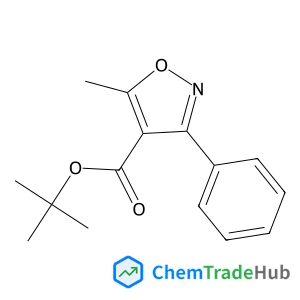
2-Methyl-2-propanyl 5-methyl-3-phenyl-1,2-oxazole-4-carboxylate
CAS Number:
211429-79-7
Molecular Formula:
C15H17NO3
Daniel Kopetzki, Markus Antonietti
It is demonstrated that transfer hydrogenation from formic acid to levulinic acid under hydrothermal conditions can be catalyzed by bases, but also by simple sodium sulfate. The action of salt addition could be clarified and ascribed to the changing dissociation constants at high temperature. This renders sulfate a temperature-switchable base in hydrothermal syntheses. Using such salts can help in preventing waste, as neutralization after reaction is not necessary. By optimizing the reaction conditions, the yield of γ-valerolactone, a sustainable biofuel molecule, could be raised to 12% for a simple passage through a capillary flow reactor with a residence time of less than 20 min.

Russian Chemical Reviews

Molecular Pharmacology

Journal of Catalysis

Journal of Heterocyclic Chemistry

Organic Preparations and Procedures International

Fibre Chemistry

Pure and Applied Chemistry

Israel Journal of Chemistry

Journal of Organometallic Chemistry

Proceedings of the National Academy of Sciences of the United States of America
Alireza Azizi, Roya Momen, Steven R. Kirk, Samantha Jenkins
DOI: 10.1039/C9CP05066C
Pei-Ling Luo, Er-Chien Horng
DOI: 10.1039/C9CP03090E
José R. B. Gomes, Francesc Viñes, Francesc Illas, José L. C. Fajín
DOI: 10.1039/C9CP02817J
Stella Schmode, Payal Chatterjee, Alexander D. MacKerell, Jr., Christian Schröder
DOI: 10.1039/C9CP03000J
Jae-Uk Lee, Min Ho Chang, Takuji Oda
DOI: 10.1039/C9CP03188J
Yunfan Yang, Yu Zhao, Shixing Liu, Yongqing Li
DOI: 10.1039/C9CP03752G
Di Huang, Haina Zhu
DOI: 10.1039/C9CP04018H
Hiroki Uratani, Chien-Pin Chou
DOI: 10.1039/C9CP04739E
When handling 4-Methyl-6-(trifluoromethyl)quinoline (CAS: 40716-16-3), safety go...
4-(3,5-Difluorophenyl)aniline is an aromatic organic compound with the CAS numbe...
5-{[4-(Trifluoromethyl)phenyl]sulfanyl}-1,2,3-thiadiazole-4-carboxylic acid can ...
The market for 4-Benzylaniline hydrochloride (CAS: 6317-57-3) is steadily growin...
[3-(Diethylsulfamoyl)phenyl]boronic acid is generally considered safe when handl...
3-Bromo-2,5-dimethoxyaniline is mainly used in the pharmaceutical and chemical i...
N-Methyl-1-(5-methyl-1H-indol-3-yl)methanamine (CAS: 915922-67-7) is subject to ...
This compound is primarily used in the pharmaceutical industry for the synthesis...
2-Methyl-2-propanyl [(1S,3R)-3-aminocyclohexyl]carbamate (CAS: 1298101-47-9) sho...
Ethyl 2-bromo-4,4,4-trifluorobutanoate (CAS: 367-33-9) is utilized in the pharma...

Green Chemistry provides a unique forum for the publication of innovative research on the development of alternative green and sustainable technologies. The scope of Green Chemistry is based on, but not limited to, the definition proposed by Anastas and Warner (Green Chemistry: Theory and Practice, P T Anastas and J C Warner, Oxford University Press, Oxford, 1998). Green chemistry is the utilisation of a set of principles that reduces or eliminates the use or generation of hazardous substances in the design, manufacture and application of chemical products. Green Chemistry is at the frontiers of this continuously-evolving interdisciplinary science and publishes research that attempts to reduce the environmental impact of the chemical enterprise by developing a technology base that is inherently non-toxic to living things and the environment. Submissions on all aspects of research relating to the endeavour are welcome. The journal publishes original and significant cutting-edge research that is likely to be of wide general appeal. To be published, work must present a significant advance in green chemistry. Papers must contain a comparison with existing methods and demonstrate advantages over those methods before publication can be considered. For more information please see this Editorial. Coverage includes the following, but is not limited to: Design (e.g. biomimicry, design for degradation/recycling/reduced toxicity…) Reagents & Feedstocks (e.g. renewables, CO2, solvents, auxiliary agents, waste utilization…) Synthesis (e.g. organic, inorganic, synthetic biology…) Catalysis (e.g. homogeneous, heterogeneous, enzyme, whole cell…) Process (e.g. process design, intensification, separations, recycling, efficiency…) Energy (e.g. renewable energy, fuels, photovoltaics, fuel cells, energy storage, energy carriers…) Applications (e.g. electronics, dyes, consumer products, coatings, pharmaceuticals, preservatives, building materials, chemicals for industry/agriculture/mining…) Impact (e.g. safety, metrics, LCA, sustainability, (eco)toxicology…) Green chemistry is, by definition, a continuously-evolving frontier. Therefore, the inclusion of a particular material or technology does not, of itself, guarantee that a paper is suitable for the journal. To be suitable, the novel advance should have the potential for reduced environmental impact relative to the state of the art. Green Chemistry does not normally deal with research associated with 'end-of-pipe' or remediation issues.
![[3-(2,6-Dichlorophenyl)-5-isopropyl-1,2-oxazol-4-yl]methanol structure](https://static.chemtradehub.com/structs/278/278597-30-1-5c79.webp "[3-(2,6-Dichlorophenyl)-5-isopropyl-1,2-oxazol-4-yl]methanol structure")





