












![1-[3-(4-Morpholinylsulfonyl)phenyl]methanamine structure](https://static.chemtradehub.com/structs/933/933989-32-3-51af.webp "1-[3-(4-Morpholinylsulfonyl)phenyl]methanamine structure")
New insights into the plasmonic enhancement for photocatalytic H2 production by Cu–TiO2 upon visible light illumination
Literature Information
Publication Date
2018-01-19
DOI
10.1039/C7CP07762A
Impact Factor
3.676
Authors
S. Hamid, F. Sieland, J. Sann, S. Xia, J. Schneider
View Original
Abstract
Cu nanoparticles were deposited on the surface of commercial TiO2 nanoparticles (Cu–TiO2) using different methods aiming at the production of highly efficient visible light photocatalysts. Photocatalytic H2 evolution rates obtained from methanol/water mixtures revealed no significant influence of the presence of copper oxides on the photoreaction upon visible light illumination. The photocatalytic H2 production rates were evaluated upon illumination with different spectral ranges (≥420 nm or ≥500 nm) and the results evidenced that the visible light induced charge carrier formation on the Cu–TiO2 photocatalysts consists of two distinct pathways: the direct excitation of TiO2 and the induced excitation by the so-called surface plasmon resonance (SPR) effect of the Cu nanoparticles on the TiO2 surface. Both pathways are present when the full visible range of the spectrum is used (≥420 nm), while for illumination at longer wavelengths (≥500 nm), the photocatalytic activity is solely promoted by the Cu-SPR effect. Electron paramagnetic resonance (EPR) and laser flash photolysis measurements were performed to clarify the underlying mechanism of Cu–TiO2 photocatalysts upon visible light illumination.
Related Literature
Enhancement of hematoporphyrin IX potential for photodynamic therapy by entrapment in silica nanospheres
Paulo R. Silva, Lucas L. R. Vono, Breno P. Espósito, Maurício S. Baptista, Liane M. Rossi
2011-07-19
Paper
DOI: 10.1039/C1CP21525F
Interactions of 1-butyl-3-methylimidazolium carboxylate ionic liquids with glucose in water: a study of volumetric properties, viscosity, conductivity and NMR
Kelei Zhuo, Yujuan Chen, Jing Chen, Guangyue Bai, Jianji Wang
2011-07-12
Paper
DOI: 10.1039/C1CP20948E
Interactions of the N3 dye with the iodide redox shuttle: quantum chemical mechanistic studies of the dye regeneration in the dye-sensitized solar cell
Abu Md Asaduzzaman, Georg Schreckenbach
2011-07-20
Paper
DOI: 10.1039/C1CP21168D
Ionic liquids and oligomer electrolytes based on the B(CN)4− anion; ion association, physical and electrochemical properties
Johan Scheers, Jagath Pitawala, Frederic Thebault, Jae-Kwang Kim, Jou-Hyeon Ahn, Aleksandar Matic, Per Jacobsson
2011-07-21
Paper
DOI: 10.1039/C1CP21062A
Excitons in semiconducting carbon nanotubes: diameter-dependent photoluminescence spectra
Yoshihiko Kanemitsu
2011-07-07
Perspective
DOI: 10.1039/C1CP21235D
Oxygen-containing gas-phase diatomic trications and tetracations: ReOz+, NbOz+ and HfOz+ (z = 3, 4)
V. Brites, K. Franzreb, J. N. Harvey, S. G. Sayres, M. W. Ross, D. E. Blumling, A. W. Castleman, Jr., M. Hochlaf
2011-07-15
Paper
DOI: 10.1039/C1CP21566C
μ-XAFS of a single particle of a practical NiOx/Ce2Zr2Oy catalyst
Tomoya Uruga, Hajime Tanida, Yasuko Terada, Yasuhiro Iwasawa, Shin-ichi Ohkoshi
2011-06-08
Communication
DOI: 10.1039/C1CP20895K
Testing variations of the GW approximation on strongly correlated transition metal oxides: hematite (α-Fe2O3) as a benchmark
Peilin Liao, Emily A. Carter
2011-07-14
Paper
DOI: 10.1039/C1CP20829B
Molecular dynamics studies of native and substituted cyclodextrins in different media: 1. Charge derivation and force field performances
Christine Cézard, Frédéric Aubry, Florence Djedaïni-Pilard, François-Yves Dupradeau
2011-07-26
Paper
DOI: 10.1039/C1CP20854C
Kinetics of the C–C bond beta scission reactions in alkyl radicals
Artur Ratkiewicz
2011-07-22
Paper
DOI: 10.1039/C1CP21229J
You might also like
Compound Q&A
What are the main uses of 1-(3-Aminophenyl)-3-[(3R)-1-(3,3-dimethyl-2-oxobutyl)-2-oxo-5-(2-pyridinyl)-2,3-dihydro-1H-1,4-benzodiazepin-3-yl]urea (CAS: 155412-88-7)?
This compound is mainly used as an intermediate in the synthesis of antipsychoti...
155412-88-71-(3-Aminophenyl)-3-...
Compound Q&A
How should waste containing 1-(D-Ribofuranosyl)-1,4-dihydro-3-pyridinecarboxamide (CAS: 19132-12-8) be handled?
Waste containing 1-(D-Ribofuranosyl)-1,4-dihydro-3-pyridinecarboxamide (CAS: 191...
19132-12-81-(D-Ribofuranosyl)-...
Compound Q&A
What regulatory guidelines apply to 2-Methyl-2-propanyl 3-bromo-3-(hydroxymethyl)-1-azetidinecarboxylate (CAS: 2007919-81-3)?
2-Methyl-2-propanyl 3-bromo-3-(hydroxymethyl)-1-azetidinecarboxylate (CAS: 20079...
2007919-81-32-Methyl-2-propanyl ...
Compound Q&A
What is N-(4-Chloro-2-pyridinyl)acetamide (CAS: 245056-66-0)?
N-(4-Chloro-2-pyridinyl)acetamide (CAS: 245056-66-0) is a chemical compound with...
245056-66-0N-(4-Chloro-2-pyridi...
Compound Q&A
What is 5-Chloro-2-hydroxybenzoic acid (CAS: 321-14-2)?
5-Chloro-2-hydroxybenzoic acid, also known as 5-chlorosalicylic acid, is an arom...
321-14-25-Chloro-2-hydroxybe...
Compound Q&A
What precautions should be taken when handling 1,1-Dichloro-1-fluoroethane (CAS: 1717-00-6)?
When handling 1,1-Dichloro-1-fluoroethane (CAS: 1717-00-6), it is important to u...
1717-00-61,1-Dichloro-1-fluor...
Compound Q&A
What are the physical and chemical properties of Fmoc-(2S,3R)-3-phenylpyrrolidine-2-carboxylic acid (CAS: 281655-32-1)?
Fmoc-(2S,3R)-3-phenylpyrrolidine-2-carboxylic acid is a white crystalline solid ...
281655-32-1Fmoc-(2S,3R)-3-pheny...
Compound Q&A
What are the main uses of 4-Amino-5-bromo-2-pyridinecarboxylic acid (CAS: 1363381-01-4)?
4-Amino-5-bromo-2-pyridinecarboxylic acid is primarily used as a precursor in th...
1363381-01-44-Amino-5-bromo-2-py...
Compound Q&A
What precautions should be taken when handling (S)-tert-butyl 2-((2-(4-bromophenyl)-2-oxoethyl)carbamoyl)pyrrolidine-1-carboxylate (CAS: 1007881-98-2)?
Handling this compound should be done with personal protective equipment (PPE) i...
1007881-98-2(S)-tert-butyl 2-((2...
Compound Q&A
What precautions should be taken when handling 8-bromo-2,2-dimethyl-3,4-dihydro-2H-1,4-benzoxazin-3-one (CAS: 688363-73-7)?
When handling 8-bromo-2,2-dimethyl-3,4-dihydro-2H-1,4-benzoxazin-3-one, use prop...
688363-73-78-bromo-2,2-dimethyl...
Source Journal
Physical Chemistry Chemical Physics

CiteScore:
5.5
Self-citation Rate:
10.3%
Articles per Year:
3036
Physical Chemistry Chemical Physics (PCCP) is an international journal co-owned by 19 physical chemistry and physics societies from around the world. This journal publishes original, cutting-edge research in physical chemistry, chemical physics and biophysical chemistry. To be suitable for publication in PCCP, articles must include significant innovation and/or insight into physical chemistry; this is the most important criterion that reviewers and Editors will judge against when evaluating submissions. The journal has a broad scope and welcomes contributions spanning experiment, theory, computation and data science. Topical coverage includes spectroscopy, dynamics, kinetics, statistical mechanics, thermodynamics, electrochemistry, catalysis, surface science, quantum mechanics, quantum computing and machine learning. Interdisciplinary research areas such as polymers and soft matter, materials, nanoscience, energy, surfaces/interfaces, and biophysical chemistry are welcomed if they demonstrate significant innovation and/or insight into physical chemistry. Joined experimental/theoretical studies are particularly appreciated when complementary and based on up-to-date approaches.
Recommended Compounds
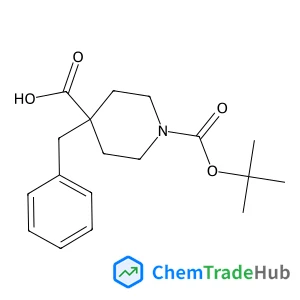
4-Benzyl-1-(tert-butoxycarbonyl)piperidine-4-carboxylic acid
CAS Number:
170838-87-6
Molecular Formula:
C18H25NO4

Recommended Suppliers






Disclaimer
This page provides academic journal information for reference and research purposes only. We are not affiliated with any journal publishers and do not handle publication submissions. For publication-related inquiries, please contact the respective journal publishers directly.
If you notice any inaccuracies in the information displayed, please contact us at support@chemtradehub.com. We will promptly review and address your concerns.