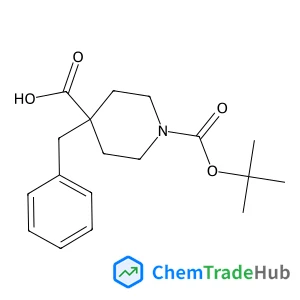
4-Benzyl-1-(tert-butoxycarbonyl)piperidine-4-carboxylic acid
CAS Number:
170838-87-6
Molecular Formula:
C18H25NO4
Natalia Wilke, Luis S. Mayorga
Cell-penetrating peptides (CPP) are short sequences of cationic amino-acids that show a surprising ability to traverse lipid bilayers. CPP are considered to be some of the most effective vectors to introduce membrane-impermeable cargos into cells, but the molecular basis of the membrane translocation mechanisms and its dependence on relevant membrane physicochemical properties have yet to be fully determined. In this paper we resort to Molecular Dynamics simulations and experiments to investigate how the electrostatic potential across the lipid/water interface affects the insertion of hydrophilic and amphipathic CPP into two-dimensional lipid structures. Simulations are used to quantify the effect of the transmembrane potential on the free-energy profile associated with the transfer of the CPP across a neutral lipid bilayer. It is found that the electrostatic bias has a relatively small effect on the binding of the peptides to the membrane surface, but that it significantly lowers the permeation barrier. A charge compensation mechanism, arising from the segregation of counter-ions while the peptide traverses the membrane, determines the shape and symmetry of the free-energy curves and underlines relevant mechanistic considerations. Langmuir monolayer experiments performed with a variety of amphiphiles model the incorporation of the CPP into the external membrane leaflet. It is shown that the dipole potential of the monolayer controls the extent of penetration of the CPP into the lipid aggregate, to a greater degree than its surface charge.

Journal of Catalysis

Molecular Pharmacology

Nature

Journal of Organometallic Chemistry

Planta Medica

European Journal of Wood and Wood Products

Proceedings of the National Academy of Sciences of the United States of America

Organic Preparations and Procedures International

Journal of Medicinal Chemistry

Kinetics and Catalysis
Dongsheng Fu, Yufeng Liu, Guoming Liu, Yunlan Su, Dujin Wang
DOI: 10.1039/C1CP21281H
Princia Salvatore, Allan Glargaard Hansen, Thomas Bjørnholm, Richard John Nichols, Jens Ulstrup
DOI: 10.1039/C1CP21197H
Troels Markussen, Robert Stadler, Kristian S. Thygesen
DOI: 10.1039/C1CP20924H
Hary Razafindralambo, Aurore Richel, Bernard Wathelet, Christophe Blecker, Jean-Paul Wathelet, Robert Brasseur, Laurence Lins, Jose Miñones, Jr., Michel Paquot
DOI: 10.1039/C1CP21365B
P. Schmitteckert
DOI: 10.1039/C1CP21247H
Hongpeng You
DOI: 10.1039/C1CP20635D
DOI: 10.1039/C1CP20508K
Andrea Sabatié-Gogova, Eric Renault, Gilles Montavon, Nicolas Galland
DOI: 10.1039/C1CP20512A
Junki Nagakubo, Minoru Ashizawa, Tadashi Kawamoto, Akihiko Tanioka
DOI: 10.1039/C1CP21507H
This compound is mainly used as an intermediate in the synthesis of antipsychoti...
Waste containing 1-(D-Ribofuranosyl)-1,4-dihydro-3-pyridinecarboxamide (CAS: 191...
2-Methyl-2-propanyl 3-bromo-3-(hydroxymethyl)-1-azetidinecarboxylate (CAS: 20079...
N-(4-Chloro-2-pyridinyl)acetamide (CAS: 245056-66-0) is a chemical compound with...
5-Chloro-2-hydroxybenzoic acid, also known as 5-chlorosalicylic acid, is an arom...
When handling 1,1-Dichloro-1-fluoroethane (CAS: 1717-00-6), it is important to u...
Fmoc-(2S,3R)-3-phenylpyrrolidine-2-carboxylic acid is a white crystalline solid ...
4-Amino-5-bromo-2-pyridinecarboxylic acid is primarily used as a precursor in th...
Handling this compound should be done with personal protective equipment (PPE) i...
When handling 8-bromo-2,2-dimethyl-3,4-dihydro-2H-1,4-benzoxazin-3-one, use prop...

Physical Chemistry Chemical Physics (PCCP) is an international journal co-owned by 19 physical chemistry and physics societies from around the world. This journal publishes original, cutting-edge research in physical chemistry, chemical physics and biophysical chemistry. To be suitable for publication in PCCP, articles must include significant innovation and/or insight into physical chemistry; this is the most important criterion that reviewers and Editors will judge against when evaluating submissions. The journal has a broad scope and welcomes contributions spanning experiment, theory, computation and data science. Topical coverage includes spectroscopy, dynamics, kinetics, statistical mechanics, thermodynamics, electrochemistry, catalysis, surface science, quantum mechanics, quantum computing and machine learning. Interdisciplinary research areas such as polymers and soft matter, materials, nanoscience, energy, surfaces/interfaces, and biophysical chemistry are welcomed if they demonstrate significant innovation and/or insight into physical chemistry. Joined experimental/theoretical studies are particularly appreciated when complementary and based on up-to-date approaches.
![4-Chloro-3-(trifluoromethyl)-1H-pyrrolo[2,3-b]pyridine structure](https://static.chemtradehub.com/structs/869/869335-75-1-a9d0.webp "4-Chloro-3-(trifluoromethyl)-1H-pyrrolo[2,3-b]pyridine structure")
![2,6-Di(thiophen-2-yl)dithieno[3,2-b:2',3'-d]thiophene structure](https://static.chemtradehub.com/structs/910/910788-24-8-5b70.webp "2,6-Di(thiophen-2-yl)dithieno[3,2-b:2',3'-d]thiophene structure")
![2,6-Bis({(2R)-2-[hydroxy(diphenyl)methyl]-1-pyrrolidinyl}methyl)-4-methylphenol structure](https://static.chemtradehub.com/structs/877/877395-58-9-70bf.webp "2,6-Bis({(2R)-2-[hydroxy(diphenyl)methyl]-1-pyrrolidinyl}methyl)-4-methylphenol structure")