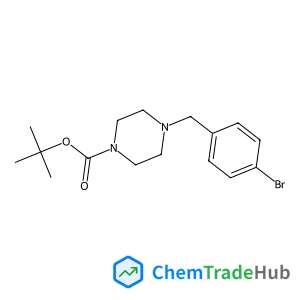
2-Methyl-2-propanyl 4-(4-bromobenzyl)-1-piperazinecarboxylate
CAS Number:
844891-10-7
Molecular Formula:
C16H23BrN2O2
Benjamin D. Datko, Alan K. Thomas, Zhuping Fei, Martin Heeney, John K. Grey
Triplet formation and interactions with emissive singlet excitons are investigated in poly(3-hexylselenophene) (P3HS) using single molecule spectroscopy. P3HS is a heavy atom analog of the more commonly studied poly(3-hexylthiophene) (P3HT), a benchmark polymer for solar cells. P3HS tends to aggregate strongly which necessitates dilution to ultra-low levels within a solid inert host in order to resolve photophysical responses of single chains. Fluorescence excitation intensity modulation is performed on isolated P3HS chains using a sequence of rectangular pulses of varying intensities to probe the presence of spin-forbidden triplet excitons. Triplet population dynamics originating from singlet–triplet and triplet–triplet interactions appear as quenching of the initial fluorescence intensity to steady-state levels on characteristic time scales of ∼1–10 μs. Over 80% of all molecules studied display significant fluorescence intensity modulation (quenching depths >50%) indicative of efficient intersystem crossing and large triplet occupancies. Because triplets are highly localized and singlet–triplet and triplet–triplet annihilation rate constants are comparable to those of intersystem crossing, multiple triplets are present at any given time on single P3HS chains. Triplet lifetimes were estimated to be ∼4 μs (upper limit) determined from recovery to the ground electronic singlet state in the absence of light and, surprisingly, triplets vanish at the onset of P3HS aggregation. This result was unexpected since P3HS triplet formation takes place on time scales <30 ps making this process competitive with most accessible non-radiative deactivation pathways.

Nature Reviews Drug Discovery

Journal of Medical Biochemistry

Faraday Discussions

Contact Lens & Anterior Eye

Physical Chemistry Chemical Physics

Foundations of Chemistry

European Journal of Organic Chemistry

Coloration Technology

Journal of Enzyme inhibition and Medicinal Chemistry

Photochemical & Photobiological Sciences
Gabriele Centi, Siglinda Perathoner
DOI: 10.1039/D3GC02135A
Renjith S. Pillai, Frédéric Sauvage, Anders Hagfeldt
DOI: 10.1039/D3TA06046B
Irina Delidovich, Valérie Toussaint
DOI: 10.1039/D3GC04049F
Ji Young Maeng, Minjun Bae, Yonghwan Kim, Dohyeong Kim, Yujin Chang, Seungman Park, Juhyung Choi, Eunji Lee, Jeongyeon Lee
DOI: 10.1039/D3TA05963D
Mahyar Fazeli, Hossein Baniasadi, Roozbeh Abidnejad, Muhammad Mujtaba, Juha Lipponen, Jukka Seppälä
DOI: 10.1039/D3GC03154C
Huan Liu, Xiuli Huang, Lei Ding, Yiming Ren, Zongcheng Miao, Maodong Xu
DOI: 10.1039/D3TA06393C
Yijie Wang, Yan Tan, Chuanwei Cheng
DOI: 10.1039/D3TA06372K
Fanda Zeng, Xiliang Gong, Zijin Xu, Zhengyan Du, Jian Xu, Ting Deng, Dong Wang, Yi Zeng, Shansheng Yu, Zeshuo Meng, Xiaoying Hu, Hongwei Tian
DOI: 10.1039/D3TA05838G
DOI: 10.1039/D3TA05984G
Waste containing 2-Ethyl-4-Methyl-1H-Imidazole-5-Carbaldehyde (CAS: 88634-80-4) ...
Triethoxy(octyl)silane (CAS: 1385031-14-0) is widely used in the pharmaceuticals...
Several alternatives to 3-iodo-7-nitro-1H-indazole (CAS: 864724-64-1) exist in t...
Yes, there are alternatives to Benzene, bis[(trimethoxysilyl)ethyl] (CAS: 266317...
Isothiazole-3-carbonitrile (CAS: 1452-17-1) is generally considered safe when us...
(3-Chlorophenyl)methanol (CAS: 873-63-2) is considered low to moderately toxic. ...
(2S,3S)-2-Hydroxy-3-({[(2-methyl-2-propanyl)oxy]carbonyl}amino)-3-(2-naphthyl)pr...
Proper handling of methyl 2-(bromomethyl)-5-methoxybenzoate requires the use of ...
6,8-Dibromoimidazo[1,2-a]pyridine-2-carboxylic acid (CAS: 904805-36-3) is an aro...
3-Amino-5-bromo-2-pyridinecarbonitrile is considered safe when handled under pro...
Physical Chemistry Chemical Physics (PCCP) is an international journal co-owned by 19 physical chemistry and physics societies from around the world. This journal publishes original, cutting-edge research in physical chemistry, chemical physics and biophysical chemistry. To be suitable for publication in PCCP, articles must include significant innovation and/or insight into physical chemistry; this is the most important criterion that reviewers and Editors will judge against when evaluating submissions. The journal has a broad scope and welcomes contributions spanning experiment, theory, computation and data science. Topical coverage includes spectroscopy, dynamics, kinetics, statistical mechanics, thermodynamics, electrochemistry, catalysis, surface science, quantum mechanics, quantum computing and machine learning. Interdisciplinary research areas such as polymers and soft matter, materials, nanoscience, energy, surfaces/interfaces, and biophysical chemistry are welcomed if they demonstrate significant innovation and/or insight into physical chemistry. Joined experimental/theoretical studies are particularly appreciated when complementary and based on up-to-date approaches.