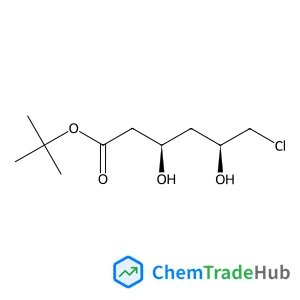
2-Methyl-2-propanyl (3R,5S)-6-chloro-3,5-dihydroxyhexanoate
CAS Number:
154026-93-4
Molecular Formula:
C10H19ClO4
Anita Dawes, Søren V. Hoffmann, Nykola C. Jones, Nigel J. Mason
We present the first high resolution vacuum ultraviolet photoabsorption study of amorphous benzene with comparisons to annealed crystalline benzene and the gas phase. Vapour deposited benzene layers were grown at 25 K and annealed to 90 K under conditions pertinent to interstellar icy dust grains and icy planetary bodies in our solar system. Three singlet–singlet electronic transitions in solid benzene correspond to the 1B2u, 1B1u and 1E1u states, redshifted by 0.05, 0.25 and 0.51 eV respectively with respect to the gas phase. The symmetry forbidden 1B2u ← 1A1g and 1B1u ← 1A1g transitions exhibit vibronic structure due to vibronic coupling and intensity borrowing from the allowed 1E1u ← 1A1g transition. Additionally the 1B2u ← 1A1g structure shows evidence of coupling between intramolecular vibrational and intermolecular lattice modes in crystalline benzene with Davydov crystal field splitting observed. The optically forbidden 0–0 electronic origin is clearly visible as a doublet at 4.69/4.70 eV in the crystalline solid and as a weak broadened feature at 4.67 eV in amorphous benzene. In the case of the 1B1u ← 1A1g transition the forbidden 0–0 electronic origin is only observed in crystalline benzene as an exciton peak at 5.77 eV. Thicker amorphous benzene samples show diffuse bands around 4.3, 5.0 and 5.4 eV that we tentatively assign to spin forbidden singlet–triplet 3B2u ← 1A1g, 3E1u ← 1A1g and 3B1u ← 1A1g transitions respectively, not previously reported in photoabsorption spectra of amorphous benzene. Furthermore, our results show clear evidence of non-wetting or ‘islanding’ of amorphous benzene, characterised by thickness-dependent Rayleigh scattering tails at wavelengths greater than 220 nm. These results have significant implications for our understanding of the physical and chemical properties and processes in astrochemical ices and highlight the importance of VUV spectroscopy.
Francielle Miranda de Matos, Gabriela Boscariol Rasera, Ruann Janser Soares de Castro
DOI: 10.1039/D3FB00097D
Anna Hu, Yujie Zhang, Jinchuang Zhang, Tongqing Li, Zhaojun Wang, Qiang Wang
DOI: 10.1039/D3FB00171G
Kanika Miglani, Saumya Singh, Devendra Pratap Singh, Meena Krishania
DOI: 10.1039/D3FB00100H
Anju Srivastava, Sriparna Dutta, Reena Jain
DOI: 10.1039/D3SU00246B
Apoorv Balwani, Tridib Ambardar, Adarsh Kumar Pandey, Aravind Dasari, Sujay Chattopadhyay
DOI: 10.1039/D3SU00289F
Michele Melchionna
DOI: 10.1039/D3LF00202K
Amalia Piscopo, Simone Santacaterina, Elisa Imeneo, Alessandra De Bruno, Marco Poiana
DOI: 10.1039/D3FB00125C
(1R,3S)-1,3-Cyclopentanediol finds applications in various industries. In the ph...
When handling N'-[4-(Dimethylamino)phenyl]-N,N-dimethyl-1,4-benzenediamine, it i...
There are several alternatives to 5-(2,4-Difluorophenyl)-2-methoxypyrimidine in ...
1-(3-Methoxyphenoxy)propan-2-ol (CAS: 382141-68-6) must comply with the Globally...
Tetrodotoxin Citrate is extremely dangerous and should be handled with extreme c...
2-Methyl-2-propanyl [(1R,3S)-3-hydroxycyclopentyl]carbamate (CAS: 225641-84-9) i...
Waste containing 4-(2-Hydroxyhexafluoroisopropyl)Benzoic Acid (CAS: 16261-80-6) ...
2-Methyl-2-proanyl {(2S)-1-[(benzyloxy)amino]-3-hydroxy-3-methyl-1-oxo-2-butanyl...
Benzeneethanamine, α-ethyl-, hydrochloride (1:1) is an organic compound with the...
In the synthesis of compounds similar to 3-{(E)-[4-(Dimethylamino)phenyl]diazeny...

Physical Chemistry Chemical Physics (PCCP) is an international journal co-owned by 19 physical chemistry and physics societies from around the world. This journal publishes original, cutting-edge research in physical chemistry, chemical physics and biophysical chemistry. To be suitable for publication in PCCP, articles must include significant innovation and/or insight into physical chemistry; this is the most important criterion that reviewers and Editors will judge against when evaluating submissions. The journal has a broad scope and welcomes contributions spanning experiment, theory, computation and data science. Topical coverage includes spectroscopy, dynamics, kinetics, statistical mechanics, thermodynamics, electrochemistry, catalysis, surface science, quantum mechanics, quantum computing and machine learning. Interdisciplinary research areas such as polymers and soft matter, materials, nanoscience, energy, surfaces/interfaces, and biophysical chemistry are welcomed if they demonstrate significant innovation and/or insight into physical chemistry. Joined experimental/theoretical studies are particularly appreciated when complementary and based on up-to-date approaches.