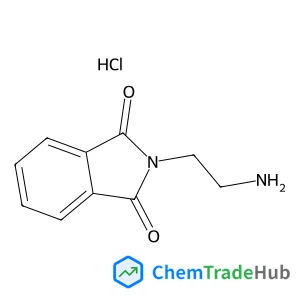
2-(2-Aminoethyl)-1H-isoindole-1,3(2H)-dione hydrochloride (1:1)
CAS Number:
30250-67-0
Molecular Formula:
C10H11ClN2O2
David N. Bowman, Jason C. Asher, Sean A. Fischer, Christopher J. Cramer, Niranjan Govind
Three meso-substituted tetrapyridyl porphyrins (free base, Ni(II), and Cu(II)) were investigated for their optical limiting (OL) capabilities using real-time (RT-), linear-response (LR-), and quadratic-response (QR-) time-dependent density functional theory (TDDFT) methods. These species are experimentally known to display a prominent reverse saturable absorption feature between the Q and B bands of the ground-state absorption (GSA), which has been attributed to increased excited-state absorption (ESA) relative to GSA. A recently developed RT-TDDFT based method for calculating ESA from a LR-TDDFT density was utilized with eight exchange–correlation functionals (BLYP, PBE, B3LYP, CAM-B3LYP, PBE0, M06, BHLYP, and BHandH) and contrasted with calculations of ESA using QR-TDDFT with five exchange–correlation functionals (BLYP, B3LYP, CAM-B3LYP, BHLYP, and BHandH). This allowed for comparison between functionals with varying amounts of exact exchange as well as between the ability of RT-TDDFT and QR-TDDFT to reproduce OL behavior in porphyrin systems. The absorption peak positions and intensities for GSA and ESA are significantly impacted by the choice of DFT functional, with the most critical factor identified as the amount of exact exchange in the functional form. Calculating ESA with QR-TDDFT is found to be significantly more sensitive to the amount of exact exchange than GSA and ESA with RT-TDDFT, as well as GSA with LR-TDDFT. An analogous behavior is also demonstrated for the polycyclic aromatic hydrocarbon coronene. This is problematic when using the same approximate functional for calculation of both GSA and ESA, as the LR- and QR-TDDFT excitation energies will not have similar errors. Overall, the RT-TDDFT method with hybrid functionals reproduces the OL features for the porphyrin systems studied here and is a viable computational approach for efficient screening of molecular complexes for OL properties.
Amir H. Mahmoudkhani, Adrien P. Côté, George K. H. Shimizu
DOI: 10.1039/B412325E
Donald H. McCullough, III, Steven L. Regen
DOI: 10.1039/B410027C
S. P. Cork, G. Cressey, R. H. Jones, S. J. Teat, V. L. Zholobenko
DOI: 10.1039/B410366C
Simon M. Langenegger, Robert Häner
DOI: 10.1039/B412831A
Atsushi Shimojima
DOI: 10.1039/B411794H
Ulf Hanefeld, Isabel W. C. E. Arends, Adriaan J. Minnaard, Thomas Maschmeyer, Roger A. Sheldon
DOI: 10.1039/B411506F
Xianying Li, Hongzhi Wang, Kouzou Inoue, Masato Uehara, Hiroyuki Nakamura, Masaya Miyazaki, Eiichi Abe, Hideaki Maeda
DOI: 10.1039/B300765K
Kenji Wada, Naoki Watanabe, Koichi Yamada, Teruyuki Kondo, Take-aki Mitsudo
DOI: 10.1039/B413921F
Olaf Köhler, Dilip Venkatrao Jarikote, Oliver Seitz
DOI: 10.1039/B411877D
(1R,3S)-1,3-Cyclopentanediol finds applications in various industries. In the ph...
When handling N'-[4-(Dimethylamino)phenyl]-N,N-dimethyl-1,4-benzenediamine, it i...
There are several alternatives to 5-(2,4-Difluorophenyl)-2-methoxypyrimidine in ...
1-(3-Methoxyphenoxy)propan-2-ol (CAS: 382141-68-6) must comply with the Globally...
Tetrodotoxin Citrate is extremely dangerous and should be handled with extreme c...
2-Methyl-2-propanyl [(1R,3S)-3-hydroxycyclopentyl]carbamate (CAS: 225641-84-9) i...
Waste containing 4-(2-Hydroxyhexafluoroisopropyl)Benzoic Acid (CAS: 16261-80-6) ...
2-Methyl-2-proanyl {(2S)-1-[(benzyloxy)amino]-3-hydroxy-3-methyl-1-oxo-2-butanyl...
Benzeneethanamine, α-ethyl-, hydrochloride (1:1) is an organic compound with the...
In the synthesis of compounds similar to 3-{(E)-[4-(Dimethylamino)phenyl]diazeny...

Physical Chemistry Chemical Physics (PCCP) is an international journal co-owned by 19 physical chemistry and physics societies from around the world. This journal publishes original, cutting-edge research in physical chemistry, chemical physics and biophysical chemistry. To be suitable for publication in PCCP, articles must include significant innovation and/or insight into physical chemistry; this is the most important criterion that reviewers and Editors will judge against when evaluating submissions. The journal has a broad scope and welcomes contributions spanning experiment, theory, computation and data science. Topical coverage includes spectroscopy, dynamics, kinetics, statistical mechanics, thermodynamics, electrochemistry, catalysis, surface science, quantum mechanics, quantum computing and machine learning. Interdisciplinary research areas such as polymers and soft matter, materials, nanoscience, energy, surfaces/interfaces, and biophysical chemistry are welcomed if they demonstrate significant innovation and/or insight into physical chemistry. Joined experimental/theoretical studies are particularly appreciated when complementary and based on up-to-date approaches.

![Ethyl 3-((6-(4,5-dihydro-1H-benzo[d]azepin-3(2H)-yl)-2-(pyridin-2-yl)pyrimidin-4-yl)amino)propanoate structure](https://static.chemtradehub.com/structs/137/1373423-53-0-496a.webp "Ethyl 3-((6-(4,5-dihydro-1H-benzo[d]azepin-3(2H)-yl)-2-(pyridin-2-yl)pyrimidin-4-yl)amino)propanoate structure")