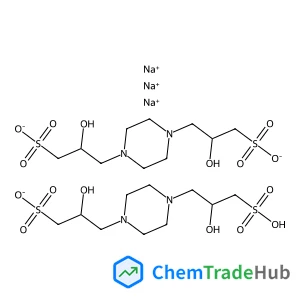
3,3'-(Piperazine-1,4-diyl)bis(2-hydroxypropane-1-sulfonic acid) Sodium Salt
CAS Number:
108321-08-0
Molecular Formula:
C20H41N4Na3O16S4
Sajan Singh, Pratick Samanta, Rajiv Srivastava, Andriy Horechyy, Uta Reuter, Hsin-Lung Chen, Bhanu Nandan
We investigate the self-assembly of a cylinder-forming polystyrene-block-poly(4-vinylpyridine) (PS-b-P4VP) block copolymer (BCP) mixed with trioctylphosphine oxide (TOPO) capped cadmium selenide (CdSe) quantum dots (QDs). The QDs were found to be enthalpically compatible with the P4VP chains via ligand displacement of TOPO from the QD surface. However, the QDs were found to localize preferentially at the PS/P4VP interphase plausibly to gain translational entropy in order to further lower the energetics of the self-assembled structure. Interestingly, the morphological transformation observed with increasing weight fraction of the QDs in the BCP/QD composite was driven by the migration of the displaced TOPO from the QD surface to the PS phase, effectively increasing its total volume fraction. Hence, the PS-b-P4VP BCP with PS as the minority block displayed lamellar morphology in its composite with QDs. Furthermore, the preferred localization of the QDs at the PS/P4VP interface led to the formation of a trilayer lamellar morphology which was deduced from the suppression of the primary scattering peak, relative to higher order peaks in the SAXS data. The morphological transformation was accompanied by a significant increase in the domain spacing due to excessive stretching of the longer P4VP chains of the asymmetric block copolymer. However, in the PS-b-P4VP/CdSe composites with P4VP as the minority block, cylindrical morphology was retained and the domain spacing decreased due to dominance of the co-surfactant effect as well as interfacial localization of CdSe QDs. We also demonstrate that these PS-b-P4VP/CdSe self-assembled hybrid materials could further be used to obtain isolated core–shell nanoobjects, such as nanofibers and nanosheets, containing CdSe QDs. The nanoobjects so obtained exhibited photoluminescence properties typical of CdSe quantum dots. These photoluminescent polymer nanoobjects could have potential applications in biological targeting and fluorescence labeling.

Acta Materialia

Russian Journal of Bioorganic Chemistry

Current Opinion in Solid State & Materials Science

Saudi Pharmaceutical Journal

Russian Journal of Coordination Chemistry

New Journal of Chemistry

Crystallography Reports

Journal of Saudi Chemical Society

Current Opinion in Colloid & Interface Science

Drug Discovery Today
Yanan Tang, Huadou Chai, Weiguang Chen, Xiao Cui, Yaqiang Ma, Mingyu Zhao
DOI: 10.1039/C7CP05683D
Mireia Via-Nadal
DOI: 10.1039/C7CP03349D
Ge Yao, Zelong Zhang, Jianwei Wang
DOI: 10.1039/C7CP02846F
Oleg I. Gnezdilov, Nicklas Hjalmarsson, Oleg N. Antzutkin, István Furó
DOI: 10.1039/C7CP01772C
Mo-Ran Wang, Xiang-Yang Ren, Nian-Ke Chen, Hong-Bo Sun
DOI: 10.1039/C7CP05034H
DOI: 10.1039/C7CP04068G
Kenji Aramaki, Chikahiro Iwata, Jitendra Mata, Tetsuya Maehara, Daisuke Aburano, Yuichi Sakanishi, Kyuhei Kitao
DOI: 10.1039/C7CP02585H
Tatsiana Liavitskaya, Lily Birx, Sergey Vyazovkin
DOI: 10.1039/C7CP05486F
Chunmei Zhang, Yalong Jiao, Tianwei He, Fengxian Ma, Liangzhi Kou, Ting Liao, Steven Bottle, Aijun Du
DOI: 10.1039/C7CP04758D
M. Kalapsazova, S. Ivanova, R. Kukeva, S. Simova, S. Wegner, E. Zhecheva, R. Stoyanova
DOI: 10.1039/C7CP04849A
3-Fluoro-2-methylbenzylamine is an organic compound with the CAS number 771573-3...
Tert-butyl 2-(oxetan-3-ylidene)acetate is considered safe for its intended uses ...
Proper personal protective equipment (PPE) such as gloves, goggles, and a lab co...
2-Ethyl-4-methyl-1,3-thiazole is commonly synthesized via the reaction of thiour...
This compound should be stored in a cool, dry place away from direct sunlight an...
L-Lysine Acetate Salt (CAS: 52315-92-1) is subject to various regulatory guideli...
6-Fluoro-3-hydroxy-2-pyrazinecarboxamide (CAS: 259793-96-9) is generally conside...
1,1'-Sulfonylbis(1H-imidazole) is a crystalline solid with a molecular weight of...
4-Methyl-7-nitro-1H-indole-3-carbonitrile (CAS: 289483-82-5) is primarily used i...
Waste containing 5-Bromo-3-indolyl-beta-galactoside (CAS: 97753-82-7) should be ...

Physical Chemistry Chemical Physics (PCCP) is an international journal co-owned by 19 physical chemistry and physics societies from around the world. This journal publishes original, cutting-edge research in physical chemistry, chemical physics and biophysical chemistry. To be suitable for publication in PCCP, articles must include significant innovation and/or insight into physical chemistry; this is the most important criterion that reviewers and Editors will judge against when evaluating submissions. The journal has a broad scope and welcomes contributions spanning experiment, theory, computation and data science. Topical coverage includes spectroscopy, dynamics, kinetics, statistical mechanics, thermodynamics, electrochemistry, catalysis, surface science, quantum mechanics, quantum computing and machine learning. Interdisciplinary research areas such as polymers and soft matter, materials, nanoscience, energy, surfaces/interfaces, and biophysical chemistry are welcomed if they demonstrate significant innovation and/or insight into physical chemistry. Joined experimental/theoretical studies are particularly appreciated when complementary and based on up-to-date approaches.
![trans,trans-4-n-Propyl-4-[4-(trifluoromethoxy)phenyl]bicyclohexyl structure](https://static.chemtradehub.com/structs/133/133937-72-1-25ef.webp "trans,trans-4-n-Propyl-4-[4-(trifluoromethoxy)phenyl]bicyclohexyl structure")