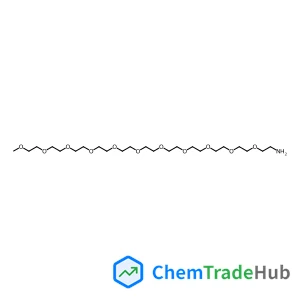
2,5,8,11,14,17,20,23,26,29,32-Undecaoxatetratriacontan-34-amine
CAS Number:
854601-60-8
Molecular Formula:
C23H49NO11
Johann Thurn, Johannes Maier, Martti Pärs, Katja Gräf, Mukundan Thelakkat, Jürgen Köhler
Photochromic molecules that are covalently linked to a strong fluorophore combine the requirements of external control and strong fluorescence, which will become increasingly important for super-resolution microscopy techniques based on single molecules. However, given the bulky structure of such constructs, steric hindrance might affect their photoconversion efficiencies upon immobilising them for imaging purposes. In this study the efficiencies of the photochromic conversion processes of molecular triads that are embedded in a polymer have been studied as a function of temperature. The triads consist of two perylene bisimide dye molecules that are connected via a dithienylcyclopentene photochromic bridge that undergoes a cyclization/cycloreversion reaction upon appropriate illumination. It is found that photochromic switching remains active, even at 5 K, yet with reduced but finite efficiency for the cycloreversion reaction. This might even be an advantage for the achievement of high labelling densities in super-resolution microscopy.

New Journal of Chemistry

Current Opinion in Solid State & Materials Science

Journal of Saudi Chemical Society

Organic Process Research & Development

Saudi Pharmaceutical Journal

Russian Chemical Bulletin

Russian Journal of Organic Chemistry

Russian Journal of Coordination Chemistry

Drug Discovery Today

Chemistry Education Research and Practice
DOI: 10.1039/C7CP03307A
Jiapeng Liu
DOI: 10.1039/C7CP03703A
Massimiliano Bartolomei, Ricardo Pérez de Tudela, Kilian Arteaga, Tomás González-Lezana, Marta I. Hernández, José Campos-Martínez, Pablo Villarreal, Javier Hernández-Rojas, José Bretón
DOI: 10.1039/C7CP03819D
DOI: 10.1039/C7CP04125J
Patrick S. Barber, Paula Berton
DOI: 10.1039/C7CP05710E
Makoto Hatakeyama, Koji Ogata, Yuto Sumida, Tomoe Sumida
DOI: 10.1039/C7CP04739H
Qingyu Liu, Fang Zuo, Zhigang Zhao, Junxian Chen, Dingguo Xu
DOI: 10.1039/C7CP02292A
John C. Mullaney, Chris Medcraft, David P. Tew, Luke Lewis-Borrell, Bernard T. Golding, Nicholas R. Walker, Anthony C. Legon
DOI: 10.1039/C7CP04315E
Huiyun Zhang, Guixian Liu, Yanqiang Cao, Jing Chen, Kai Shen, Ashwini Kumar, Mingxiang Xu, Qi Li
DOI: 10.1039/C7CP03470A
3-Fluoro-2-methylbenzylamine is an organic compound with the CAS number 771573-3...
Tert-butyl 2-(oxetan-3-ylidene)acetate is considered safe for its intended uses ...
Proper personal protective equipment (PPE) such as gloves, goggles, and a lab co...
2-Ethyl-4-methyl-1,3-thiazole is commonly synthesized via the reaction of thiour...
This compound should be stored in a cool, dry place away from direct sunlight an...
L-Lysine Acetate Salt (CAS: 52315-92-1) is subject to various regulatory guideli...
6-Fluoro-3-hydroxy-2-pyrazinecarboxamide (CAS: 259793-96-9) is generally conside...
1,1'-Sulfonylbis(1H-imidazole) is a crystalline solid with a molecular weight of...
4-Methyl-7-nitro-1H-indole-3-carbonitrile (CAS: 289483-82-5) is primarily used i...
Waste containing 5-Bromo-3-indolyl-beta-galactoside (CAS: 97753-82-7) should be ...

Physical Chemistry Chemical Physics (PCCP) is an international journal co-owned by 19 physical chemistry and physics societies from around the world. This journal publishes original, cutting-edge research in physical chemistry, chemical physics and biophysical chemistry. To be suitable for publication in PCCP, articles must include significant innovation and/or insight into physical chemistry; this is the most important criterion that reviewers and Editors will judge against when evaluating submissions. The journal has a broad scope and welcomes contributions spanning experiment, theory, computation and data science. Topical coverage includes spectroscopy, dynamics, kinetics, statistical mechanics, thermodynamics, electrochemistry, catalysis, surface science, quantum mechanics, quantum computing and machine learning. Interdisciplinary research areas such as polymers and soft matter, materials, nanoscience, energy, surfaces/interfaces, and biophysical chemistry are welcomed if they demonstrate significant innovation and/or insight into physical chemistry. Joined experimental/theoretical studies are particularly appreciated when complementary and based on up-to-date approaches.