












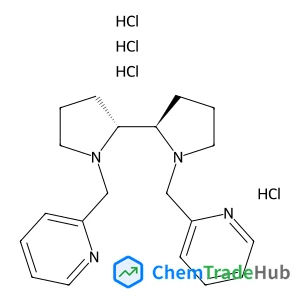
(2R,2'R)-1,1'-Bis(2-pyridinylmethyl)-2,2'-bipyrrolidine tetrahydrochloride
CAS Number:
1228077-88-0
Molecular Formula:
C20H30Cl4N4
Caroline R. Kwawu, Richard Tia, Evans Adei, Nelson Y. Dzade, C. Richard A. Catlow
We have used spin polarized density functional theory calculations to perform extensive mechanistic studies of CO2 dissociation into CO and O on the clean Fe(100), (110) and (111) surfaces and on the same surfaces coated by a monolayer of nickel. CO2 chemisorbs on all three bare facets and binds more strongly to the stepped (111) surface than on the open flat (100) and close-packed (110) surfaces, with adsorption energies of −88.7 kJ mol−1, −70.8 kJ mol−1 and −116.8 kJ mol−1 on the (100), (110) and (111) facets, respectively. Compared to the bare Fe surfaces, we found weaker binding of the CO2 molecules on the Ni-deposited surfaces, where the adsorption energies are calculated at +47.2 kJ mol−1, −29.5 kJ mol−1 and −65.0 kJ mol−1 on the Ni-deposited (100), (110) and (111) facets respectively. We have also investigated the thermodynamics and activation energies for CO2 dissociation into CO and O on the bare and Ni-deposited surfaces. Generally, we found that the dissociative adsorption states are thermodynamically preferred over molecular adsorption, with the dissociation most favoured thermodynamically on the close-packed (110) facet. The trends in activation energy barriers were observed to follow that of the trends in surface work functions; consequently, the increased surface work functions observed on the Ni-deposited surfaces resulted in increased dissociation barriers and vice versa. These results suggest that measures to lower the surface work function will kinetically promote the dissociation of CO2 into CO and O, although the instability of the activated CO2 on the Ni-covered surfaces will probably result in CO2 desorption from the nickel-doped iron surfaces, as is also seen on the Fe(110) surface.
DOI: 10.1039/A905655F
DOI: 10.1039/B009377G
Marina G. Taylor, Stewart F. Parker, Kenneth Simkiss, Philip C. H. Mitchell
DOI: 10.1039/B005666I
DOI: 10.1039/B009642N
C. G. Eisenhardt
DOI: 10.1039/B009507I
S. Amira, G. Vanhaelewyn, F. Callens
DOI: 10.1039/B008249J
Jaroslaw Sadlo, Marek Danilczuk, Jacek Michalik
DOI: 10.1039/B008246P
(3.beta.)-3-Hydroxy-N,N-dimethyl-chol-5-en-24-amide (CAS: 79066-03-8) is primari...
5-(Aminomethyl)-2-methoxyphenol (CAS: 89702-89-6) is classified under GHS as a s...
Thieno[2,3-c]pyridin-7(6H)-one (CAS: 28981-13-7) is a heterocyclic organic compo...
1-[(6-Methoxy-3-pyridinyl)methyl]-4-piperidinamine dihydrochloride is generally ...
[(2E)-3-Phenyl-2-propen-1-yl]phosphonic acid (CAS: 146404-58-2) is regulated und...
6-Bromo-7-methoxyquinoline (CAS: 1620515-86-7) falls under the scope of the Glob...
This compound is primarily used in the pharmaceutical industry for the developme...
1-Ethyl-7-[2-methyl-6-(4H-1,2,4-triazol-3-yl)-3-pyridinyl]-3,5-dihydropyrazino[2...
Alternative reagents such as 2-[(dimethylamino)methyl]phenylboronic acid or rela...
3-(Piperidin-4-yloxy)pyridine (CAS: 310881-48-2) is an organic compound with the...

Physical Chemistry Chemical Physics (PCCP) is an international journal co-owned by 19 physical chemistry and physics societies from around the world. This journal publishes original, cutting-edge research in physical chemistry, chemical physics and biophysical chemistry. To be suitable for publication in PCCP, articles must include significant innovation and/or insight into physical chemistry; this is the most important criterion that reviewers and Editors will judge against when evaluating submissions. The journal has a broad scope and welcomes contributions spanning experiment, theory, computation and data science. Topical coverage includes spectroscopy, dynamics, kinetics, statistical mechanics, thermodynamics, electrochemistry, catalysis, surface science, quantum mechanics, quantum computing and machine learning. Interdisciplinary research areas such as polymers and soft matter, materials, nanoscience, energy, surfaces/interfaces, and biophysical chemistry are welcomed if they demonstrate significant innovation and/or insight into physical chemistry. Joined experimental/theoretical studies are particularly appreciated when complementary and based on up-to-date approaches.
![Ethanone, 1-[4-chloro-2-(methylthio)-5-pyrimidinyl]- structure](https://static.chemtradehub.com/structs/661/66116-82-3-863e.webp "Ethanone, 1-[4-chloro-2-(methylthio)-5-pyrimidinyl]- structure")
![7-Bromo-5-chloro-1H-pyrazolo[4,3-b]pyridine structure](https://static.chemtradehub.com/structs/135/1351813-70-1-a716.webp "7-Bromo-5-chloro-1H-pyrazolo[4,3-b]pyridine structure")
![(3E)-3-[4-Hydroxy-3,5-bis(2-methyl-2-propanyl)benzylidene]dihydro-2(3H)-furanone structure](https://static.chemtradehub.com/structs/102/102271-49-8-cba7.webp "(3E)-3-[4-Hydroxy-3,5-bis(2-methyl-2-propanyl)benzylidene]dihydro-2(3H)-furanone structure")





