












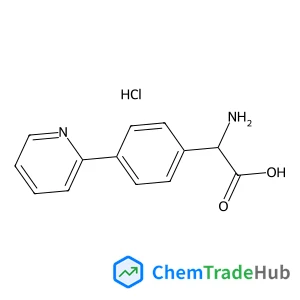
2-Amino-2-(4-(pyridin-2-YL)phenyl)acetic acid hydrochloride
CAS Number:
1135818-89-1
Molecular Formula:
C13H13ClN2O2
We present a numerical study of the electronic structure of an azurin mutant of the bacterium Alcaligenes denitrificans. The electronic structure is described by a tight-binding Hamiltonian, which permits the computation of electronic properties in the presence and in the absence of hydrogen bonds. We have investigated the density of states, the population and the localization properties of eigenfunctions around the HOMO–LUMO gap. In the absence of hydrogen bonds, eigenstates are extended up to a length scale of an isolated secondary structure element of the biopolymer, typically a β-sheet. The introduction of tight-binding matrix elements for hydrogen bonds induces a considerable spread of valence and conduction band eigenfunctions, and nonsequentially couples up to three β-sheets. We discuss the implications of this delocalization effect for electron transfer reactions and visualize the contribution of an extended eigenfunction to a possible intramolecular electron pathway.
(3.beta.)-3-Hydroxy-N,N-dimethyl-chol-5-en-24-amide (CAS: 79066-03-8) is primari...
5-(Aminomethyl)-2-methoxyphenol (CAS: 89702-89-6) is classified under GHS as a s...
Thieno[2,3-c]pyridin-7(6H)-one (CAS: 28981-13-7) is a heterocyclic organic compo...
1-[(6-Methoxy-3-pyridinyl)methyl]-4-piperidinamine dihydrochloride is generally ...
[(2E)-3-Phenyl-2-propen-1-yl]phosphonic acid (CAS: 146404-58-2) is regulated und...
6-Bromo-7-methoxyquinoline (CAS: 1620515-86-7) falls under the scope of the Glob...
This compound is primarily used in the pharmaceutical industry for the developme...
1-Ethyl-7-[2-methyl-6-(4H-1,2,4-triazol-3-yl)-3-pyridinyl]-3,5-dihydropyrazino[2...
Alternative reagents such as 2-[(dimethylamino)methyl]phenylboronic acid or rela...
3-(Piperidin-4-yloxy)pyridine (CAS: 310881-48-2) is an organic compound with the...

Physical Chemistry Chemical Physics (PCCP) is an international journal co-owned by 19 physical chemistry and physics societies from around the world. This journal publishes original, cutting-edge research in physical chemistry, chemical physics and biophysical chemistry. To be suitable for publication in PCCP, articles must include significant innovation and/or insight into physical chemistry; this is the most important criterion that reviewers and Editors will judge against when evaluating submissions. The journal has a broad scope and welcomes contributions spanning experiment, theory, computation and data science. Topical coverage includes spectroscopy, dynamics, kinetics, statistical mechanics, thermodynamics, electrochemistry, catalysis, surface science, quantum mechanics, quantum computing and machine learning. Interdisciplinary research areas such as polymers and soft matter, materials, nanoscience, energy, surfaces/interfaces, and biophysical chemistry are welcomed if they demonstrate significant innovation and/or insight into physical chemistry. Joined experimental/theoretical studies are particularly appreciated when complementary and based on up-to-date approaches.
![Ethanone, 1-[4-chloro-2-(methylthio)-5-pyrimidinyl]- structure](https://static.chemtradehub.com/structs/661/66116-82-3-863e.webp "Ethanone, 1-[4-chloro-2-(methylthio)-5-pyrimidinyl]- structure")





