












The influence of heteroatoms on the aromatic character and the current pathways of B2N2-dibenzo[a,e]pentalenes
Literature Information
Publication Date
2017-07-06
DOI
10.1039/C7CP02964K
Impact Factor
3.676
Authors
Maria Dimitrova, Heike Fliegl, Dage Sundholm
View Original
Abstract
Four polycyclic molecules have been investigated at the DFT B3LYP/def2-TZVP level of theory using calculated magnetically induced current densities as an indicator of their (anti)aromaticity. Complicated current pathways were found in dibenzo[a,e]pentalene and its three heterocyclic analogues each containing two boron and two nitrogen atoms. The antiaromatic character of the pentalene moiety is weaker in the hydrocarbon molecule and in 5,11-dihydrobenzo[d]benzo[4,5][1,2,3]azadiborolo[3,2-b][1,2,3]azadiborole as compared to the pentalene molecule. The antiaromatic character of the pentalene moiety is completely absent in the other two heterocyclic structures. In 6,12-dihydrobenzo[d]benzo[4,5][1,2,3]diazaborolo[2,1-a][1,2,3]diazaborole all four molecular rings are aromatic according to the ring-current criterion, and in 6,12-dihydrobenzo[d]benzo[3,4][1,2,5]azadiborolo[1,2-a][1,3,2]diazaborole, the diazaborole ring is aromatic, while the azadiborole ring is antiaromatic. In all four molecules the six-membered rings are aromatic sustaining a weaker ring current than benzene does.
Related Literature
Nonseparable exchange–correlation functional for molecules, including homogeneous catalysis involving transition metals
Haoyu S. Yu, Pragya Verma, Donald G. Truhlar
2015-04-09
Paper
DOI: 10.1039/C5CP01425E
Experimental and computational study of solvent effects on one- and two-photon absorption spectra of chlorinated harmines
Dalibor Hršak, Lotte Holmegaard, Anton S. Poulsen, Nanna H. List, Jacob Kongsted, M. Paula Denofrio, Rosa Erra-Balsells, Franco M. Cabrerizo, Ove Christiansen, Peter R. Ogilby
2015-04-09
Paper
DOI: 10.1039/C5CP00773A
Radical anions of hypervalent silicon compounds: 1-substituted silatranes
Elena F. Belogolova, Tamara I. Vakul'skaya, Valery F. Sidorkin
2015-04-23
Paper
DOI: 10.1039/C4CP06046F
Activation of weak IR fundamentals of two species of astrochemical interest in the Td point group – the importance of amorphous ices
R. L. Hudson, P. A. Gerakines, M. J. Loeffler
2015-04-16
Paper
DOI: 10.1039/C5CP00975H
Experimental determination of the rate of V–V collisional relaxation in 14N2 in its ground (X1Σg+) electronic state between 77 and 300 K
R. Z. Martínez, D. Bermejo
2015-04-23
Paper
DOI: 10.1039/C5CP01264C
Electrodeposition of germanium at elevated temperatures and pressures from ionic liquids
Minxian Wu, Gijs Vanhoutte, Neil R. Brooks, Koen Binnemans, Jan Fransaer
2015-04-10
Paper
DOI: 10.1039/C4CP06076H
Tinene: a two-dimensional Dirac material with a 72 meV band gap
Bo Cai, Shengli Zhang, Ziyu Hu, Yonghong Hu, Yousheng Zou, Haibo Zeng
2015-03-24
Paper
DOI: 10.1039/C5CP00563A
Photocarrier recombination dynamics in ternary chalcogenide CuInS2 quantum dots
Michio Ikezawa, Xiuying Wang, Pengtao Jing, Haibo Li, Yasuaki Masumoto
2015-02-17
Paper
DOI: 10.1039/C5CP00034C
Infrared spectra of small anionic water clusters from density functional theory and wavefunction theory calculations
Sai Duan, Guangjun Tian, Jun Jiang, Xin Xu
2015-04-13
Paper
DOI: 10.1039/C5CP01378J
You might also like
Compound Q&A
How should waste containing N-Methoxy-N-methyl-1,3-thiazole-5-carboxamide (CAS: 898825-89-3) be handled?
Waste containing N-Methoxy-N-methyl-1,3-thiazole-5-carboxamide (CAS: 898825-89-3...
898825-89-3N-Methoxy-N-methyl-1...
Compound Q&A
How should N-(4-Biphenylyl)dibenzo[b,d]furan-4-amine (CAS: 1318338-47-4) be stored?
N-(4-Biphenylyl)dibenzo[b,d]furan-4-amine should be stored in a tightly sealed c...
1318338-47-4N-(4-Biphenylyl)dibe...
Compound Q&A
What is the market or research trend for 3-Acetamido-5-amino-2,4,6-triiodobenzoic acid (CAS: 1713-07-1)?
The market for 3-Acetamido-5-amino-2,4,6-triiodobenzoic acid (CAS: 1713-07-1) is...
1713-07-13-Acetamido-5-amino-...
Compound Q&A
How should Benzyl 2-O-acetyl-3,4,6-tri-O-benzyl-beta-D-galactopyranoside (CAS: 61820-03-9) be stored?
Benzyl 2-O-acetyl-3,4,6-tri-O-benzyl-beta-D-galactopyranoside (CAS: 61820-03-9) ...
61820-03-9Benzyl 2-O-acetyl-3,...
Compound Q&A
What regulatory guidelines apply to 2-Ethylpiperazine dihydrochloride (CAS: 438050-52-3)?
2-Ethylpiperazine dihydrochloride (CAS: 438050-52-3) is regulated under the Glob...
438050-52-32-Ethylpiperazine di...
Compound Q&A
What regulatory guidelines apply to 1,1'-[1,3-Phenylenebis(methylene)]bis(3-methyl-1H-pyrrole-2,5-dione) (CAS: 119462-56-5)?
1,1'-[1,3-Phenylenebis(methylene)]bis(3-methyl-1H-pyrrole-2,5-dione) (CAS: 11946...
119462-56-51,1'-[1,3-Phenyleneb...
Compound Q&A
Are there alternatives to 5-Fluoro-2-(1-pyrrolidinyl)pyridine (CAS: 1287217-79-1) in synthesis?
Several alternatives can be used in the synthesis of 5-Fluoro-2-(1-pyrrolidinyl)...
1287217-79-15-Fluoro-2-(1-pyrrol...
Compound Q&A
What precautions should be taken when handling 1-((2R,3R,4R,5R)-5-((bis(4-methoxyphenyl)(phenyl)methoxy)methyl)-4-hydroxy-3-methoxytetrahydrofuran-2-yl)-5-methylpyrimidine-2,4(1H,3H)-dione (CAS: 153631-19-7)?
Proper personal protective equipment (PPE) must be worn when handling this compo...
153631-19-71-((2R,3R,4R,5R)-5-(...
Compound Q&A
What precautions should be taken when handling 6-Bromoimidazo[1,2-a]pyridin-8-amine (CAS: 676371-00-9)?
When handling 6-Bromoimidazo[1,2-a]pyridin-8-amine, it is important to wear appr...
676371-00-96-Bromoimidazo[1,2-a...
Compound Q&A
Are there alternatives to (2S,4R)-4-(4-Nitrobenzyl)pyrrolidine-2-carboxylic acid hydrochloride (CAS: 1049740-22-8) in synthesis?
Alternatives to (2S,4R)-4-(4-Nitrobenzyl)pyrrolidine-2-carboxylic acid hydrochlo...
1049740-22-8(2S,4R)-4-(4-Nitrobe...
Source Journal
Physical Chemistry Chemical Physics

CiteScore:
5.5
Self-citation Rate:
10.3%
Articles per Year:
3036
Physical Chemistry Chemical Physics (PCCP) is an international journal co-owned by 19 physical chemistry and physics societies from around the world. This journal publishes original, cutting-edge research in physical chemistry, chemical physics and biophysical chemistry. To be suitable for publication in PCCP, articles must include significant innovation and/or insight into physical chemistry; this is the most important criterion that reviewers and Editors will judge against when evaluating submissions. The journal has a broad scope and welcomes contributions spanning experiment, theory, computation and data science. Topical coverage includes spectroscopy, dynamics, kinetics, statistical mechanics, thermodynamics, electrochemistry, catalysis, surface science, quantum mechanics, quantum computing and machine learning. Interdisciplinary research areas such as polymers and soft matter, materials, nanoscience, energy, surfaces/interfaces, and biophysical chemistry are welcomed if they demonstrate significant innovation and/or insight into physical chemistry. Joined experimental/theoretical studies are particularly appreciated when complementary and based on up-to-date approaches.
Recommended Compounds

N1,N1-Bis(4-aminophenyl)benzene-1,4-diamine trihydrochloride
CAS Number:
114254-48-7
Molecular Formula:
C18H21Cl3N4
![4-Chloro-2-{[(2-chlorophenoxy)acetyl]amino}benzoic acid structure](https://static.chemtradehub.com/structs/351/351424-20-9-9467.webp "4-Chloro-2-{[(2-chlorophenoxy)acetyl]amino}benzoic acid structure")
4-Chloro-2-{[(2-chlorophenoxy)acetyl]amino}benzoic acid
CAS Number:
351424-20-9
Molecular Formula:
C15H11Cl2NO4
![[5-fluoro-2-(morpholine-4-carbonyl)phenyl]boronic acid structure](https://static.chemtradehub.com/structs/121/1217501-26-2-505c.webp "[5-fluoro-2-(morpholine-4-carbonyl)phenyl]boronic acid structure")
[5-fluoro-2-(morpholine-4-carbonyl)phenyl]boronic acid
CAS Number:
1217501-26-2
Molecular Formula:
C11H13BFNO4
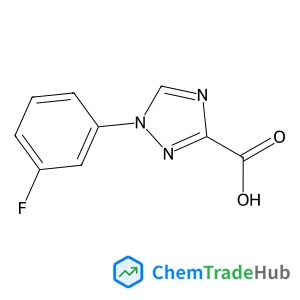
1-(3-Fluorophenyl)-1H-1,2,4-triazole-3-carboxylic acid
CAS Number:
1292369-51-7
Molecular Formula:
C9H6FN3O2
Recommended Suppliers



Disclaimer
This page provides academic journal information for reference and research purposes only. We are not affiliated with any journal publishers and do not handle publication submissions. For publication-related inquiries, please contact the respective journal publishers directly.
If you notice any inaccuracies in the information displayed, please contact us at support@chemtradehub.com. We will promptly review and address your concerns.